基金销售监管

Search documents
传小红书禁言部分基金实时估值博主,官方暂无回应
Xin Lang Cai Jing· 2026-02-05 07:49
Group 1 - The core message indicates that Xiaohongshu has implemented a ban on certain "real-time fund valuation bloggers" following regulatory guidance [1][3] - Regulatory authorities have emphasized the need for fund sales institutions and third-party platforms to enhance self-examination and rectify issues, specifically by removing features that may mislead investors, such as "real-time fund valuation," "increased positions leaderboard," and "actual trading leaderboard" [1][3] Group 2 - As of the time of reporting, Xiaohongshu has not provided an official response to inquiries regarding the ban [2][4]
“大V带货”遭监管重拳:基金销售擦边球玩到头了
Jing Ji Guan Cha Wang· 2026-01-30 14:45
Core Viewpoint - The recent regulatory actions by the China Securities Regulatory Commission (CSRC) highlight serious compliance issues in the mutual fund sales industry, particularly focusing on the D Fund Company and its collaboration with internet influencers, which has drawn public attention to the irregularities in fund sales practices [2][4]. Group 1: Regulatory Actions and Compliance - The CSRC's report indicates that the D Fund Company engaged in marketing practices with unqualified internet influencers, leading to a surge in daily subscription volumes exceeding 10 billion yuan [2]. - The regulatory response includes a combination of corrective measures and product registration suspensions, holding both the fund company and its executives accountable for the violations [7]. - The recent draft of the "Regulations on the Sales Behavior of Publicly Raised Securities Investment Funds" aims to establish stricter guidelines for fund sales, emphasizing the need for compliance in promotional activities and performance disclosures [7][8]. Group 2: Sales Practices and Market Impact - The collaboration with internet influencers has created a "buying frenzy," leveraging their influence to attract investors to high-risk products [4]. - The trend of real-time valuation and rankings in fund sales has resurfaced, which can mislead inexperienced investors into making impulsive trading decisions [5][6]. - The shift in performance evaluation criteria for funds is moving away from sales volume towards focusing on investor profitability and holding periods, promoting a long-term investment perspective [8][10]. Group 3: Industry Transformation - The tightening of regulations is expected to challenge traditional sales models that rely on short-term incentives and influencer partnerships, necessitating a reevaluation of customer engagement strategies [9]. - Future fund sales are anticipated to depend more on professional advisory services and long-term client relationships rather than mere marketing tactics [10][11]. - The regulatory framework aims to foster a more sustainable development of the fund sales industry, balancing growth with investor protection [10][11].


“大V预告买入基金”竟是套路?
第一财经· 2026-01-30 09:40
Core Viewpoint - The article discusses the recent regulatory actions taken by the China Securities Regulatory Commission (CSRC) against a fund company for engaging in illegal marketing practices, particularly involving collaboration with unqualified internet influencers to boost fund subscriptions. This incident highlights the ongoing issues within the fund industry related to "flow marketing" and the need for stricter compliance measures to protect investors [3][4][6]. Regulatory Actions - The CSRC's first regulatory report of 2026 revealed that a certain D fund company was penalized for collaborating with unqualified internet influencers to artificially inflate fund subscription volumes, leading to a double penalty of corrective orders and suspension of new product registrations [3][6]. - The regulatory measures are part of a broader initiative to address the "scale worship" phenomenon in the fund industry, shifting the focus from short-term growth to investor-centric compliance [4][12]. Issues with "Big V Marketing" - The article outlines the emergence of a gray market involving "Big V" influencers who, in exchange for substantial advertising fees, promote fund products to their followers, often without adequate risk disclosures [6][8]. - This practice has been linked to significant subscription spikes, such as the reported 12 billion yuan in a single day for a fund, raising concerns about the integrity of fund marketing and investor protection [7][8]. Misleading Sales Practices - The CSRC has also targeted other misleading sales practices, including real-time fund valuation and inducement rankings, which can mislead investors regarding the risks associated with certain funds [10][11]. - The article notes discrepancies in risk level assessments across different sales platforms, which can confuse investors and lead to inappropriate investment decisions [10][11]. Shift in Industry Focus - The regulatory changes are seen as a continuation of previous efforts to curb aggressive sales tactics and promote a more sustainable, investor-focused approach within the fund industry [12][14]. - The article emphasizes that the fund industry must transition from a product-selling mentality to a service-oriented approach, addressing the disconnect between fund performance and investor returns [12][14]. Compliance and Future Outlook - The article concludes that the recent regulatory actions serve as a warning to the entire industry, urging fund companies to enhance their compliance frameworks and risk management practices to avoid reputational damage and ensure sustainable growth [14].

“某基金产品单日吸金超百亿”,监管出手:严禁与不具备资质的互联网“大V”合作,下架“加仓榜”“实盘榜”等
Mei Ri Jing Ji Xin Wen· 2026-01-30 04:34
Core Viewpoint - Regulatory authorities have issued a new notice emphasizing the need for stricter supervision of fund sales and promotional activities, particularly targeting violations related to unqualified internet influencers and the re-emergence of previously banned functionalities like real-time fund valuation [1][2][4]. Group 1: Regulatory Requirements - Fund companies and sales institutions are strictly prohibited from collaborating with unqualified internet influencers for any form of fund sales or promotional activities [5][6]. - Fund sales institutions and third-party platforms must enhance self-inspection and rectify issues by removing functionalities such as "real-time fund valuation," "increased positions ranking," and "actual holdings ranking" to prevent misleading investors [5][6]. Group 2: Focus on Violations - Two main types of violations have been identified as regulatory priorities: collaboration with unqualified internet influencers and the unauthorized reintroduction of functionalities like "real-time fund valuation" that were previously banned [2][3]. - The notice highlights that these functionalities could mislead investors, dilute fund product returns, and lead to complaints and disputes [4]. Group 3: Industry Impact - The new regulations are expected to compel fund institutions and third-party platforms to return to compliance, moving away from a short-term focus on scale and towards enhancing research capabilities and investor education [7]. - The removal of misleading functionalities is anticipated to help investors develop a more rational investment mindset, focusing on long-term performance stability rather than short-term market fluctuations [7].
基金销售新规划定多重红线
第一财经· 2025-12-12 14:08
Core Viewpoint - A regulatory storm aimed at reshaping the fund sales ecosystem is underway, with a focus on protecting investor rights and addressing long-standing issues in the industry, such as prioritizing sales over service [3][4]. Summary by Sections Regulatory Framework - The newly released draft regulation, titled "Norms for Publicly Raised Securities Investment Fund Sales Behavior," outlines multiple core dimensions including promotion, live sales, fee disclosure, performance assessment, and integrity in operations [3][4]. Promotion and Advertising Standards - The regulation prohibits the annualized display of performance for funds with a duration of less than one year and mandates that performance rankings must be based on publicly available data from fund evaluation agencies for periods exceeding three years [7][8]. - Strict guidelines are set for promotional language to avoid misleading investors, banning terms like "positive return" and emphasizing the importance of the research team over individual fund managers [7][8]. Fee Disclosure - The regulation enhances the transparency of fee disclosures, requiring comprehensive information on all fees associated with fund purchases, including subscription fees, redemption fees, and maintenance fees [8][9]. - Fund managers must ensure that investors can access and understand the core content of fund product information before making purchases [8]. Live Sales Regulations - Fund live sales are now subject to strict regulations, requiring sales personnel to have appropriate qualifications and banning unqualified platforms from participating in transactions [10][11]. - The regulation mandates that live sales must undergo compliance checks, including script reviews and real-time monitoring during broadcasts [11]. Performance Assessment - The performance assessment for fund sales will now focus on two main dimensions: sales activity and investor profitability, with an emphasis on long-term investor returns [12]. - The regulation prohibits the use of sales revenue and scale as primary assessment metrics, aiming to shift the industry focus from short-term marketing to long-term service [12]. Integrity and Compliance - A dedicated chapter on "Integrity in Operations" has been established, requiring fund managers and sales institutions to implement effective risk prevention and accountability mechanisms [13][14]. - Financial practices related to sales must be transparent and accurately recorded to prevent irregularities such as false expense reporting [14].

直播禁打赏、业绩禁“美颜”、营销禁造星,基金销售新规划定多重红线
Di Yi Cai Jing· 2025-12-12 12:24
Core Viewpoint - The regulatory storm aims to reshape the fund sales ecosystem, emphasizing investor protection and shifting the focus from "scale worship" to "profitability-oriented" practices in the industry [1] Regulatory Framework - The newly released draft regulation, titled "Norms for Publicly Raised Securities Investment Fund Sales Behavior," consolidates existing policies into a systematic regulatory framework, addressing long-standing issues in the industry [2] - The regulation outlines strict guidelines on promotional behavior, performance assessment, and compliance, aiming to realign fund sales with investor interests [1][2] Promotion and Advertising Standards - The regulation prohibits the display of annualized performance for funds with a duration of less than one year and mandates that performance data must be based on a minimum of six months [3] - It emphasizes the need for accurate and non-misleading promotional language, banning terms that could downplay risks, such as "positive returns" and "low risk" [3][4] - Fund managers are required to focus on the overall capabilities of the research and investment team rather than individual fund managers, discouraging the "star marketing" approach [3][4] Fee Disclosure Requirements - The regulation enhances the transparency of fee disclosures, requiring comprehensive information on all fees associated with fund purchases, including subscription and redemption fees [4][5] - Fund managers must ensure that investors can access and understand the key information before making purchases, addressing concerns about hidden fees [4] Live Streaming Regulations - Fund live streaming is now subject to strict regulations, requiring sales personnel to have appropriate qualifications and banning unqualified individuals from discussing fund content [6] - The regulation mandates compliance checks for live streaming content and requires the retention of records for a minimum of 20 years for promotional materials [6] Performance Assessment Criteria - The regulation shifts the performance assessment focus from sales volume to investor returns, incorporating metrics such as long-term investment gains and the proportion of profitable investors [7] - It prohibits the use of sales revenue and scale as primary assessment criteria, aiming to align sales practices with genuine investor outcomes [7] Integrity and Compliance Measures - A dedicated chapter on "integrity in operations" establishes a comprehensive risk prevention system, requiring fund managers to implement effective measures for compliance and accountability [8] - The regulation mandates thorough audits of marketing expenses to ensure transparency and prevent irregularities in financial reporting [8]
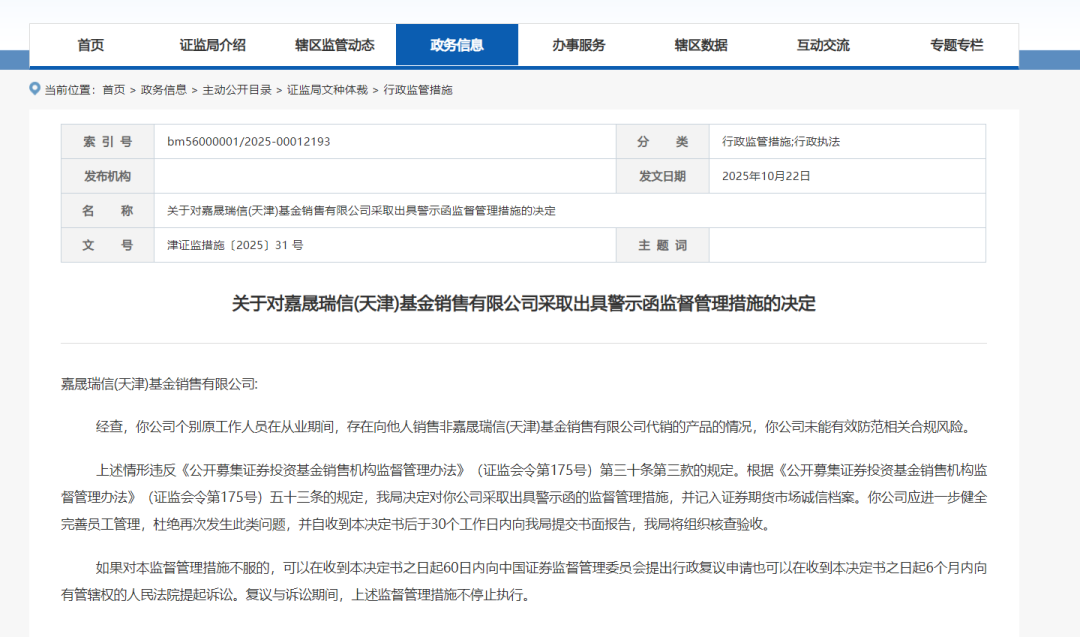
一基金销售机构 被出具警示函!
Zhong Guo Ji Jin Bao· 2025-10-22 15:24
Core Viewpoint - The regulatory environment for fund sales institutions is becoming increasingly stringent, as evidenced by the issuance of warning letters to Jia Sheng Rui Xin (Tianjin) Fund Sales Co., Ltd. and its former employee for violations during their tenure [1][3][4]. Group 1: Regulatory Actions - The Tianjin Securities Regulatory Bureau issued a warning letter to former employee Zheng for selling non-company products, violating regulations [3][4]. - Jia Sheng Rui Xin (Tianjin) Fund was also penalized for failing to prevent compliance risks, which is a violation of the relevant regulatory framework [3][6]. - The company is required to improve employee management and submit a written report within 30 working days [6]. Group 2: Industry Context - Multiple fund sales institutions have faced penalties this year for various violations, including unqualified sales personnel and non-compliant marketing activities [2][8]. - Banks and independent fund sales platforms have been the primary focus of regulatory scrutiny, with several banks receiving fines for similar issues [8]. - A third-party evaluation suggests that sales channels need to enhance compliance and risk management frameworks to ensure effective governance [9].