多模态数据

Search documents
畅想2026:第一部分
3 6 Ke· 2026-01-17 00:03
Infrastructure - The chaos of unstructured, multimodal data is a significant bottleneck for companies, with 80% of enterprise knowledge residing in unstructured formats, leading to a decline in data real-time, structuredness, and authenticity [2] - AI will automate much of the repetitive work in cybersecurity, addressing the recruitment challenges faced by Chief Information Security Officers (CISOs) as the number of cybersecurity job vacancies has increased from under 1 million to 3 million from 2013 to 2021 [3] - The rise of "agent-native" infrastructure will be crucial as businesses transition from human-speed traffic to agent-speed loads, necessitating a redesign of backend systems to accommodate rapid, recursive tasks [4][5] Growth - By 2026, traditional record systems will lose their core status as AI shortens the distance between intent and execution, transforming ITSM and CRM systems into autonomous workflow engines [9] - Vertical AI is evolving from information retrieval to a "multi-party collaboration" model, with companies in sectors like healthcare and finance rapidly increasing their annual recurring revenue (ARR) to over $100 million [10][11] Bio + Health - A new customer segment termed "Healthy Monthly Active Users" (MAUs) will emerge, focusing on regular health monitoring rather than reactive treatment, representing a significant market opportunity [15][16] Speedrun - AI-driven world models will revolutionize storytelling through interactive virtual environments, merging gaming mechanics with natural language programming, leading to the creation of a "generative multiverse" [17] - The trend towards personalized products will become prominent, with AI tailoring educational experiences and health plans to individual needs, marking a shift from mass production to customization [18][19] Education - The first AI-native university is anticipated to emerge, designed to adapt in real-time based on data feedback, with a focus on producing graduates skilled in collaborating with AI systems [20][21][22]
Agent时代,为什么多模态数据湖是必选项?
机器之心· 2026-01-15 00:53
Core Viewpoint - The year 2025 is anticipated to be remembered as the dawn of the AI industrial era, with many companies racing to invest in AI applications and agent development, but the true competition lies beyond just application-level advancements [1][4]. Group 1: AI Infrastructure and Data Management - The AI era emphasizes that the foundation for AI applications is robust data infrastructure, which is crucial for building true competitive advantages for companies [3][8]. - Companies need to develop capabilities to handle multimodal data, as the real benefits of the AI era lie not in merely possessing state-of-the-art models but in the ability to continuously manage and nurture them [9][18]. - The industry is entering the "second half" of AI, where the focus shifts to how AI should be utilized and how to measure real progress, necessitating a change in mindset to leverage AI thinking [4][5]. Group 2: Multimodal Data Lakes - The construction of multimodal data lakes is becoming essential for companies to participate in the agent competition, as it allows for the transformation of previously dormant unstructured data into usable competitive assets [14][21]. - IDC predicts that by 2025, over 80% of enterprise data will be unstructured, highlighting the need to awaken this data to build competitive strength in the agent era [16][19]. - The transition from traditional data lakes to multimodal data lakes is critical, as it enables companies to manage and utilize diverse data types effectively, driving business intelligence and operational efficiency [12][22]. Group 3: Data Infrastructure Evolution - The evolution of data infrastructure is outlined in three progressive stages: overcoming computing bottlenecks, integrating models into data pipelines, and implementing comprehensive data governance [30][31][33]. - The first stage focuses on breaking through computing limitations by adopting heterogeneous architectures that support both CPU and GPU, ensuring data can be processed quickly and efficiently [30]. - The second stage emphasizes the integration of pre-trained large models into data workflows, allowing for the automatic conversion of multimodal data into usable formats for AI applications [31][32]. - The final stage aims for unified data governance, enhancing the management and activation of data assets while ensuring compliance and security [33][34]. Group 4: Strategic Recommendations for Companies - Companies should prioritize transforming their data infrastructure from a "storage center" to a "value center," ensuring that data can be quickly accessed and understood by AI models [38][39]. - The focus should be on practical business applications, avoiding the pitfalls of excessive computational power that does not translate into business value [40][41]. - A modular and open data infrastructure is essential for adapting to future uncertainties, allowing companies to upgrade smoothly as technologies evolve [43][44][45]. Group 5: Industry Applications and Impact - The implementation of multimodal data lakes has shown significant improvements across various industries, such as a 20-fold performance increase in a smart driving company's model training and a 90% efficiency boost in content production for a leading media company [51][59]. - These examples illustrate the necessity of adopting multimodal data strategies to unlock the potential for intelligent transformation across diverse sectors [52][56].


诺亦腾机器人完成Pre-A+轮融资,启明创投领投
雷峰网· 2025-12-22 01:33
Core Viewpoint - Noitom Robotics has completed a Pre-A+ round of financing, raising several hundred million RMB, with plans to enhance its data solutions for humanoid robots and accelerate its development in the industry [2]. Group 1: Financing and Investment - The recent financing round was led by Qiming Venture Partners, with participation from various institutions including Wuyuan Capital and Junlian Capital, and saw oversubscription [2]. - The funds will be primarily used for research and development in multi-modal data collection, processing, and delivery technologies, as well as to build a scalable data production system and engineering platform [2]. Group 2: Company Overview and Team - Noitom Robotics focuses on providing high-quality, scalable training data and infrastructure capabilities for the humanoid robot and embodied intelligence industries [2]. - The company is led by Dr. Dai Ruoli, a co-founder of Noitom Ltd., who has over 15 years of experience in motion capture and human-computer interaction [3]. - Dr. Han Lei, the Chief Scientist, has a strong background in robotics and reinforcement learning, previously leading Tencent's Robotics X Lab [3]. Group 3: Data Collection Strategies - Noitom Robotics has developed a dual approach to data collection: In-the-factory and In-the-wild, ensuring high-dimensional, multi-modal, and high-precision data [4]. - The In-the-factory method focuses on collecting data that surpasses the dimensions and modalities of robots, while the In-the-wild method captures natural human behaviors in real-world scenarios to enhance model training [4]. Group 4: Industry Collaboration - The company has established deep collaborations with around 60 to 70 leading companies in the robotics field, covering various aspects such as data collection equipment and customized data sets [4]. - Noitom Robotics' data path system has been validated through practical delivery to numerous humanoid robot enterprises and embodied intelligence model clients globally [4].

海天瑞声20251031
2025-11-03 02:36
Summary of Haitai Ruisheng's Conference Call Company Overview - **Company**: Haitai Ruisheng - **Industry**: AI Data Services Key Points Strategic Initiatives - Haitai Ruisheng is strategically aligning with AI data initiatives, collaborating with China Mobile and other partners to connect with national-level data annotation bases, with expected delivery of millions of data entries by Q4 2025 in Chengdu and Changsha [2][3] - The company is also working with the Guangxi government to build an authoritative corpus for ASEAN countries, with expected revenue of 20 million yuan by 2026 [2][4] Revenue and Growth - In Q3 2025, Haitai Ruisheng reported revenue of 77.64 million yuan, a year-on-year increase of 36%, driven by G-class business expansion and overseas content review services [3][7] - The revenue growth rate slowed to 30% in Q3 due to delays in project confirmations from state-owned enterprises, but the overall annual growth is expected to remain strong at around 57% [2][7] Client Base and Demand - The traditional client base consists of major domestic and international tech companies with high demand for multilingual and specialized data services [5] - Future demand is expected to focus on three areas: growing multilingual needs, high-end specialized data requirements, and enhancing interaction naturalness [5] Emerging Business Highlights - The company has expanded its overseas content review business, operating a base in the Philippines that contributed approximately 20 million yuan in Q3 [6] - Haitai Ruisheng is actively entering the embodied intelligence sector, collaborating with robotics companies and local governments to provide high-quality training datasets [6] Collaborations and Partnerships - Haitai Ruisheng collaborates with several state-owned enterprises in AI, including China Mobile, China Unicom, and China Telecom, participating in national AI community projects [8] - The partnership with Huawei has led to successful projects, including the "Boguang Model" for the Shaanxi Cultural Tourism Group, with plans to replicate this model in other regions [9] Market Outlook - The intelligent data market is projected to have significant growth potential, with domestic tech giants expressing substantial demand for embodied data, potentially generating tens of millions in revenue [10] - The development of multimodal data technology is increasing the demand for high-end data annotation, particularly in OCR and related fields [13] Future Plans - The company aims for a compound annual growth rate of 40% to 50% over the next two to three years, focusing on expanding overseas operations and enhancing delivery capabilities [16] - Plans to further develop the Philippine base and explore the Indonesian market, with a focus on high-end customized data annotation services [14][15]

破解机器人产业瓶颈,北京这个训练中心年产百万数据
Bei Jing Ri Bao Ke Hu Duan· 2025-08-16 01:20
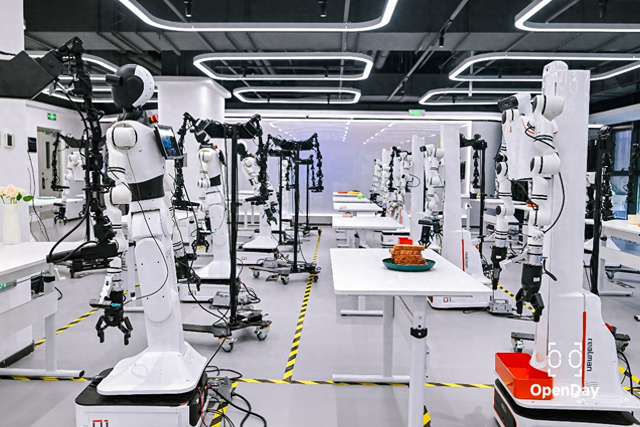
Core Insights - Humanoid robots are transitioning from laboratory settings to practical applications in daily life and production, with data scarcity being a significant bottleneck for large-scale deployment [1][2] - The Shijingshan Humanoid Robot Data Training Center, the first of its kind in Beijing, is expected to produce over one million high-quality multimodal data entries annually, providing data services to various domestic and international large model and robotics companies [1][3] Group 1: Importance of Data - High-quality, diverse, and real-world multimodal data is essential for training AI models in robots, directly influencing their ability to operate effectively in various scenarios [2] - The lack of real-world data is identified as a fundamental bottleneck in the development of intelligent robotics, emphasizing the need for large-scale applications to generate authentic data [2] Group 2: Training Center Features - The training center spans 3,000 square meters and features diverse robotic forms, including dual-arm lifting robots, wheeled humanoid robots, and bionic quadrupeds, organized into training and application scenario areas [1][3] - The center aims to address three core issues in the robotics industry: insufficient cross-scenario data generalization, significant gaps between simulated and real environments, and the lack of standardized data formats and efficient iterative ecosystems [2] Group 3: Collaborative Ecosystem - The training center collaborates with over ten companies in the embodied intelligence industry, creating a comprehensive ecosystem that covers perception, decision-making, and execution [3] - The center's data output is already being utilized by leading domestic and international large model and robotics enterprises, indicating its role in fostering innovation and collaboration within the industry [3]