
央行政策博弈

Search documents
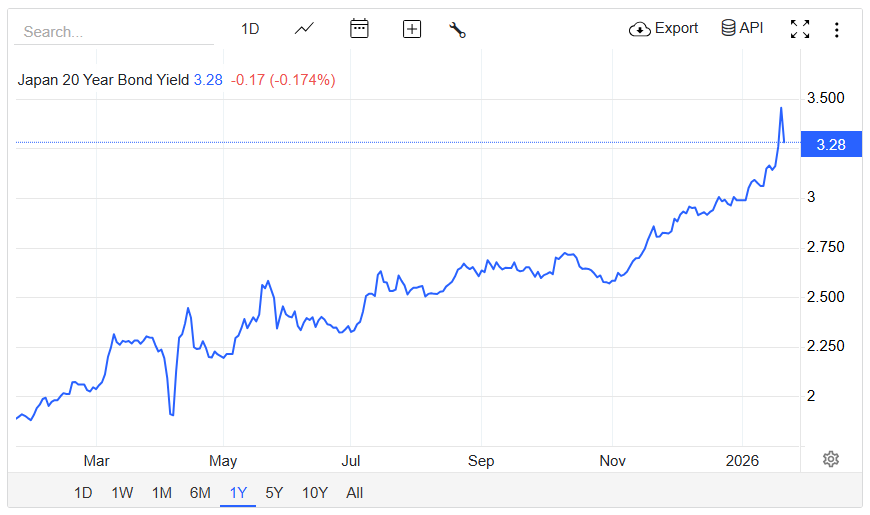
日债崩盘后,日本第二大行喊话了:准备抄底,持仓要翻倍!
Hua Er Jie Jian Wen· 2026-01-21 06:07
Core Viewpoint - Sumitomo Mitsui Financial Group plans to significantly increase its domestic sovereign debt holdings after market yields stabilize, indicating a strategic shift back to Japanese government bonds from foreign bonds [1][4]. Group 1: Investment Strategy - The bank intends to double its current Japanese government bond portfolio from 10.6 trillion yen (approximately 67 billion USD) [1]. - The current focus is on Japanese government bonds (JGBs), moving away from foreign bond investments, which were previously prioritized [4]. - The bank has already begun purchasing some 30-year bonds, believing their prices are close to fair value, but remains cautious due to inflation risks and uncertainties ahead of elections [3][4]. Group 2: Market Conditions - The Japanese bond market recently experienced a sharp sell-off, with long-term yields reaching record highs due to concerns over fiscal policies ahead of the February elections and the Bank of Japan's reduction in large-scale bond purchases [1][5]. - The 20-year government bond yield fell by 10 basis points to 3.245%, while the benchmark 10-year bond yield decreased by 5 basis points to 2.290% [1]. Group 3: Future Predictions - Nagata predicts that the Nikkei 225 index will surpass 60,000 points by the end of the year, and the yen may weaken to 180 yen per dollar in the coming years [3][8]. - The bank expects the 10-year Japanese government bond yield to exceed 2.5% by year-end, with a fair value range between 2.5% and 3% [4]. Group 4: Broader Economic Context - The recent sell-off in the bond market complicates the Bank of Japan's policy path, with expectations of potential interest rate hikes to address yen weakness [7]. - Nagata anticipates that the Bank of Japan may raise rates three times this year, exceeding general market expectations [7].


Exness: 两大央行的不同剧本
Cai Fu Zai Xian· 2025-08-07 06:38
Core Viewpoint - The macro environment for the Euro has dramatically shifted, with its trajectory now more dependent on the divergence in monetary policy expectations between the US and Europe rather than solely on European economic resilience [1] Group 1: European Central Bank (ECB) Policy - The ECB maintained its key interest rate at 2.0% during the July 24 meeting, entering a cautious "wait-and-see" period to assess the complex situation of stable inflation but weak growth [1] - ECB officials have set a high threshold for further rate cuts, indicating no immediate signs of inflation deviating from the target [6] - The ECB's current stance is passive, focusing on ensuring inflation stability around the 2.0% target, with no urgent need for action based on current economic data [6] Group 2: US Economic Data Impact - The US non-farm payroll report released on August 1 showed only 73,000 jobs added in July, significantly below the expected 110,000, with prior months' data revised down by a total of 258,000 jobs [1] - This weak data shifted market expectations for the Federal Reserve, with the probability of a rate cut in September rising from about 40% to over 90% [1][8] - The dual mandate of the Federal Reserve is currently in conflict, as rising inflation pressures contrast with a weakening labor market, leading to potential long-term policy uncertainty [9] Group 3: Economic Indicators in Europe - Recent data from Germany shows signs of cautious optimism, with the Ifo Business Climate Index reaching its highest point in nearly a year and the ZEW Economic Sentiment Index exceeding expectations [4] - However, France's private sector continues to contract, negatively impacting the overall Eurozone performance, highlighting the uneven nature of the recovery [5] - The divergence in economic data, with improving sentiment in Germany but weak hard data, suggests that the recovery remains fragile [5][6] Group 4: Market Reactions and Scenarios - The shift in US monetary policy expectations has placed significant downward pressure on the US dollar index (DXY), providing a favorable environment for the EUR/USD exchange rate [2][9] - Potential bullish scenarios for the Euro depend on upcoming US economic data confirming labor market weakness without a dramatic rise in inflation [10] - Conversely, bearish scenarios could arise if US inflation data exceeds expectations, potentially halting the dollar's decline and putting pressure back on the Euro [10]