存储牛市

Search documents
存储芯片的“暴力美学”:为何本轮存储牛市才刚走完上半场?
3 6 Ke· 2026-01-22 13:04
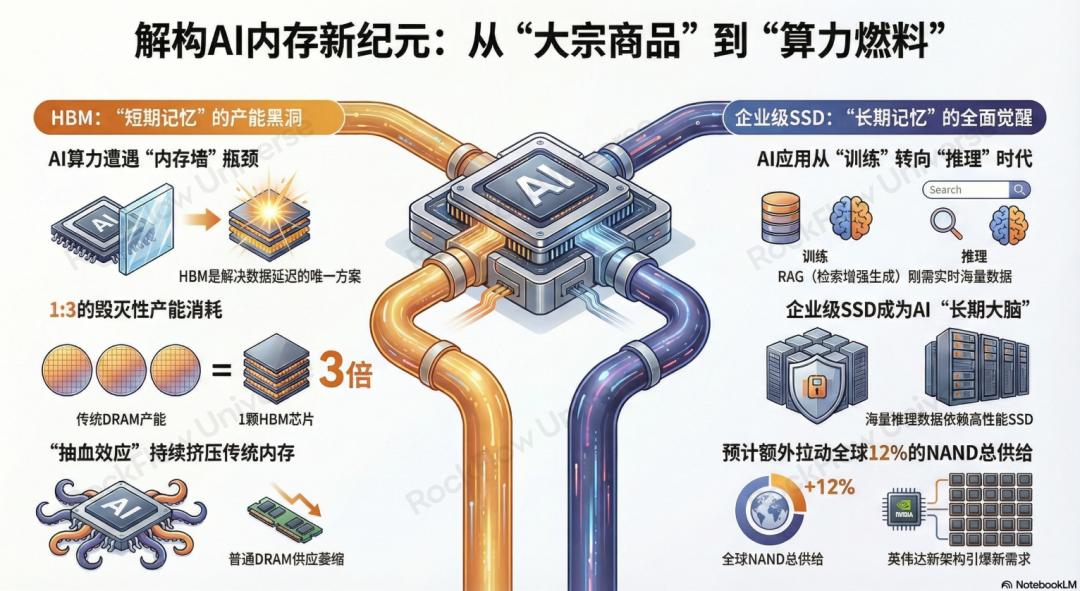
Core Insights - Storage chips are transitioning from a commodity to a core fuel for AI computing, with HBM's "capacity black hole" effect disrupting traditional DRAM supply and awakening long-term demand for enterprise SSDs [1][5] - The current supercycle in storage is accelerating differentiation among key players, with Micron (MU) breaking profit ceilings, SanDisk (SNDK) benefiting from high profit elasticity, and Western Digital (WDC) leveraging HAMR technology to protect its market position [1][2] - Four catalysts are preventing a decline in storage prices: increased memory demand from AI, a new normal of capital expenditure focused on technology iteration, a shift in power dynamics favoring manufacturers, and geopolitical factors ending price wars [1][2][19] Industry Dynamics - The perception of memory chips as a commodity is being shattered as they become essential for AI, breaking traditional cyclical valuation patterns and granting manufacturers greater pricing power [5] - HBM is crucial for addressing the "memory wall" in AI, consuming DRAM capacity at a rate of 3:1, which will lead to significant price increases for DRAM contracts in 2026 [6][12] Key Players Analysis - Micron (MU) is positioned as the only pure-play DRAM manufacturer in the U.S., benefiting from technological advancements and local incentives, with expectations for EPS to rise significantly due to increased HBM production [12][23] - SanDisk (SNDK), after its spin-off from WDC, is now viewed as a pure NAND and enterprise SSD leader, showing high sensitivity to eSSD price increases, which enhances its profit margins [13][24] - Western Digital (WDC) is seen as an undervalued player in cold data storage, with its HDD business remaining essential for cost-effective data storage, supported by HAMR technology [14][25] Future Outlook - The storage market is expected to enter a phase driven by structural demand changes starting in 2026, with significant catalysts supporting continued growth [18] - The four key catalysts include increased AI-driven demand for memory, a shift in capital expenditure focus, a reversal of pricing power to manufacturers, and geopolitical stability ensuring supply chain security [19][20][21][22] Investment Strategy - Core holdings should focus on Micron (MU) due to its technological edge and favorable policy environment, while SanDisk (SNDK) offers potential for explosive growth in enterprise SSDs [23][24] - Western Digital (WDC) serves as a defensive addition, providing stability in uncertain market conditions [25]


美股半导体暴涨,内存飙升300%,A股明天能跟上吗?
Sou Hu Cai Jing· 2026-01-17 17:45
Group 1 - The core point of the article is that the surge in memory prices is driven by substantial changes in demand, particularly due to the persistent increase in large-scale computing needs represented by AI servers, rather than being a speculative bubble [1][14] - From September 2025 to now, DDR5 prices have skyrocketed over 300%, while DDR4 prices have increased by more than 150%, indicating a volatile pricing environment influenced by supply chain constraints and the time required for capacity expansion [1] - The strong performance of the US stock market reflects a global investment trend towards future technology, particularly in semiconductors and storage, driven by actual performance and real application scenarios [3] Group 2 - The A-share market is presented with both confidence and opportunities due to external stimuli from the US market and the recovery chain brought by rising storage prices, with potential beneficiaries including supply-side companies, packaging, and system integrators [3] - Structural differentiation within the market poses challenges for A-shares, as some tech stocks have already demonstrated solid fundamentals while others are still awaiting performance realization, leading to a selective investment environment [5] - The need for supportive industrial policies and capital market mechanisms is emphasized, as a lack of such support could lead to market instability despite positive sentiment [7][9] Group 3 - Investors are advised to focus on companies capable of achieving performance transmission, with firms like TSMC being highlighted as amplifiers of trends, while also being cautious of potential short-term bottlenecks in supply and long-term expansion plans [7][11] - The article stresses the importance of monitoring orders, production schedules, cash flows, and policy patience, suggesting that the market's ability to sustain growth depends on converting short-term trends into long-term industrial assets [13][14] - The dual nature of the current market situation is noted, where the AI-driven storage bull market presents both opportunities for accelerated industrial scaling and risks of excessive speculation and blind expansion [9][14]