存款迁徙

Search documents
中国银行理财发展历程与存款迁徙研究:流水不腐,户枢不蠹
Huachuang Securities· 2026-03-18 15:25
Investment Rating - The report indicates a strong investment rating for the banking wealth management sector, highlighting its significant growth and market dominance by wealth management subsidiaries [3][34][35]. Core Insights - The banking wealth management business in China has evolved through four distinct phases: initial growth (2004-2008), rapid expansion (2009-2012), regulatory tightening (2013-2017), and the current phase of net value transformation post-asset management regulations [7][11][25]. - By the end of 2025, the total scale of banking wealth management is projected to reach 33.29 trillion yuan, making it a crucial component of the asset management market and a foundational element for household financial management [11][34]. - The market share of wealth management subsidiaries has surged, accounting for over 90% of the market by 2025, reflecting a significant shift in the industry structure towards these entities [34][35]. Summary by Sections Overview of Banking Wealth Management - The banking wealth management sector has grown from its inception in 2004, with a market size surpassing 33.29 trillion yuan by 2025, establishing itself as a key player in the asset management landscape [11][12][25]. Evolution of Banking Wealth Management - The sector has undergone four phases: 1. Initial phase (2004-2008) marked by the launch of the first RMB wealth management products and gradual market expansion [12]. 2. Rapid expansion phase (2009-2012) driven by the "Four Trillion" stimulus plan, leading to explosive growth in product offerings and market size [15][16]. 3. Regulatory tightening phase (2013-2017) where significant growth was observed but accompanied by increased regulatory scrutiny [21][24]. 4. Current phase (2018-present) characterized by the introduction of asset management regulations, leading to a transformation towards net value products [25][30]. Changes in Institutional Structure - The transition from bank departments to independent wealth management subsidiaries began in 2019, with 32 subsidiaries expected to be operational by the end of 2025, indicating a more mature industry structure [30][32]. Market Share Dynamics - Wealth management subsidiaries have seen explosive growth in market share, reaching 91.94% by 2025, with a notable increase from 63.66% in 2021 [34][35]. Drivers of Banking Wealth Management - The core drivers of the banking wealth management business have shifted from asset-driven to demand-driven models, particularly after the implementation of asset management regulations, which have redefined the competitive landscape [36][48].
银行资负观察20260301:如何看1月信贷收支表?
Guolian Minsheng Securities· 2026-03-03 06:59
Investment Rating - The report does not explicitly provide an investment rating for the industry Core Insights - In January 2026, personal deposits in financial institutions decreased by 3.37 trillion yuan year-on-year, while corporate deposits increased by 2.80 trillion yuan, government deposits increased by 1.79 trillion yuan, and non-bank deposits increased by 2.84 trillion yuan, indicating a trend of deposit migration [12][13] - The net financing of government bonds under the social financing (社融) measure increased by 0.28 trillion yuan year-on-year, but the larger increase in government deposits suggests a potential slowdown in fiscal spending [12] - The overall expansion of bank assets and liabilities is supported by the recovery of interbank asset-liability chains, but the decrease in medium- and long-term loans indicates that the real estate sector still needs to recover [19] Summary by Sections Liabilities - In January 2026, personal deposits saw a significant year-on-year decrease, confirming the trend of deposit migration, while corporate and non-bank deposits increased by a total of 5.63 trillion yuan, which is much larger than the decrease in personal deposits [12][13] - Large banks experienced a greater increase in non-bank deposits compared to small banks, indicating that some deposits from small banks may have migrated to large banks due to stronger custody services [13] - The "other" category in the funding sources of the credit balance sheet decreased by 2.39 trillion yuan year-on-year, likely due to increased interbank certificates of deposit and bank repurchase lending [12] Assets - Personal loans increased year-on-year, primarily driven by short-term loans and medium- to long-term operating loans, while medium- to long-term consumer loans decreased by 0.16 trillion yuan, possibly due to the sluggish recovery in real estate sales [17] - Corporate loans decreased year-on-year, mainly due to a reduction in bill financing by 0.36 trillion yuan, although short-term corporate loans increased by 0.34 trillion yuan [17] - Investment in debt and equity increased by 0.37 trillion yuan year-on-year, aligning with trends of fiscal expansion and non-bank balance sheet growth [17] Overall Analysis - The January 2026 data indicates a significant increase in fiscal financing and a recovery in interbank asset-liability chains, which temporarily supports the expansion of bank assets and liabilities [19] - However, the decrease in medium- and long-term loans suggests ongoing challenges in the real estate sector, and the support from non-bank sectors for bank asset-liability expansion may weaken as high-interest deposits mature [19]
迎接50万亿存款迁徙 | 固收+站上历史风口,3万亿只是起点
Xin Lang Cai Jing· 2026-02-27 09:09
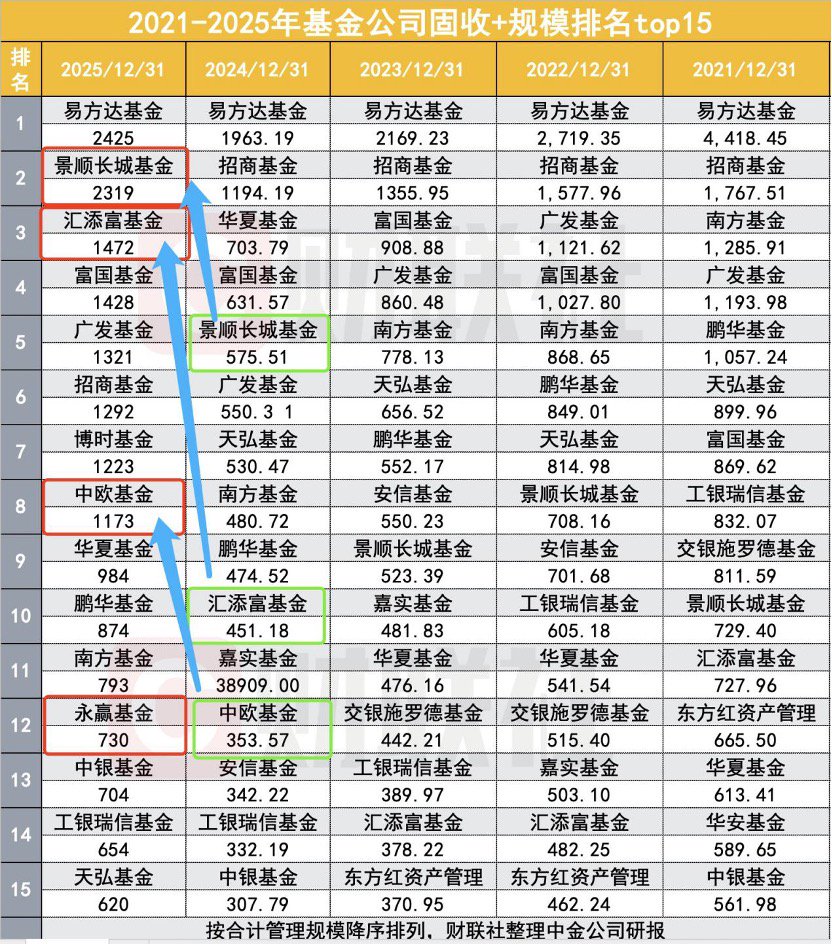
Core Insights - The public fund industry is poised for significant growth, particularly in the "fixed income +" sector, driven by a massive migration of deposits estimated at 50 trillion yuan [2][3] - The competition for "fixed income +" business is intensifying, with a consensus that the current scale of 3 trillion yuan is just the beginning, as institutions increase their investments [2][3] Group 1: Market Trends - The total scale of "fixed income +" funds reached a historical peak of 3 trillion yuan by the end of 2025, marking a 9% quarter-on-quarter increase and a 56% year-on-year growth [2] - The second-tier bond funds saw significant expansion, with a scale of 1.55 trillion yuan, reflecting a 19% increase, primarily driven by new capital inflows from institutional investors [2][3] - The market is expected to see a continued rise in the popularity of "fixed income +" strategies, with a focus on dynamic adjustments based on market trends [3][10] Group 2: Company Performance - E Fund remains the leader in "fixed income +" management with a scale of 242.5 billion yuan, followed closely by Invesco Great Wall and Huatai-PB, with 231.9 billion yuan and 147.2 billion yuan respectively [5][6] - Several companies, including Yongying Fund, have entered the top 12 in "fixed income +" management scale, indicating a competitive landscape [4][6] - The top 15 fund companies have shown substantial growth in their "fixed income +" scales from 2021 to 2025, with notable increases in assets under management [5] Group 3: Regulatory Environment - The regulatory environment is becoming more favorable for "fixed income +" products, with expectations of accelerated product approvals as high-interest deposits mature [7] - Fund companies are encouraged to actively engage in "fixed income +" strategies to capture migrating funds, with a focus on clear risk-return profiles to attract institutional investors [7][9] - The approval process for new products is becoming more refined, with faster pathways for higher-rated fund companies [7] Group 4: Strategic Developments - E Fund is evolving its strategy from fixed income enhancement to a multi-asset allocation model, aiming for comprehensive synergy in investment research [8] - Southern Fund has introduced the "优生优养计划" to emphasize product design and investor experience, with "fixed income +" and FOF as key components [9] - BlackRock is also focusing on "fixed income +" as a priority in its domestic fund strategy, leveraging its extensive multi-asset business framework [9]


流动性系列之二:高息存款到期高点或已过
Guolian Minsheng Securities· 2026-02-10 11:36
Investment Rating - The report maintains a recommendation rating for the industry [2] Core Insights - The report discusses the reality and narrative surrounding deposit maturity, highlighting that a significant amount of high-interest deposits will mature in early 2026, which may lead to a migration of funds to capital markets due to lower new deposit rates [7][10][57] - It emphasizes that while there is a narrative around the migration of deposits to capital markets, this may not have a positive long-term impact on market health, as it could lead to increased volatility and wealth redistribution [11][60] Summary by Sections 1. Introduction: Reality and Narrative of Deposit Maturity - The report introduces a framework for measuring deposit maturity based on listed bank reports, aiming to clarify the reality versus the narrative surrounding deposit migration to capital markets [8][14] 2. Reality One: Significant Deposits Held by Residents and Enterprises - As of December 2025, total deposits in China amount to 286 trillion yuan, with 166 trillion yuan in household deposits and 120 trillion yuan in enterprise deposits. The growth rates of household deposits have significantly outpaced those of enterprise deposits [15] 3. Reality Two: Annual Maturity of Large Amounts of Time Deposits - In 2025, approximately 105 trillion yuan of time deposits are expected to mature, an increase of 14 trillion yuan year-on-year. The report notes that the first quarter typically sees the highest volume of maturing deposits [23][24] 4. Reality Three: Low Rates on Newly Issued Time Deposits - The report highlights that the interest rates on newly issued time deposits have been significantly reduced, creating a gap between maturing high-interest deposits and current rates, which may drive depositors to seek alternative financial products [34] 5. Reality Four: First Quarter of 2026 as the Peak for Deposit Maturity - The estimated maturity of high-interest deposits in 2026 is around 32 trillion yuan, with the first quarter expected to see the highest pressure from maturing deposits [39][40] 6. High-Interest Deposit Maturity Peak May Have Passed - The report concludes that the peak for high-interest deposit maturity occurred in the first quarter of 2026, with expectations that the narrative around deposit migration may begin to fade as market conditions change [57] 7. Thoughts on Deposit Migration and Bull Market Narratives - The report argues that while deposit migration narratives may be prevalent during bullish market conditions, they may not contribute positively to the long-term health of capital markets, suggesting a need for a focus on corporate performance and valuation instead [11][60]
储户注意了:存取5万以上不用登记?新规之下这些细节要明白
Sou Hu Cai Jing· 2025-08-25 01:18
Group 1: International and Domestic Trends - The Federal Reserve maintained the federal funds rate at 4.25%-4.5% in March 2025, but signals of potential rate cuts were released by Powell at the Jackson Hole meeting on August 23, leading to a 91.3% market bet on a September rate cut [1][2] - The international trend of rate cuts has impacted the Chinese financial market, with household deposits increasing by 10.77 trillion yuan in the first half of 2025, but a decrease of 1.11 trillion yuan in July, indicating a shift of funds towards wealth management and funds [1][3] Group 2: Effects of Rate Cuts on Capital Flow - Following three rate cuts by the Federal Reserve in 2024, foreign institutions increased their holdings of Chinese bonds by over 300 billion yuan in Q4 2024, while enterprises in the Shanghai Free Trade Zone saw a 45% year-on-year increase in cross-border purchases of high-yield foreign deposits [3] - In response to the Fed's rate cuts, the People's Bank of China lowered the reserve requirement ratio by 0.5 percentage points in September 2024 and again in May 2025, resulting in a historical low average interest rate of 3.68% for new corporate loans in the first half of 2025 [3] Group 3: Structural Changes in Domestic Deposits - The acceleration of fund migration is evident as non-bank institution deposits surged by 2.14 trillion yuan, while the interest rates on three-year large deposits fell from 2.8% in 2023 to 1.8%-2.2% in 2025, contrasting with an average return of 4.5% for balanced stock and bond funds during the same period [3] Group 4: New Regulations and Their Implications - The new regulation allows cash withdrawals of over 50,000 yuan without mandatory registration of the source or purpose, addressing previous concerns over excessive scrutiny [4] - Financial institutions must still adhere to the "Know Your Customer" principle, with enhanced scrutiny for high-risk clients, while technology is being utilized to streamline processes and protect customer privacy [4][5] Group 5: Economic and Real Estate Impacts - The central bank's liquidity injection of 600 billion yuan through a one-year MLF operation aims to alleviate market pressure and direct more funds into the real economy [6] - The rental market is expected to grow due to new housing rental regulations, which may divert some funds from home purchases and ease pressure on the housing market [7] Group 6: Expert Analysis on Regulatory Changes - The new regulations do not relax anti-money laundering efforts but instead focus resources on higher-risk areas, ensuring that banks maintain rigorous checks on clients from high-risk regions [9] - Innovations in local policies, such as the introduction of combination products by banks, aim to enhance customer returns while maintaining compliance with new regulations [12]