
守牢底线

Search documents
《求是》杂志发表习近平总书记重要文章当前经济工作的重点任务
Shan Xi Ri Bao· 2026-02-16 00:16
Core Insights - The article emphasizes the importance of focusing on key tasks for economic work in 2026, highlighting the need to prioritize domestic demand and build a strong domestic market [1] - It outlines a multi-faceted approach to stimulate consumption, investment, innovation, and reform to drive high-quality economic development [2][3][4][5] Group 1: Economic Strategy - The strategy includes promoting consumption and investment through various measures, such as implementing a plan for increasing urban and rural residents' income and optimizing the supply of quality goods and services [1] - It stresses the need for a robust domestic market by leveraging China's large-scale market advantages and enhancing consumer spending [1] Group 2: Innovation and Technology - The article advocates for innovation-driven growth, emphasizing the role of technological advancements in upgrading industries and fostering new productive forces [2] - It calls for the establishment of international technology innovation centers in key regions like Beijing, Shanghai, and the Guangdong-Hong Kong-Macau Greater Bay Area [2] Group 3: Reform and Market Dynamics - The need for comprehensive reforms is highlighted, including the establishment of a unified national market and the deepening of state-owned enterprise reforms [2] - It also mentions the importance of improving the market ecosystem by addressing issues like "involution" competition and enhancing the role of private enterprises [2] Group 4: International Cooperation - The article discusses the importance of maintaining an open economy and promoting cooperation across multiple fields to enhance domestic and international dual circulation [3] - It emphasizes the need for expanding service sector openness and advancing the construction of free trade zones [3] Group 5: Sustainable Development - The commitment to green transformation is underscored, with initiatives aimed at reducing carbon emissions, enhancing energy efficiency, and promoting renewable energy [4] - It highlights the importance of environmental protection and the establishment of a national carbon trading market [4] Group 6: Social Welfare and Employment - The article stresses the importance of prioritizing people's livelihoods, focusing on employment stability, and enhancing social security measures for vulnerable groups [5] - It also mentions the need for educational reforms to increase access to quality education and improve healthcare services [5] Group 7: Risk Management - The article outlines strategies for managing risks in key areas, particularly in the real estate market, emphasizing the need for targeted policies to stabilize the market [5] - It discusses the importance of addressing local government debt risks and optimizing debt restructuring methods [5]
《当前经济工作的重点任务》
Xin Lang Cai Jing· 2026-02-15 22:16
Core Viewpoint - The article emphasizes the key tasks for economic work in 2026, focusing on domestic demand, innovation, reform, and sustainable development to enhance economic resilience and growth. Group 1: Domestic Demand and Investment - The article stresses the importance of a strong domestic market, advocating for measures to boost consumption and investment, including the implementation of a plan to increase urban and rural residents' income and optimize the use of local government special bonds [1][2] - It highlights the need to stabilize investment and increase the scale of central budget investments, while also enhancing the vitality of private investments through new policy tools [1][2] Group 2: Innovation and Technology - The article calls for an innovation-driven approach to foster new growth drivers, emphasizing the role of technological innovation in industrial upgrading and the establishment of international technology innovation centers in key regions [2][3] - It also mentions the importance of protecting intellectual property rights in emerging fields and accelerating the transformation of scientific and technological achievements [2] Group 3: Reform and Market Development - The article outlines the necessity of deepening reforms to enhance high-quality development, including the establishment of a unified national market and the promotion of state-owned enterprise reforms [2][3] - It emphasizes the need to improve the market ecosystem and support the development of platform enterprises and their operators [2] Group 4: International Cooperation and Trade - The article discusses the importance of maintaining an open approach to enhance cooperation and facilitate domestic and international dual circulation, including the promotion of free trade zones and digital trade [3][4] - It highlights the need for more regional and bilateral trade agreements to support economic growth [3] Group 5: Green Development and Sustainability - The article advocates for a comprehensive green transition, focusing on carbon reduction, pollution control, and the development of a new energy system [4][5] - It emphasizes the importance of environmental protection and the establishment of a carbon trading market to support sustainable growth [4] Group 6: Social Welfare and Employment - The article stresses the importance of prioritizing employment and social welfare, including measures to stabilize employment for key groups such as college graduates and migrant workers [4][5] - It also highlights the need for improvements in healthcare, education, and support for vulnerable populations [4] Group 7: Risk Management - The article underscores the importance of risk management in key areas, particularly in stabilizing the real estate market and addressing local government debt risks [5] - It calls for a coordinated approach to risk prevention and development to enhance economic resilience [5]
习近平:当前经济工作的重点任务
财联社· 2026-02-15 07:13
Core Viewpoint - The article emphasizes the importance of focusing on key tasks for economic work in 2026, highlighting the need to strengthen domestic demand and build a robust domestic market while promoting consumption and investment [1]. Group 1: Economic Strategy - The article outlines the need to implement actions to boost consumption, including urban and rural income increase plans and optimizing the supply of quality goods and services [1]. - It stresses the importance of stabilizing investment and increasing the scale of central budget investments, while optimizing the use of local government special bonds [1]. Group 2: Innovation and Reform - The article advocates for innovation-driven growth, emphasizing the role of technology in industrial upgrades and the establishment of international technology innovation centers in key regions [2]. - It calls for reforms to enhance market vitality, including the establishment of a unified national market and the promotion of private sector development [2]. Group 3: International Cooperation - The article highlights the need for open international cooperation, promoting trade and investment integration, and expanding service sector openness [3]. - It encourages the development of digital and green trade, as well as the signing of more regional and bilateral trade agreements [3]. Group 4: Sustainable Development - The article stresses the importance of green transformation, advocating for carbon reduction and pollution control while enhancing green development momentum [4]. - It outlines plans for energy system construction and solid waste management to support environmental sustainability [4]. Group 5: Social Welfare - The article emphasizes prioritizing people's livelihoods, focusing on employment stability and improving access to education and healthcare [5]. - It highlights the need for policies to support vulnerable groups, including the elderly and those in flexible employment [5]. Group 6: Risk Management - The article discusses the importance of risk management in key areas, particularly in stabilizing the real estate market and addressing local government debt risks [6]. - It advocates for measures to optimize debt restructuring and mitigate financing platform risks [6].


筑牢起步根基 续写发展新篇
Xin Lang Cai Jing· 2026-01-12 16:57
Core Insights - The article emphasizes the comprehensive implementation of the central economic work conference's spirit, focusing on key tasks such as expanding institutional openness, promoting coordinated development, leading with "dual carbon" initiatives, and ensuring bottom-line safety for economic and social development in the 14th Five-Year Plan period [1] Group 1: Deepening Opening Up - Multiple departments are implementing practical measures to expand the depth and breadth of opening up, injecting open momentum into high-quality development [2] - The National Development and Reform Commission (NDRC) has proposed to steadily expand institutional openness and promote high-quality development of the Belt and Road Initiative [3] Group 2: Coordinated Development - The central economic work conference calls for promoting urban-rural integration and regional linkage to address unbalanced development issues [6] - The NDRC emphasizes the need for a people-centered new urbanization and regional strategic implementation to enhance urban-rural integration [7] Group 3: Green Transformation - Various departments are responding to the call for a comprehensive green transformation, focusing on energy structure optimization and industrial green upgrades [9] - The NDRC plans to implement a dual control system for carbon emissions and strengthen evaluation and assessment [10] Group 4: Risk Prevention - The central economic work conference highlights the importance of risk awareness and bottom-line thinking, focusing on local debt, financial markets, and safety production [12] - The People's Bank of China has outlined specific measures for financial risk management, including supporting the resolution of financing platform debt risks [13]
“八个坚持”拓开2026年中国经济大视野
Guo Ji Jin Rong Bao· 2025-12-15 03:12
Group 1: Macroeconomic Policy and Domestic Market - The core macroeconomic policy emphasizes a more proactive approach, focusing on quality and efficiency as key development themes, with the "Eight Persistences" as critical directives for economic work in the first year of the 14th Five-Year Plan [1] - Domestic demand has become the main driver of economic growth, contributing an average of 93.1% to economic growth from 2013 to 2024, highlighting the importance of a strong domestic market as a long-term strategy [2][3] Group 2: Innovation and New Growth Drivers - The necessity of innovation-driven growth is underscored, as new momentum is essential for future development and competitive positioning, requiring a systemic reshaping of production factors and business models [4][5] - The development of new momentum must support both high-end industries and traditional industry upgrades, creating high-quality employment and meeting the needs of the populace [5] Group 3: Reform and High-Quality Development - Continuous reform is essential to inject vitality into high-quality development, addressing deep-seated issues that have emerged due to changing development stages [6][7] - Emphasis on technological innovation as a key driver for high-quality development, necessitating a deep integration of innovation systems and breaking down institutional barriers [7] Group 4: Open Economy and International Cooperation - China aims for a higher level of openness, promoting multi-faceted cooperation to adapt to global economic changes and challenges, emphasizing the importance of collaborative networks in various fields [8][9] - The need for innovative cooperation mechanisms to address challenges posed by protectionism and geopolitical tensions is highlighted, focusing on quality and resilience in partnerships [9] Group 5: Coordinated Development and Urban-Rural Integration - The strategy of promoting coordinated development aims to address the growing disparities between urban and rural areas, emphasizing the need for a balanced and inclusive development approach [10][11] - Regional integration strategies like the Beijing-Tianjin-Hebei collaboration and the Yangtze River Economic Belt are examples of efforts to optimize resource allocation and promote high-quality regional economic layouts [11] Group 6: Green Transformation and Carbon Neutrality - The commitment to achieving carbon peak by 2030 and carbon neutrality by 2060 reflects China's responsibility in global climate governance and the need for a comprehensive green transformation [12][13] - Innovation is identified as the core engine for achieving carbon goals, requiring advancements in renewable energy, energy efficiency, and the establishment of supportive institutional frameworks [14] Group 7: Focus on People's Livelihood - The emphasis on prioritizing people's livelihoods reflects the increasing complexity of public demands, necessitating a responsive governance approach that addresses specific community needs [15][16] - Establishing long-term mechanisms to ensure sustainable improvements in public welfare is crucial, with a focus on resource allocation and social governance [16] Group 8: Risk Management - The need to manage risks in key areas such as real estate and local debt is highlighted, with a focus on maintaining stability while actively addressing potential threats [17][18] - A balanced approach to risk management is essential, combining immediate responses with long-term structural improvements to foster sustainable development [18]
好评中国|锚定高质量发展,奋力实现“十五五”良好开局
Huan Qiu Wang· 2025-12-13 07:45
Core Insights - The Central Economic Work Conference held on December 10-11, 2025, is crucial for setting the direction for China's economic work in 2026 and ensuring a good start for the "15th Five-Year Plan" [1][2] - The conference emphasizes the importance of unity in thought, consensus, and confidence to navigate the complexities of the current economic landscape and achieve high-quality development [2][3] Economic Strategy - The conference outlines a series of strategic deployments focused on stabilizing and advancing economic growth, with a priority on domestic demand and building a strong domestic market [3] - Key tasks include boosting consumption, optimizing investment, fostering innovation, and addressing risks in real estate and local debt [3][4] Leadership and Governance - Strengthening the Party's comprehensive leadership over economic work is highlighted as essential for overcoming challenges and achieving targets [4] - The need for a correct performance view that prioritizes people's well-being and practical results is emphasized, along with avoiding bureaucratic tendencies [4] Future Outlook - The conference sets a clear roadmap for 2026, aiming for a robust start to the "15th Five-Year Plan" and a commitment to high-quality development [5] - A call for collective effort and determination to overcome obstacles and achieve economic goals is made, reinforcing the vision for a modern socialist country [5]
八大重点任务,每一项都沉甸甸的,都吸引着世界的目光
Sou Hu Cai Jing· 2025-12-13 03:00
Group 1 - The primary task is to maintain domestic demand as the leading force and build a strong domestic market, which is crucial for economic stability amidst international uncertainties [2] - The second task emphasizes innovation-driven growth, highlighting the need for increased market demand to stimulate corporate innovation and economic momentum [2] - The third task focuses on deepening reforms to enhance high-quality development, which is essential for generating new momentum and increasing market vitality [4] Group 2 - The fourth task is to uphold openness and promote win-win cooperation across multiple fields, despite challenges from unilateralism and protectionism in the international environment [4] - The fifth task stresses coordinated development to promote urban-rural integration and regional collaboration, which is vital for achieving common prosperity and modernization [5] - The sixth task is to lead with "dual carbon" initiatives, committing to comprehensive green transformation and environmental protection [6] Group 3 - The seventh task prioritizes people's livelihoods, aiming to improve the quality of life and ensure that every citizen experiences happiness and pride [8] - The eighth task involves maintaining a strong bottom line by proactively and prudently addressing risks in key areas, particularly in real estate and local government debt [8]
(经济观察)明确“路线图” 中央经济工作会议部署八项任务
Zhong Guo Xin Wen Wang· 2025-12-11 15:28
Core Insights - The Central Economic Work Conference outlined eight key tasks for China's economic work in 2026, emphasizing the importance of domestic demand and innovation as primary drivers for economic growth [1][2][3] Group 1: Domestic Demand and Market Development - The first task is to "insist on domestic demand as the main driver and build a strong domestic market," highlighting its significance in the overall economic development strategy [1] - The conference plans to implement actions to boost consumption and optimize policies related to new projects, indicating that expanding domestic demand remains a primary focus for economic work [1] Group 2: Innovation and New Growth Drivers - The second task emphasizes "insisting on innovation-driven development and accelerating the cultivation of new growth drivers," which is seen as crucial for constructing a new development pattern and expanding domestic demand [1][2] - Technological innovation is expected to create new products and consumption demands while reducing costs, thereby increasing supply [1] Group 3: Reform and High-Quality Development - The third task focuses on "insisting on reform to enhance the vitality of high-quality development," which includes deepening reforms and optimizing the business environment to remove institutional barriers [2] - This approach aims to stimulate internal dynamics and facilitate economic circulation [2] Group 4: Open Economy and International Cooperation - The fourth task is to "insist on opening up and promoting win-win cooperation in multiple fields," recognizing the complex changes in the development environment and the need for high-level openness to enhance domestic and international market interactions [2] Group 5: Coordinated Development - The fifth task emphasizes "insisting on coordinated development to promote urban-rural integration and regional linkage," which is essential for achieving a broader and more robust new development pattern [2] Group 6: Green Transformation - The sixth task focuses on "insisting on carbon neutrality as a guiding principle to promote comprehensive green transformation," aligning with the goals of reducing carbon emissions and promoting sustainable growth [2] Group 7: Social Welfare and Stability - The seventh task is to "insist on prioritizing people's livelihoods and strive to do practical things for the public," reiterating the importance of stabilizing employment, businesses, markets, and expectations [2][3] Group 8: Risk Management - The eighth task is to "insist on maintaining a bottom line and actively and prudently resolving risks in key areas," particularly in stabilizing the real estate market and managing local government debt risks [3] - The conference emphasizes a shift in economic policy focus from growth to quality and efficiency, advocating for a coordinated approach to policy implementation [3]
明年经济工作怎么干 记住“八个坚持”
Xin Hua She· 2025-12-11 13:30
Core Viewpoint - The Central Economic Work Conference has outlined eight key tasks for economic work in 2026, focusing on domestic demand, innovation, reform, openness, coordinated development, green transformation, improving people's livelihoods, and risk management [1]. Group 1: Domestic Demand and Market Development - Emphasis on maintaining domestic demand as the primary driver and building a strong domestic market [1]. Group 2: Innovation and New Momentum - Focus on innovation-driven growth and accelerating the cultivation of new growth drivers [1]. Group 3: Reform and High-Quality Development - Commitment to tackling reforms to enhance the vitality and momentum for high-quality development [1]. Group 4: Openness and Cooperation - Advocacy for maintaining openness and promoting win-win cooperation across multiple fields [1]. Group 5: Coordinated Development - Support for coordinated development to promote urban-rural integration and regional synergy [1]. Group 6: Green Transformation - Commitment to leading with "dual carbon" goals and promoting comprehensive green transformation [1]. Group 7: Livelihood Improvement - Focus on prioritizing people's livelihoods and striving to address practical issues for the populace [1]. Group 8: Risk Management - Emphasis on safeguarding the bottom line and actively and prudently resolving risks in key areas [1].
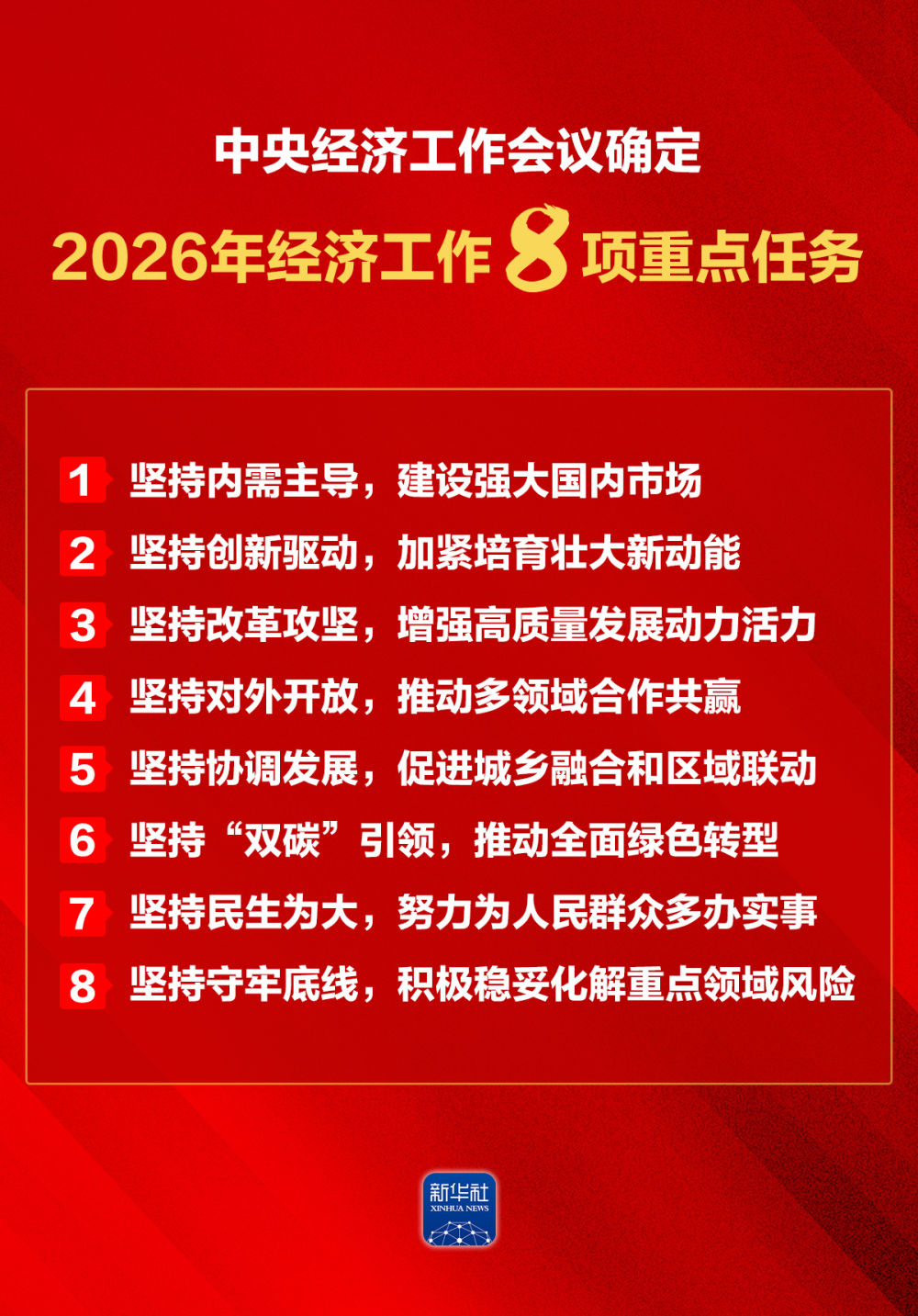
【图解】速览!2026年经济工作八大重点任务
Zhong Guo Jing Ji Wang· 2025-12-11 12:29
Core Viewpoint - The Central Economic Work Conference held on December 10-11 in Beijing outlined eight key tasks for economic work in 2026, focusing on domestic demand, innovation, reform, openness, coordinated development, green transformation, public welfare, and risk management. Group 1: Domestic Demand - Emphasis on leading domestic demand and building a strong domestic market through actions to boost consumption and implement urban and rural income increase plans [1] - Expansion of quality goods and services supply, optimization of "two new" policy implementation, and removal of unreasonable restrictions in the consumption sector to unleash service consumption potential [1][2] - Encouragement of investment stabilization, with an increase in central budget investment scale and optimization of local government special bond usage [1] Group 2: Innovation - Focus on innovation-driven growth by developing a comprehensive plan for education, technology, and talent development [2] - Establishment of international technology innovation centers in key regions such as Beijing, Shanghai, and the Guangdong-Hong Kong-Macau Greater Bay Area [2] - Strengthening the role of enterprises in innovation and improving intellectual property protection in emerging fields [2] Group 3: Reform - Commitment to reform efforts to enhance high-quality development, including the establishment of a unified national market and further deepening state-owned enterprise reforms [3] - Initiatives to clear overdue payments to businesses and promote win-win scenarios for platform enterprises and their operators [3] - Expansion of market-oriented reforms and improvement of the local tax system [3] Group 4: Openness - Promotion of multi-field cooperation and gradual advancement of institutional openness, including the expansion of service sector autonomy and optimization of free trade zone layouts [4] - Encouragement of service exports and development of digital and green trade [4] - Strengthening of foreign investment promotion mechanisms and enhancing overseas service systems [4] Group 5: Coordinated Development - Coordination of urban-rural integration and regional collaboration, focusing on high-quality development in county economies [5] - Maintenance of arable land and food production stability, ensuring reasonable prices for key agricultural products [5] - Support for major economic provinces and enhancement of cooperation among key urban clusters [5] Group 6: Green Transformation - Advancement of energy-saving and carbon reduction initiatives in key industries and the establishment of a new energy system [6] - Strengthening of the national carbon emissions trading market and implementation of comprehensive waste management actions [6] - Promotion of environmental protection initiatives and improvement of disaster response infrastructure [6] Group 7: Public Welfare - Implementation of actions to stabilize employment for key groups such as college graduates and migrant workers, and support for flexible employment [7] - Adjustment of educational resource allocation to increase high school and quality university enrollment [7] - Optimization of drug procurement and deepening of medical insurance payment reforms [7] Group 8: Risk Management - Focus on stabilizing the real estate market with city-specific policies to control inventory and encourage the acquisition of existing housing for social welfare [8]
