
完美风暴

Search documents
法兴银行:三大因素塑造推动美债走势的 “完美风暴”
Sou Hu Cai Jing· 2026-01-21 03:25
Core Viewpoint - The U.S. 10-year Treasury yield reached its highest point since late August at 4.313%, closing at 4.287% after a rise of 5.6 basis points, indicating a potential upward trend in yields [1] Group 1 - The 10-year Treasury yield has broken through the key technical level of 4.20%, which may pave the way for a challenge of the resistance level around 4.50% [1] - Factors contributing to the movement in U.S. Treasury yields include a significant sell-off in Japanese bonds, threats from Trump's tariffs, and momentum from the yield closing above the important technical level of 4.20% [1]
今天,金价创出今年“第36个新高”
Hua Er Jie Jian Wen· 2025-09-23 11:38
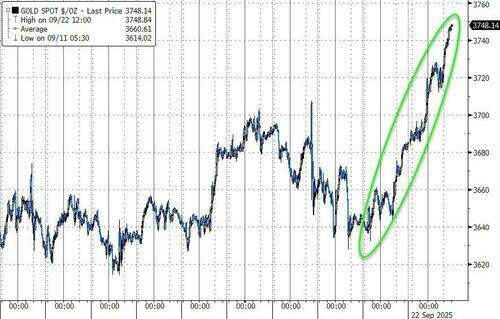
Core Viewpoint - The strong upward trend in gold prices continues, with significant increases driven by geopolitical uncertainty, inflation concerns, and expectations of interest rate cuts [1][3][4] Group 1: Gold Price Performance - On Monday, gold futures for December delivery settled at $3,775.10 per ounce, marking a $69.30 increase (1.9%) and the highest closing price ever for the main contract [1] - Year-to-date, gold prices have risen by 44%, surpassing the inflation-adjusted high from 1980 [3] Group 2: Market Drivers - The current macroeconomic environment is described as a "perfect storm" for gold, benefiting from inflation, currency devaluation, debt, conflict, and socio-economic anxieties [4] - Analysts highlight that the combination of internal U.S. divisions, political violence, and escalating NATO-Russia tensions enhances gold's appeal as a safe-haven asset [4] Group 3: Technical Analysis - The recent price increase is characterized as a "healthy bull market" driven by technical price behavior rather than new information [5] - Gold's price chart shows classic breakout behavior, indicating strong bullish momentum [5] Group 4: Market Sentiment and Bubble Concerns - Key indicators in the options market do not suggest irrational exuberance, indicating that the gold market is not in a bubble [6] - Despite some signs of potential bubble formation, such as increased media presence and ETF activity, the overall market sentiment remains optimistic [7]

金价创出今年“第36个新高”!大涨之后,黄金泡沫化了吗?
Hua Er Jie Jian Wen· 2025-09-23 10:54
Group 1 - The core viewpoint of the articles highlights that gold prices have reached record highs due to a combination of geopolitical uncertainty, inflation concerns, and expectations of interest rate cuts, creating a "perfect storm" for gold [3][4] - Gold futures for December delivery settled at $3,775.10 per ounce, marking a $69.30 increase and a 1.9% rise, which is the highest closing price for the main contract in history [1] - Year-to-date, gold prices have increased by 44%, surpassing the inflation-adjusted high from 1980, raising concerns among some investors about the sustainability of this upward trend [3] Group 2 - Analysts view the current macroeconomic environment as favorable for gold, with factors such as inflation, currency devaluation, debt, conflict, and socio-economic anxiety driving demand for gold as a "disaster insurance" [4] - The ongoing political violence and division within the U.S., combined with escalating tensions between NATO and Russia, have enhanced the appeal of gold and silver as safe-haven assets [4] - Significant inflows into gold ETFs, such as SPDR Gold Trust (GLD), indicate that real money is beginning to flow into precious metals, with GLD recording increases for five consecutive weeks [4] Group 3 - Technical indicators suggest a healthy bull market for gold, with recent price movements driven by technical price behavior rather than new information [5] - The price charts indicate a classic breakout pattern, characterized by a long consolidation phase, clear resistance levels, and strong bullish momentum [5] - Key indicators in the options market do not show signs of irrational exuberance, suggesting that the gold market is not currently in a bubble [6] Group 4 - The spread between out-of-the-money options and at-the-money options has not significantly widened, indicating that investors are not excessively chasing high-risk options, which is typical in bubble environments [6] - Despite the optimistic market sentiment, there are some signs that could indicate potential bubble formation, such as increased media presence and explosive growth in gold ETF activity [6]

刚刚,金价创出今年“第36个新高”
Hua Er Jie Jian Wen· 2025-09-23 00:11
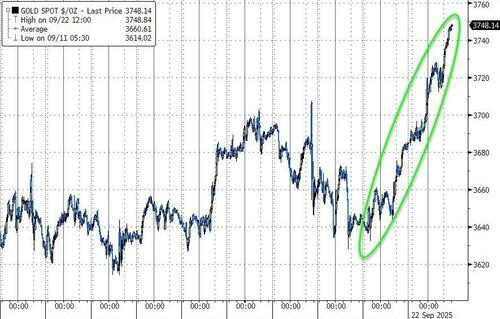
Core Viewpoint - The strong upward trend in gold prices continues, with the price reaching a record high for the year, driven by geopolitical uncertainty, inflation concerns, and expectations of interest rate cuts [1][3][4]. Group 1: Price Movement - On Monday, December gold futures settled at $3,775.10 per ounce, marking a $69.30 increase or 1.9%, which is the highest closing price ever for the main contract [1]. - Year-to-date, gold prices have increased by approximately 43%, surpassing the inflation-adjusted high from 1980 [3]. Group 2: Market Drivers - The current macroeconomic environment is described as a "perfect storm" for gold, benefiting from inflation, currency devaluation, debt, conflict, and socio-economic anxieties [4]. - Analysts suggest that the combination of rising political violence in the U.S. and escalating tensions between NATO and Russia enhances gold's appeal as a safe-haven asset [4]. Group 3: Technical Analysis - The recent price increase is characterized as a "healthy bull market," driven by technical price behavior rather than new information [5]. - Gold's price chart indicates a classic breakout pattern, suggesting strong bullish momentum [5]. Group 4: Market Sentiment and Bubble Concerns - Key indicators in the options market do not show signs of irrational exuberance, suggesting that the gold market is not in a bubble [6]. - Despite some potential signs of a bubble, such as increased media presence and ETF activity, the overall market sentiment remains cautious [7].
阿富汗为何遭遇“完美风暴”?
Xin Lang Cai Jing· 2025-09-01 08:23
Core Points - A 6.1 magnitude earthquake struck Afghanistan on August 31, resulting in 610 deaths and 1,300 injuries, with significant destruction in several villages [1] - The earthquake's epicenter was near Jalalabad, a key trade center and border point with Pakistan, affecting a population of approximately 300,000 [1] - The Taliban government has mobilized rescue efforts, but many remain trapped under rubble, and the death toll is expected to rise [1] Group 1 - The earthquake's depth was measured at only 8 kilometers, categorizing it as a shallow earthquake, which typically causes more damage [2] - The region's geological conditions, including the presence of the Hindu Kush mountain range, contributed to landslides and increased destruction [2] - Continuous rainfall exacerbated the situation, leading to more building collapses [2] Group 2 - Afghanistan is classified as one of the least developed countries, with a GDP per capita of $493, and has faced over 40 years of conflict, severely damaging infrastructure [3] - The country struggles with economic development and rebuilding efforts, with over 6 million people having become refugees [3] - The earthquake occurred at night, leaving residents with little warning, which contributed to the high casualty rate [4] Group 3 - The situation in Afghanistan is further complicated by ongoing drought and the repatriation of nearly 2 million refugees from Iran, as well as similar plans from Pakistan [4] - The Chinese government has expressed willingness to provide disaster relief assistance based on Afghanistan's needs [4]