宏观经济增长预期

Search documents
A股投资者情绪整体较为乐观
Xin Lang Cai Jing· 2026-02-09 22:25
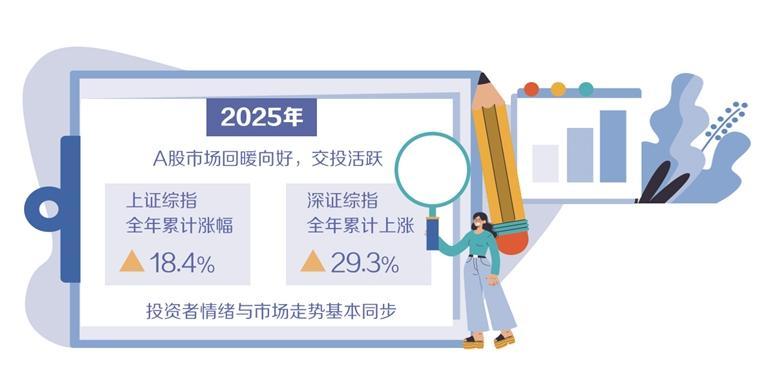
Group 1 - The overall sentiment of A-share investors is optimistic, with 62.3% of respondents believing that A-shares will rise, and the proportion of retail investors expecting an increase has risen to 64.2%, up 2.5 percentage points from the previous survey [2] - The Shanghai Composite Index saw an annual increase of 18.4%, while the Shenzhen Composite Index rose by 29.3%, indicating a positive correlation between investor sentiment and market performance [2] - The willingness to invest in stocks has increased, with a net increase of 13.9% in the number of respondents willing to invest, and retail investor willingness has risen to 20.3%, an increase of 2.2 percentage points [2] Group 2 - Gold prices increased significantly by 62.7% in 2025, driven by heightened demand for safe-haven assets amid global economic volatility and geopolitical uncertainties [3] - The report indicates a growing preference for investing in gold and bonds, with a net increase of 14.2% in respondents willing to invest in precious metals, up 1.6 percentage points from the last survey [3] - The optimism in A-share investor sentiment is largely attributed to stable expectations for China's macroeconomic growth, with 37.6% of respondents believing GDP growth will exceed 5% in the future [3] Group 3 - China's total goods trade import and export value reached 45.47 trillion yuan in 2025, a year-on-year increase of 3.8%, with exports growing by 6.1% [4] - The contribution rate of net exports to economic growth was 32.7%, highlighting the strength of China's industrial system and supply capabilities [4] - Approximately 46% of respondents believe China is a world leader in artificial intelligence, and 51.2% think it leads in the new energy vehicle sector, reflecting investor confidence in China's technological advancements [4] Group 4 - Despite the optimistic market sentiment, there are structural challenges in boosting domestic demand, which is crucial for a stable capital market [5] - The central economic work conference has prioritized "domestic demand as the main driver" for 2026, emphasizing the importance of stimulating domestic consumption [5] - Future efforts are needed to stabilize the real estate market and enhance service consumption potential to further support domestic demand [5]

闪辉:高盛回答“关税十二问”
Sou Hu Cai Jing· 2025-05-03 09:10
Group 1 - The impact of tariffs on various industries is significant, with the U.S. relying heavily on imports of manufactured goods from China, while China imports mainly commodities from the U.S. [4] - Over 70% of products imported by the U.S. from China account for 36% of total imports, while only 10% of products imported by China from the U.S. have a similar reliance [4] - The contribution of exports to the U.S. from China is less than 3% of China's GDP, indicating that excessive tariffs may not significantly harm China's economy [4] Group 2 - Tariffs are expected to indirectly affect the profitability of Chinese companies through a slowdown in global GDP growth, with Goldman Sachs lowering its U.S. economic growth forecast for Q4 2025 from 2.5% to 0.5% [5][6] - The anticipated increase in China's fiscal deficit to 14.5% of GDP and a 60 basis point cut in interest rates are expected to mitigate some of the negative impacts of tariffs [6] Group 3 - The Chinese government may increase fiscal support for affected export products and consider measures to assist the 10-20 million jobs linked to exports to the U.S. [7] - Infrastructure projects may be expedited to stimulate GDP growth amidst trade tensions [7] Group 4 - The current market response to U.S.-China relations is less intense than in previous years, with the Goldman Sachs U.S.-China Relations Index indicating lower pressure compared to the peaks of 2022-2023 [8][9] Group 5 - Recent policies aimed at stabilizing the A-share market have shown effectiveness, with a focus on attracting long-term investments and improving shareholder returns [10] - The national team's intervention has provided market stability, with sufficient liquidity support available if needed [11] Group 6 - Overseas funds have increased their positions in Chinese stocks, particularly in the AI sector, with a notable rise in allocations to emerging markets and Asia [12] - A-shares are expected to outperform H-shares in the next three months due to domestic investor stability and government support [13][14] Group 7 - Key sectors to watch include consumer goods, pharmaceuticals, and government-related industries, which are expected to be less negatively impacted by external risks [15][16] Group 8 - The likelihood of Chinese companies being forced to delist from U.S. markets is lower than in previous trade disputes, as many have already listed in Hong Kong [17] Group 9 - The extent of tariff increases will depend on the desired outcomes, balancing revenue generation and the potential loss of exports [18] Group 10 - The recent rise in U.S. Treasury yields has raised questions about who is selling U.S. debt, with diversification of foreign reserves being a potential factor [19]