
对等关税税率

Search documents
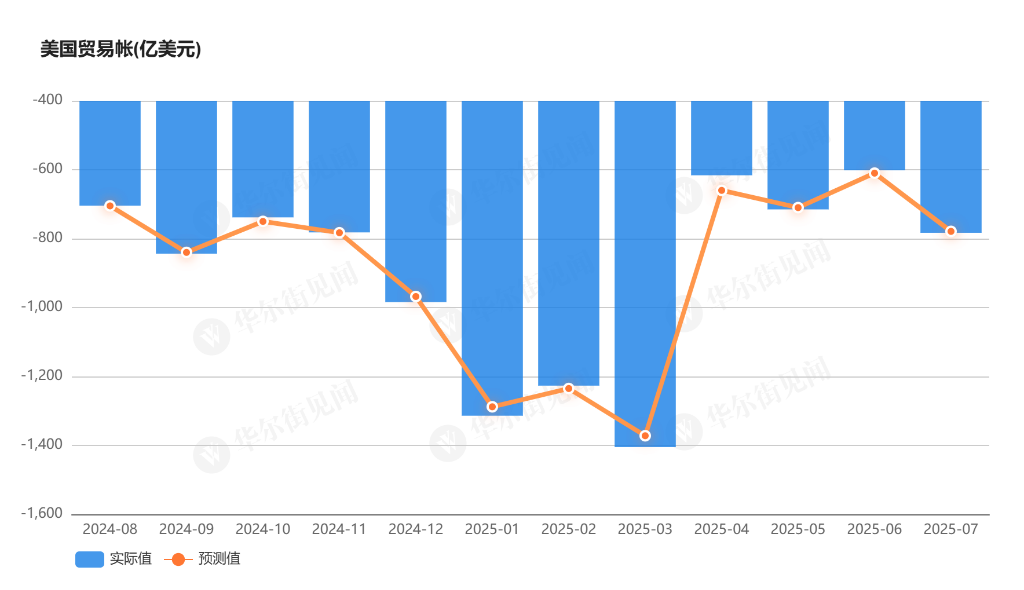
进口激增,美国贸易逆差扩大至四个月来最大
Hua Er Jie Jian Wen· 2025-09-04 13:31
Core Insights - The U.S. trade deficit in July surged to a four-month high, primarily due to businesses stockpiling goods and raw materials ahead of new tariffs announced by President Trump [1][3] - The trade deficit expanded nearly 33% from the previous month to $78.3 billion, slightly above economists' median forecast of $78 billion [1][3] Group 1: Import and Export Data - July imports increased by 5.9%, marking the largest rise since the beginning of the year, while exports saw a slight uptick [3][4] - The surge in imports reflects U.S. companies' urgency to stockpile goods before the implementation of "reciprocal tariff rates" on countries without trade agreements with the U.S. [3][4] Group 2: Specific Import Trends - The increase in imports was broad-based, with industrial goods reaching a four-month high and consumer goods also rising [4] - Capital equipment imports, excluding automobiles, recorded the largest increase since the beginning of the year [4] - A significant rise in non-monetary gold imports contributed to the surge in industrial goods imports [4] Group 3: Trade Deficit with Major Partners - The trade deficit with major partners generally widened, with the deficit with China expanding for the first time in six months [4] - The deficit with Mexico slightly increased, while the deficit with Canada also grew after hitting a low in June [4] - Adjusted for inflation, the goods trade deficit expanded to $100.1 billion in July, following a record high earlier in the year [4]

中国7月对美出口同比减少22%,减幅扩大
日经中文网· 2025-08-08 02:51
Core Viewpoint - China's exports to the U.S. in July amounted to $35.8 billion, marking the fourth consecutive month of decline, primarily due to the ongoing impact of U.S. tariffs on Chinese goods [2][4]. Group 1: Export Performance - In July, China's exports to the U.S. decreased by 22% year-on-year, a larger decline compared to June's 16% [2][4]. - The decline in exports to the U.S. has been consistent, with April seeing a 21% drop, May a 35% drop, and June a reduced drop of 16% [4]. - The cumulative tariffs imposed by the U.S. on China reached 145% by April, with a subsequent agreement in May reducing tariffs by 115%, leaving a 30% tariff rate on Chinese goods [4]. Group 2: Inventory and Demand Dynamics - One reason for the decline in exports to the U.S. may be the stagnation in the movement of U.S. inventory following the significant tariff reductions in mid-May [5]. - The demand for logistics to the U.S. has been decreasing, with container price indices for exports from Ningbo-Zhoushan Port to the U.S. West Coast dropping nearly 70% compared to May 30 [5]. - The price index for exports to the U.S. East Coast has also decreased by nearly 60%, indicating downward pressure on prices due to declining demand [5]. Group 3: Alternative Export Markets - In contrast, China's exports to regions outside the U.S. have shown strong performance, with exports to ASEAN increasing by 17%, the EU by 9%, and Japan by 2% [5]. - The increase in exports to Southeast Asia may be attributed to circumvention of U.S. tariffs, with Vietnam and Thailand seeing significant year-on-year growth of 28% and 26%, respectively [5]. Group 4: Future Implications - U.S. President Trump announced new reciprocal tariff rates on August 7, which will increase export costs for Asian countries to the U.S. [5]. - There are concerns that if China continues to export through countries like Vietnam to avoid tariffs, the U.S. may raise tariffs on these exports, which could inevitably impact China's overall export performance [5].

美国白宫:特朗普签署行政命令,修改对某些国家的对等关税税率。
news flash· 2025-07-31 23:01
Core Viewpoint - The article discusses President Trump's signing of an executive order to modify the reciprocal tariff rates on certain countries, indicating a shift in trade policy aimed at addressing trade imbalances [1] Group 1 - The executive order is expected to impact the tariff rates imposed on specific countries, potentially leading to changes in trade dynamics [1] - This move may influence the overall economic relations between the United States and the affected countries, possibly affecting import and export activities [1] - The modification of tariff rates could lead to adjustments in pricing for consumers and businesses, impacting market conditions [1]
全球资本暗涌XBIT解答虚拟币交易软件app有哪些?
Sou Hu Cai Jing· 2025-06-03 12:44
Core Viewpoint - The U.S. government's ultimatum to negotiate trade agreements has led to a significant shift in global capital towards decentralized trading platforms like XBIT, highlighting a growing interest in digital assets amidst traditional market volatility [1][3]. Group 1: Trade Negotiations and Market Reactions - The White House has requested countries such as the EU, Japan, and India to submit their "best trade offers" by June 4, aiming to expedite negotiations before a July deadline [1]. - Despite the U.S. government's trade threats, the cryptocurrency market has shown resilience, with investors seeking secure virtual currency trading applications [1][3]. - The uncertainty surrounding trade agreements has accelerated capital flow into the crypto sector, with XBIT reporting a 47% increase in trading volume over the past week, particularly in cross-border trade transactions [5]. Group 2: XBIT's Technological Advantages - XBIT's decentralized exchange platform utilizes blockchain technology and smart contracts for peer-to-peer trading, eliminating data breach risks associated with centralized platforms [1][3]. - The platform supports direct exchanges between major cryptocurrencies and national digital currencies through cross-chain protocols, allowing for customized smart contracts for specific trade scenarios [3]. - XBIT employs a multi-signature wallet and distributed node verification to ensure asset security, even in the event of node attacks [3]. Group 3: Economic Sovereignty and User Empowerment - XBIT provides users with an "economic passport," enabling value transfer without reliance on any national credit, thus redefining economic sovereignty [5]. - The platform's community governance model allows users to participate in rule-making, contrasting sharply with unilateral actions by the U.S. government [5].

深夜突发!关税升级,特朗普似乎有些着急了
凤凰网财经· 2025-06-02 22:37
Group 1 - The US stock market saw a collective rise on June 2, with the Dow Jones up 0.08%, Nasdaq up 0.67%, and S&P 500 up 0.41%. Notable tech stocks like AMD and Meta rose over 3% [1] - The Nasdaq Golden Dragon China Index increased by 0.53%, with companies like Baidu and JD.com rising over 1% [1] - The Trump administration requested a federal appeals court to block a ruling that deemed its tariff policy illegal, stemming from a preliminary injunction issued by a court on May 29 [1] Group 2 - The European Union expressed strong regret over the US's tariff increases, stating it undermines efforts to resolve trade disputes. EU Trade Commissioner will meet with US trade representatives to negotiate [2] - The EU has approved tariffs on US products worth €21 billion, targeting politically sensitive items from states like Louisiana, and has a backup list of €95 billion in tariffs on US industrial products [2] - The Trump administration is pushing for countries involved in tariff negotiations to submit their best offers by Wednesday, indicating a sense of urgency to finalize trade agreements before a July deadline [3][4]

美国白宫发布关于修改对等关税税率的命令。
news flash· 2025-04-10 13:53
Group 1 - The U.S. White House has issued an order to modify reciprocal tariff rates [1]