就业衰退

Search documents
每日机构分析:12月10日
Sou Hu Cai Jing· 2025-12-10 10:14
Group 1 - Moody's indicates that the U.S. labor market is approaching the edge of "employment recession," with a surge in layoffs among small businesses, stagnation in job vacancies, and rising unemployment rates among vulnerable groups, suggesting a potential broader employment contraction [1][3] - Standard & Poor's Global Ratings states that the most challenging phase for South Korean corporate credit may have passed, although overall credit conditions will remain under pressure until 2026, with clearer policy directions helping to reduce uncertainty [3] - Nomura Securities highlights market skepticism regarding the sustainability of the Bank of Japan's interest rate hikes, as negative real interest rates hinder the yen's strength, despite signals of a potential rate increase in December [1][2] Group 2 - Electus Financial notes that the yen is becoming a "vent" for market sentiment, affected by rising U.S. Treasury yields and concerns over Japan's fiscal and economic outlook, predicting continued yen weakness into the new year [1] - Neuberger Berman's Chief Investment Officer emphasizes that regardless of whether the Federal Reserve lowers rates this week, rates will eventually decline, reviving U.S. economic momentum and creating upward space for risk assets [3] - Deutsche Bank warns that the current pace of Fed rate cuts in a non-recession context is rare, which may support markets in the short term but could lead to economic overheating and inflation rebound, ultimately forcing the Fed to raise rates again [3]
穆迪首席经济学家警告:美国“就业衰退”的前奏已至
Jin Shi Shu Ju· 2025-12-10 09:23
Group 1 - The chief economist of Moody's, Mark Zandi, expresses concern that the U.S. labor market no longer has a buffer, with many Americans living on the financial edge, which could trigger a recession if spending is cut [2] - Job openings have only increased by a few hundred thousand since summer, remaining far below the pandemic peak, while layoffs have slightly increased and the quit rate has decreased, indicating workers are hesitant to leave their current jobs [2][3] - The ADP report indicates that private employers cut 32,000 jobs in November, the largest decline in over two years, primarily affecting small businesses, which eliminated 120,000 positions [3] Group 2 - Zandi notes that the increase in layoff announcements, totaling 1.1 million this year, is significant and reflects decisions made months before actual layoffs occur, suggesting that layoffs are imminent [4] - The unemployment rate for young workers and Black workers has risen, indicating early signs of labor market deterioration, particularly in industries heavily reliant on foreign-born labor [4] - High-income households continue to spend robustly despite rising borrowing costs, acting as a buffer against a slowdown, while middle- and low-income families face increasing pressure [5] Group 3 - The Federal Reserve is debating interest rate cuts, reflecting growing concerns that without support, the labor market could deteriorate more rapidly by early 2026 [6] - There is internal tension within the Federal Reserve, with some officials recognizing rising unemployment risks and advocating for further easing, while others believe the economy still has sufficient strength [6][7] - Zandi warns that the visible weaknesses in small business jobs, layoff announcements, and early demographic pressures could culminate in an impending wave of layoffs [7]
大规模裁员通知"激增",数据接连“报警”,美国就业市场急转直下
Hua Er Jie Jian Wen· 2025-11-12 06:00
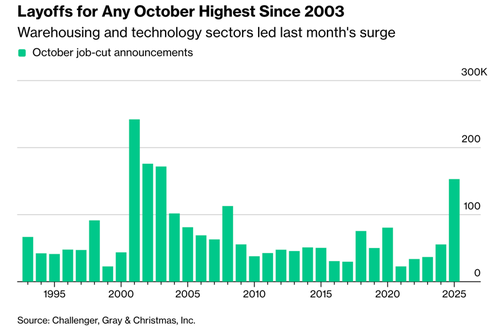
Group 1 - The U.S. labor market is experiencing a significant downturn, with private sector data indicating a potential employment recession is imminent [1][2] - In October, corporate layoffs surged to 153,000, marking the highest level for that month in over 20 years, according to Challenger, Gray & Christmas [1][3] - The WARN notices, which companies must submit before large layoffs, have reached a new high since 2016, excluding pandemic-related anomalies, signaling increased layoffs ahead [1][8] Group 2 - Alternative employment data from ADP and Revelio Labs show a rapid decline in job momentum, contrasting sharply with official statistics up to August [2][6] - ADP reported an average weekly loss of 11,250 jobs in the four weeks ending October 25, suggesting a potential loss of approximately 45,000 jobs in the latter half of October [6][8] - Revelio Labs indicated a decrease of 9,100 jobs in October, marking one of the worst monthly performances since 2025, driven mainly by reductions in government positions [6][8] Group 3 - Goldman Sachs' analysis indicates that the labor market is weakening, predicting a negative growth of 50,000 jobs in the official October non-farm payrolls [8][9] - The firm highlights structural issues, with rising WARN notices and layoffs exceeding pre-pandemic levels, suggesting an impending increase in initial unemployment claims [8][10] - The sentiment among companies regarding future hiring needs is increasingly pessimistic, as evidenced by a rising proportion of firms mentioning layoffs in earnings calls [8][9] Group 4 - The role of artificial intelligence in driving layoffs has become prominent, particularly since the release of ChatGPT in November 2022, affecting industries like technology, finance, and real estate [9][10] - Goldman Sachs predicts that the median and average unemployment rates may reach 4.5% in six months, reflecting a 0.2 percentage point increase from August [9][10] - The probability of a significant rise in unemployment (0.5 percentage points or more) has increased to 20-25%, up from 10% six months ago, indicating heightened recession risks [10] Group 5 - Major companies have announced substantial layoffs, including UPS cutting 48,000 jobs, Amazon reducing 14,000 positions, and General Motors laying off over 1,700 employees [11] - Other notable layoffs include Paramount with 2,000 jobs, and Ford planning to cut up to 1,000 jobs in Germany [11] - The trend of layoffs is widespread across various sectors, reflecting a broader economic adjustment in response to rising costs and changing market conditions [11]