
工业硅市场

Search documents
工业硅期货早报-20251229
Da Yue Qi Huo· 2025-12-29 03:24
1. Report Industry Investment Rating - Not provided in the content 2. Core Views of the Report - For industrial silicon, the supply side production schedule has decreased but remains at a high level, demand recovery is at a low level, and cost support has increased. It is expected to fluctuate in the range of 8780 - 8980 [4]. - For polysilicon, the short - term production schedule on the supply side has decreased and is expected to recover in the medium term. The demand side shows a continuous decline in production of silicon wafers, battery cells, and components. Overall demand is in a continuous recession, and cost support is stable. It is expected to fluctuate in the range of 57850 - 60060 [10]. - The main logic is capacity clearance, cost support, and demand increment. The main bullish factors are cost increase support and manufacturers' shutdown and production reduction plans, while the main bearish factors are the slow recovery of post - holiday demand and the strong supply and weak demand of downstream polysilicon [14][15]. 3. Summary by Relevant Catalogs 3.1 Daily Views Industrial Silicon - Supply: Last week, the supply of industrial silicon was 87,000 tons, a month - on - month decrease of 1.13% [4]. - Demand: Last week, the demand for industrial silicon was 77,000 tons, a month - on - month decrease of 4.93%, and demand remained sluggish [4]. - Inventory: Polysilicon inventory was 303,000 tons, at a high level; silicone inventory was 43,900 tons, at a low level; aluminum alloy ingot inventory was 71,000 tons, at a high level [4]. - Cost: In Xinjiang, the production loss of sample oxygen - passing 553 was 2,874 yuan/ton, and the cost support increased during the dry season [4]. - Basis: On December 26, the spot price of non - oxygen - passing silicon in East China was 9,200 yuan/ton, and the basis of the 05 contract was 320 yuan/ton, with the spot at a premium to the futures [4]. - Market: MA20 is downward, and the futures price of the 05 contract closed above MA20 [4]. - Main position: The main position is net short, and short positions increased [4]. Polysilicon - Supply: Last week, the polysilicon production was 25,300 tons, a month - on - month increase of 1.20%. The production schedule for December is predicted to be 113,500 tons, a month - on - month decrease of 0.95% compared to the previous month [8]. - Demand: Last week, the silicon wafer production was 10.33GW, a month - on - month decrease of 3.18%, and the inventory was 216,900 tons, a month - on - month increase of 0.88%. Currently, silicon wafer production is in a loss state. The production schedules of battery cells and components in December also show a downward trend [9]. - Cost: The average cost of N - type polysilicon in the industry is 38,600 yuan/ton, and the production profit is 12,400 yuan/ton [9]. - Basis: On December 26, the price of N - type dense material was 51,000 yuan/ton, and the basis of the 05 contract was - 6555 yuan/ton, with the spot at a discount to the futures [12]. - Inventory: The weekly inventory was 303,000 tons, a month - on - month increase of 3.41%, at a high level in the same period of history [12]. - Market: MA20 is upward, and the futures price of the 05 contract closed above MA20 [12]. - Main position: The main position is net short, and short positions increased [12]. 3.2 Market Overview Industrial Silicon - Futures closing prices of some contracts increased, with increases ranging from 0.40% - 1.02%. Some basis values decreased, and the registered warehouse receipt number increased by 1.81% [18]. - The weekly DMC production decreased by 6.10%, and the daily DMC price remained unchanged. The daily silicone oil price increased by 0.99% [18]. - The monthly DMC inventory decreased by 22.02%, and the monthly production of primary aluminum alloy ingots decreased by 8.66%, while the monthly production of recycled aluminum alloy ingots increased by 5.74% [18]. - The weekly social inventory of industrial silicon increased by 0.36%, and the weekly sample enterprise inventory increased by 1.61% [18]. Polysilicon - The prices of some polysilicon contracts decreased, with decreases ranging from 1.36% - 2.97%. The weekly silicon wafer production increased by 5.74%, and the weekly silicon wafer inventory decreased by 22.06% [20]. - The monthly production of photovoltaic cells decreased by 6.18%, and the monthly production of components decreased by 2.49% [20]. - The domestic inventory of components decreased by 51.73%, and the European inventory decreased by 6.50% [20]. 3.3 Other Aspects - **Price and Basis Trends**: The price trends of industrial silicon and polysilicon, as well as the basis trends of their main contracts, are presented through charts [22][25]. - **Inventory Trends**: The inventory trends of industrial silicon, including warehouse and port inventories, and sample enterprise inventories, are shown [28]. - **Production and Capacity Utilization Trends**: The production and capacity utilization trends of industrial silicon, including sample enterprise weekly production, monthly production by specification, and sample enterprise start - up rates, are presented [32]. - **Cost Trends**: The cost trends of industrial silicon in sample regions, including cost and profit trends in Sichuan, Yunnan, and Xinjiang, are shown [39]. - **Supply - Demand Balance Tables**: The weekly and monthly supply - demand balance tables of industrial silicon and the monthly supply - demand balance table of polysilicon are provided, showing supply, demand, import, export, and balance situations [41][70]. - **Downstream Trends**: The price, production, inventory, and supply - demand trends of industrial silicon's downstream industries, including silicone, aluminum alloy, and polysilicon, are presented in detail [47][57][67].
工业硅、多晶硅日评:市场信心较差工业硅价格持续下探,多晶硅低位整理-20250605
Hong Yuan Qi Huo· 2025-06-05 02:17
Report Summary 1. Industry Investment Rating No investment rating for the industry is provided in the report. 2. Core View - The silicon market shows a situation of weak supply and demand, with high inventory pressure in the industry. Both the futures and spot prices are declining in tandem. It is expected to maintain a weak trend in the short - term, and the bottom of silicon prices is difficult to determine. For industrial silicon, it is recommended to gradually take profit on previous short positions and wait for opportunities to short on rebounds. For polysilicon, it is advisable to short on rebounds due to the weak fundamentals and the difficulty of an upward trend in the short - term [1]. 3. Summary by Relevant Catalogs Industrial Silicon - **Price Changes**: The average price of industrial silicon non - oxygenated 553 (East China) decreased by 0.61% to 8,100 yuan/ton, and the 421 (East China) remained flat at 8,850 yuan/ton. The futures main contract closing price increased by 2.97% to 7,280 yuan/ton [1]. - **Supply Side**: Some silicon enterprises in the north reduced production due to cost inversion. In the southwest production area, although the wet season is approaching, there is a lack of confidence in the future market, with strong wait - and - see sentiment and insufficient willingness to resume production. The overall start - up rate decreased [1]. - **Demand Side**: Polysilicon enterprises maintained a production - reduction state, and the resumption of production might be postponed. The organic silicon industry had a strong willingness to reduce production to support prices, but demand was weak. The silicon - aluminum alloy enterprises purchased as needed, and the downstream had insufficient willingness to stock up at low levels [1]. - **Investment Strategy**: It is recommended to gradually take profit on previous short positions and wait for opportunities to short on rebounds, and continuously monitor the production dynamics of silicon enterprises [1]. Polysilicon - **Price Changes**: The price of N - type polysilicon materials remained flat at 35.5 yuan/kg, and the futures main contract closing price increased by 2.02% to 35,055 yuan/ton [1]. - **Supply Side**: Polysilicon enterprises maintained a production - reduction state, and some plants might have new production capacity put into operation. The output was expected to be within 100,000 tons [1]. - **Demand Side**: The photovoltaic market was weak, with rising inventories of silicon wafers and polysilicon, continuous decline in the prices of silicon wafers, battery cells, and components, and weak market transactions [1]. - **Investment Strategy**: The strategy is to short on rebounds, and continuously monitor changes in the supply side [1]. Other Information - A monomer enterprise in North China started a 15 - day maintenance, which was expected to affect the DMC output by about 4,000 tons [1]. - Bangjie Co., Ltd. decided to continue the suspension of its battery cell production line to avoid expanding losses [1]. - In May, the non - manufacturing business activity index was 50.3%, with the construction industry at 51.0% and the service industry at 50.2%. Some industries were in a high - prosperity range, while others were below the critical point [1].
【工业硅】继续松动下行,究竟何时能够迎来“光明”??
Sou Hu Cai Jing· 2025-05-27 12:52
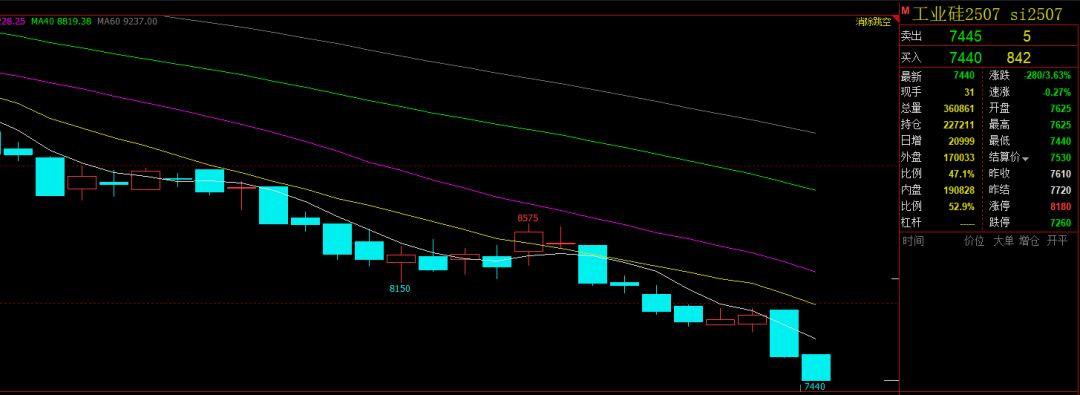
Core Viewpoint - The industrial silicon market is experiencing a downward trend characterized by weak futures prices, negative sentiment among industry participants, and a lack of effective support for prices [1][4][9]. Futures Market - Industrial silicon futures continue to perform poorly, with prices hitting a new low since listing. On May 27, the main contract 2507 closed at 7440, down 3.63% from the previous day, with a trading volume of 360,878 contracts and an open interest of 568,774 contracts [2]. Spot Market - The spot market for industrial silicon is also under pressure, with prices declining due to low-priced goods entering the market and reduced cost support from falling raw material prices. The overall sentiment remains pessimistic, with many participants lacking confidence in a market recovery [4]. Demand Side - The demand for downstream products such as polysilicon and organic silicon remains stable, with little change in market pricing [6]. Comprehensive Analysis - The industrial silicon market is currently in a downward cycle driven by "cost collapse, oversupply, and emotional breakdown," making it difficult to find effective support for prices. There is a risk of further price declines, although some companies may consider reducing production if losses continue to grow. Additionally, extremely low prices could attract traders looking to stockpile, but this depends on market entry willingness [9].

工业硅多晶硅市场周报:双硅需求难有起色,库存依旧压制价格-20250523
Rui Da Qi Huo· 2025-05-23 09:42
Report Industry Investment Rating No relevant content provided. Core Viewpoints of the Report - This week, industrial silicon prices fell by 2.82%, mainly due to cost reduction during the wet season and weak downstream demand. The basis weakened, and it is expected that price will be supported after inventory decline. Polysilicon prices rose by 0.32%, with a small increase at the end of Friday due to rumors and news, but its fundamentals remain poor [5]. - Looking ahead, for industrial silicon, supply has a cost advantage during the wet season, but the willingness to resume production in the southwest is low. Downstream demand in organic silicon, polysilicon, and aluminum alloy sectors is weak, and overall demand is declining. The large number of industrial silicon warehouse receipts still exerts pressure on the market. For polysilicon, supply is operating at a reduced load, demand is weak, and high inventory suppresses prices [5]. - Operationally, it is recommended that the main contract of industrial silicon fluctuate within the range of 7,500 - 9,000, with a stop - loss range of 7,300 - 9,200. The main contract of polysilicon should fluctuate in the short - term within the range of 33,000 - 39,000, with a stop - loss range of 34,000 - 42,000 [5]. Summary by Directory 1. Weekly Key Points Summary - **Market Review**: Industrial silicon prices fell by 2.82% this week, with cost reduction during the wet season and weak downstream demand. Polysilicon prices rose by 0.32%, with a small increase at the end of Friday due to rumors and news [5]. - **Market Outlook**: For industrial silicon, supply has a cost advantage during the wet season, but the willingness to resume production in the southwest is low. Downstream demand is weak, and overall demand is declining. The large number of warehouse receipts exerts pressure on the market. For polysilicon, supply is operating at a reduced load, demand is weak, and high inventory suppresses prices [5]. - **Operation Suggestion**: The main contract of industrial silicon should fluctuate within 7,500 - 9,000, with a stop - loss range of 7,300 - 9,200. The main contract of polysilicon should fluctuate in the short - term within 33,000 - 39,000, with a stop - loss range of 34,000 - 42,000 [5]. 2. Spot and Futures Market - **Industrial Silicon**: This week, industrial silicon futures and spot prices fell, and the basis weakened. As of May 23, 2025, the spot price was 8,650 yuan/ton, a decrease of 350 yuan/ton from last week, and the basis was 735 yuan/ton. The operating rate remained stable, and production increased slightly but was still at a low level. As of May 23, 2025, the overall operating rate was 17.81%, and production was 72,500 tons, an increase of 400 tons from last week [11][13][22]. - **Polysilicon**: This week, polysilicon futures prices fell significantly, and the basis weakened. As of May 23, 2025, the spot price was 33.5 yuan/kg, a decrease of 1.5 yuan/kg from last week, and the basis was - 3,510 yuan/g [15][19]. 3. Industry Situation - **Industrial Silicon Raw Materials**: This week, industrial silicon raw material prices fell, and the market price has fallen below the production cost of most manufacturers. Southwest regions have no intention to resume production due to losses [25]. - **Industrial Silicon Inventory**: As of May 23, 2025, the number of industrial silicon warehouse receipts was 65,298 lots, a decrease of 1,233 lots from last week. As of May 16, 2025, the total social inventory of metallic silicon was 599,000 tons, an increase of 3,000 tons [32]. - **Downstream Organic Silicon**: Production and operating rate continued to decline, and prices were low. As of May 23, 2025, weekly production was 39,000 tons, a decrease of 200 tons, and the weekly operating rate was 59.31%, a decrease of 0.26%. Spot costs and profits remained flat, and production cuts to support prices had initial results [35][40][46]. - **Downstream Aluminum Alloy**: Spot prices remained flat, inventory increased, and passive de - stocking continued, making it difficult to drive industrial silicon demand. As of May 23, 2025, the aluminum alloy price was 20,500 yuan/ton, unchanged from last week. As of May 16, 2025, the aluminum alloy ingot inventory was 15,700 tons, an increase of 1,800 tons [48][53]. - **Silicon Wafer and Battery Cell**: Silicon wafer prices fell, battery cell prices remained low and flat. After the end of the rush - installation period, polysilicon demand was dragged down. As of May 23, 2025, the silicon wafer price was 1.12 yuan/piece, unchanged from last week, and the battery cell price was 0.27 yuan/watt, unchanged from last week [55][60]. - **Polysilicon Production Cost and Output**: This week, the cost of trichlorosilane (photovoltaic grade) for polysilicon production remained flat, and industrial silicon prices fell, resulting in a weakening of production costs. In April 2025, the polysilicon production volume was 98,800 tons [62][67].