市场杠杆率

Search documents
利率市场周度回顾:节后曲线整体走阔,关注两会前后市场博弈情况-20260303
East Money Securities· 2026-03-03 06:07
1. Report Industry Investment Rating No information provided in the text about the report industry investment rating. 2. Core Viewpoints of the Report - After the holiday, the overall yield curve widened. The 10Y Treasury bond active bond 250016 yield increased by 1.05BP to 1.7880% compared with the previous week [2]. - The post - holiday capital market was generally stable and broad, with minor cross - month disturbances and a slight rebound in the market leverage ratio. The central bank continuously net - withdrew liquidity in the open market, and the central level of capital interest rates slightly increased from the pre - holiday low [4]. - In terms of primary bond supply, the net financing volume of interest - rate bonds increased significantly this week, but certificates of deposit continued to be in a net repayment state [4]. - In the secondary market, affected by institutional profit - taking after the holiday and the introduction of the Shanghai real - estate policy, the bond market performed weakly this week [4]. - Next week's key points in the bond market include the release of February PMI data, the Fourth Session of the 14th National People's Congress, and the maturity of 1 trillion yuan of 91 - day reverse repurchases [4]. 3. Summary According to the Directory 3.1. Money Market 3.1.1. Open - market Liquidity Injection - This week (2026.02.24 - 2026.02.28), the central bank's open - market operations had a net liquidity withdrawal of 46.14 billion yuan. As of February 28, 2026, the balance of 7 - day reverse repurchases was 164.1 billion yuan, an increase of 78.86 billion yuan compared with the pre - holiday week [11]. - The injection included 164.1 billion yuan in reverse repurchases and 60 billion yuan in medium - term lending facilities; the withdrawal included 225.24 billion yuan in reverse repurchase maturities, 15 billion yuan in treasury cash fixed - deposit maturities, and 30 billion yuan in medium - term lending facility maturities [15]. 3.1.2. Capital Market Operation - After the holiday, the capital market smoothly crossed the month, being generally stable and broad. As of February 28, 2026, DR007 was 1.50%, up 18.23BP compared with the pre - holiday week, and R007 was 1.51%, up 16.27BP [24]. - After the holiday, the trading activity of institutions recovered, and the trading volume of inter - bank pledged repurchase increased significantly. As of February 28, 2026, the trading volume of inter - bank pledged repurchase (5DMA) was 6.71 trillion yuan, an increase of 0.57 trillion yuan compared with the previous week [24]. 3.2. Cash Bond Market 3.2.1. Primary Supply - The total net supply of interest - rate bonds this week was 36.443 billion yuan, an increase of 54.7814 billion yuan compared with the previous week. The cumulative net supply of interest - rate bonds this year was 262.1148 billion yuan, with 82.886 billion yuan for treasury bonds, 1.298 billion yuan for policy - financial bonds, and 177.9308 billion yuan for local bonds [36]. - The net supply of certificates of deposit this week was - 16.347 billion yuan, a decrease of - 11.67 billion yuan compared with the previous week. The net supply of treasury bonds was 37 billion yuan, an increase of 37 billion yuan; the net supply of policy - financial bonds was - 19.214 billion yuan, a decrease of 3.014 billion yuan; the net supply of local bonds was 18.657 billion yuan, an increase of 20.7954 billion yuan [36]. - The net financing of state - owned banks was - 17.18 billion yuan, a decrease of 12.579 billion yuan; the net financing of joint - stock banks was 0.833 billion yuan, an increase of 0.909 billion yuan [37]. 3.2.2. Secondary Market Operation - The performance of cash bonds was divergent, with only the 10Y Treasury bond and 7Y China Development Bank bond showing a slight decline [47]. - **Absolute Level**: The yield curve of Treasury bonds showed a divergent trend, with the 10Y Treasury bond performing better [49]. - **Term Spread**: Most term spreads widened this week, while the 10Y/1Y Treasury bond spread slightly narrowed [55]. - **Variety Spread**: The 1Y and 10Y China Development Bank bond/Treasury bond spreads widened, while the 30Y local bond/Treasury bond spread and 1Y certificate of deposit/China Development Bank bond spread narrowed [65][68]. - **Overseas Spread**: The 10Y and 1Y China - US spreads narrowed [71]. 3.3. Next Week's Bond Market Events - On Wednesday, February PMI data will be released, which can be used to assess the current fundamental recovery [75]. - On Thursday, the Fourth Session of the 14th National People's Congress will be held, and attention should be paid to the setting of various economic targets for the new year [75]. - On Friday, 1 trillion yuan of 91 - day reverse repurchases will mature, and attention should be paid to the central bank's liquidity hedging operations [75].
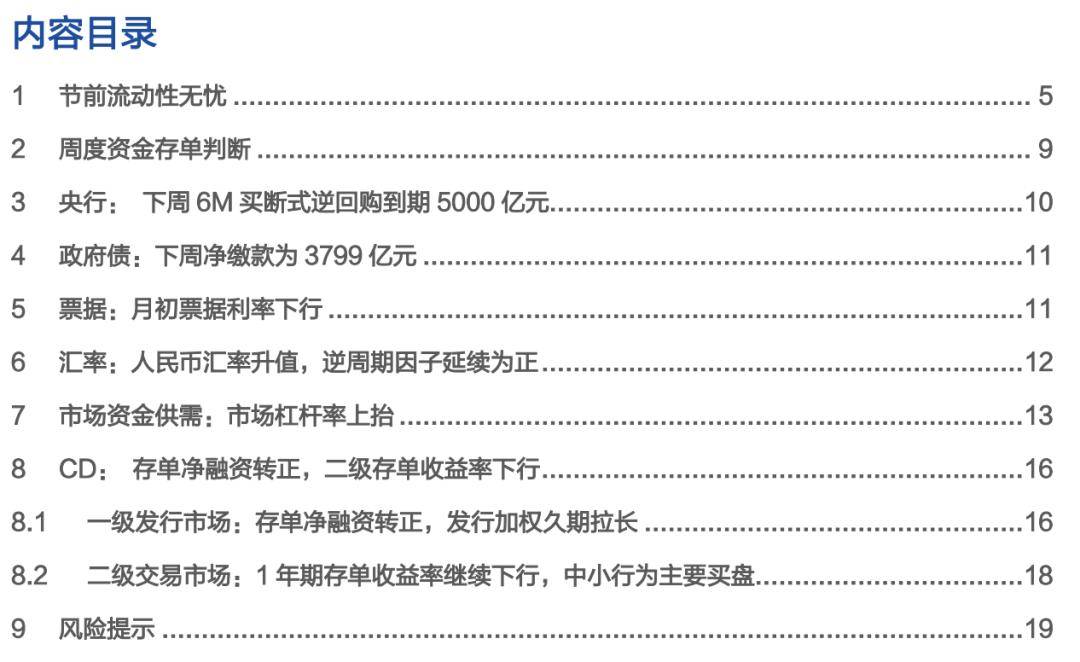
财通证券:节前流动性无忧
Sou Hu Cai Jing· 2026-02-08 05:51
Group 1 - The core viewpoint of the article indicates that the funding pressure in the upcoming week is expected to be manageable, with a focus on the central bank's operations, particularly the 6-month buyout reverse repos [1][3][21] - The central bank has shown a clear intention to support the funding environment around the New Year and specific time points, which is beneficial for the stability of the funding market [2][12][13] - Recent trends show that large banks have continued to increase net financing, suggesting that while credit may weaken, the pressure from deposit outflows is not significant [2][15][18] Group 2 - The upcoming week will see a decrease in the maturity of reverse repos, with a total of 4,055 billion yuan in 7-day reverse repos and 5,000 billion yuan in 6-month buyout reverse repos maturing, indicating reduced funding disturbances [5][26][32] - Government bond net payment pressure is slightly decreasing, which may further reduce funding disturbances, while the recent positive net financing of certificates of deposit (CDs) is noteworthy [5][27][35] - The market is expected to see a total of 9,473.5 billion yuan in CDs maturing, with a significant concentration in the 12-month and 6-month maturities [5][61][58] Group 3 - The article highlights that the yield on one-year AAA CDs has decreased to 1.585%, with demand primarily coming from small and medium-sized banks, while non-bank buying power has diminished [4][23][80] - The overall market liquidity remains stable, with the central bank's actions contributing to a neutral and slightly loose funding environment [6][56][44] - The article notes that the issuance of long-term government bonds may limit the buying enthusiasm from non-bank entities, but the continued loose funding environment suggests that there is no significant adjustment pressure on CDs [4][23][24]


16万亿美元全球国债回购市场暴露系统性脆弱性 FSB发出预警 英美出台监管方案
Sou Hu Cai Jing· 2026-02-06 04:51
Core Viewpoint - The Financial Stability Board (FSB) has issued a warning regarding systemic vulnerabilities in the $16 trillion government bond repurchase agreement market, highlighting the need for global regulatory cooperation to address rising hedge fund leverage and increased reliance on short-term financing [1][2]. Group 1: Market Overview - The government bond repurchase agreement market, crucial for global bond market liquidity, allows market participants to borrow short-term against sovereign debt as collateral [1]. - As of the end of 2024, the global outstanding government bond repurchase agreement market is projected to reach $16 trillion, representing a 20% increase from 2022 [1]. - The United States accounts for nearly 60% of the transaction volume in this market, followed by the UK, Eurozone, and Japan [1]. Group 2: Systemic Vulnerabilities - The FSB report identifies several vulnerabilities in the global government bond repurchase market, including rising market leverage, potential imbalances in supply and demand, and high concentration among borrowers, lenders, and intermediaries [1]. - Historical events, such as the spike in U.S. repo rates in September 2019 and the UK liability-driven investment fund crisis in September 2022, underscore the market's fragility and its susceptibility to disruptions [1]. Group 3: Regional Market Data - In December of the previous year, the Bank of England reported that hedge fund leverage in the UK gilt repo market reached a historical high of nearly £100 billion (approximately $132 billion), primarily driven by U.S.-managed funds [2]. - The Bank of England warned that a sudden drying up of such short-term financing could force hedge funds to sell UK government bonds en masse, potentially triggering a market chain reaction [2]. Group 4: Regulatory Responses - The Bank of England has proposed specific plans to enhance regulation of the UK government bond repurchase market by September 2025 [2]. - The U.S. Securities and Exchange Commission has implemented mandatory requirements for centralized clearing of most U.S. government bond repurchase and cash transactions by mid-2027 to mitigate counterparty risk and maintain market stability [2].
早盘直击|今日行情关注
申万宏源证券上海北京西路营业部· 2026-01-15 02:48
Core Viewpoint - The market has experienced a significant rise, particularly after the New Year, with trading volume and financing balance reaching historical highs, indicating potential bubble signs in certain sectors and stocks [1] Group 1: Market Policy and Impact - The Shanghai and Shenzhen stock exchanges announced an increase in the financing transaction margin ratio from 80% to 100%, which aims to reduce market leverage and mitigate potential risks [1] - This policy serves as a signal from management to guide rational and stable investment, avoiding blind chasing of high prices and high-leverage operations [1] Group 2: Market Performance and Trends - Following the announcement, the market experienced a volatile correction, stabilizing after a rapid rise, with trading volume continuing to increase and potentially marking a peak volume for the current phase [1] - The internet services and software development sectors showed strong performance, while energy metals and major financial sectors like banking and insurance faced declines, suggesting limited short-term switching between high and low-performing sectors [1] Group 3: Future Market Outlook - The short-term market is expected to remain strong with fluctuations, but the adjustment range is likely to be limited and of short duration, maintaining an upward trend in the medium term [1] - The likelihood of a reversal trend following the recent high and subsequent pullback is low, with the spring market expected to continue [1]

融资保证金不能低于100%了?深交所新规背后藏着什么信号!
Sou Hu Cai Jing· 2026-01-14 16:43
Core Viewpoint - The recent adjustment in the Shanghai Composite Index and the announcement from the Shenzhen Stock Exchange to raise the margin requirement for financing transactions to a minimum of 100% indicates a significant regulatory shift aimed at stabilizing the market and reducing leverage risks [1][3][4]. Group 1: Regulatory Changes - The new regulation requires investors to provide at least an equal amount of cash or securities as collateral for financing transactions, effectively raising the entry barrier for leveraged trading [3][4]. - This change is perceived as a measure to lower the overall market leverage, which has been a contributing factor to market volatility in recent years [3][4][7]. Group 2: Market Impact - In the short term, the new margin requirement may suppress active capital flow, leading to potential downward pressure on the index [4][8]. - Over the long term, a healthier leverage level and reduced speculative atmosphere could stabilize the market foundation, akin to reinforcing a building's foundation [4][10]. Group 3: Investment Strategy - Investors are encouraged to reassess their investment habits, moving from speculative trading to value discovery, as reliance on financing to amplify positions will become more challenging and costly [6][7]. - The focus should shift towards understanding the core competitiveness, management quality, and industry position of companies, as these factors will determine long-term value [7][8]. Group 4: Market Sentiment - The timing of the new regulation amidst significant market fluctuations has heightened uncertainty, leading to emotional responses among investors [3][4]. - The adjustment serves as a strong signal for investors to maintain patience and focus on long-term strategies rather than short-term gains [8][10].

这轮行情能否延续?关键看这4个信号!
大胡子说房· 2025-10-14 11:58
Core Viewpoint - The article discusses the current volatility in the A-share market, particularly after the index reached 3800 points, indicating uncertainty in market trends and the need for investors to assess various indicators to determine the sustainability of the bull market [2][3][6]. Group 1: Market Indicators - The first indicator to assess is the market leverage ratio, specifically the ratio of margin financing to market capitalization, which currently stands at approximately 6.8%, slightly up from 6.5% at the end of July but still below the 7%-9.8% range seen during the 2015 bull market [12][13]. - The second leverage indicator is the proportion of trading volume from margin financing, which is currently around 12%. Historical data suggests that if this ratio exceeds 12%-13%, regulatory measures may be implemented to cool down the market [17][18]. Group 2: Trading Volume - A significant trading volume exceeding 2 trillion yuan is a crucial indicator for sustaining a bull market. Recently, the A-share market has seen trading volumes surpassing this threshold for five consecutive days, suggesting potential for continued market momentum [20][21]. - The margin financing balance has reached 2.17 trillion yuan, nearing the peak of 2.27 trillion yuan observed in 2015, indicating a strong presence of leveraged funds in the market [23]. Group 3: Fundraising and New Accounts - The scale of newly issued public funds is another critical indicator. Currently, the average weekly fundraising for public funds is 11 billion yuan, which is significantly lower than the peak seen during the 2021 bull market, indicating that retail investor enthusiasm is not yet at a high level [24][26]. - The number of new trading accounts opened is also a vital metric. In July, 1.96 million new accounts were opened, which is considerably lower than the peaks of previous bull markets, suggesting that the current market is still in its early stages [33][34]. Group 4: Market Stage Assessment - Based on the four indicators discussed, the A-share market is still in the initial phase of the bull market, with no signs of entering the acceleration or terminal phases yet. This suggests that investors can hold their positions but should be cautious about entering the market at current levels [37][39].

行情能否持续?关键看这几个信号!
大胡子说房· 2025-10-11 05:38
Core Viewpoint - The article discusses the current volatility in the A-share market, particularly after the index reached 3800 points, indicating uncertainty in market trends and the need for investors to assess various indicators to determine the sustainability of the bull market [2][3][4]. Group 1: Market Indicators - The first indicator to monitor is the market leverage ratio, specifically the ratio of margin financing to market capitalization, which currently stands at 6.8%, slightly up from 6.5% at the end of July but still below the 7%-9.8% range seen during the 2015 bull market [12][13]. A breach of 7.5% could signal potential market risks [14]. - The second indicator is the proportion of trading volume from margin financing, which is currently about 12%. Historical data suggests that if this ratio exceeds 12%-13%, regulatory measures may be implemented to cool down the market [17][18]. Group 2: Trading Volume and Fundraising - The third indicator is the overall trading volume, with a threshold of 20 trillion yuan typically indicating the potential for a sustained bull market. Recently, the A-share market has seen trading volumes exceed this level for five consecutive days, suggesting a possibility for continued upward momentum [20][21]. - Additionally, the balance of margin financing has reached 2.17 trillion yuan, nearing the peak of 2.27 trillion yuan from 2015, indicating significant market activity [23]. Group 3: Fundraising and New Accounts - The fourth indicator is the scale of newly issued public funds. Currently, the average weekly fundraising for public funds is 11 billion yuan, which is not as high as during the previous bull market in 2022, indicating that retail investor enthusiasm is still relatively low [24][26]. - The number of new accounts opened is also a critical metric. In July, 1.96 million new accounts were opened, significantly lower than the peak of 6.8 million in October of the previous year and the average of 3.6 million during the 2015 bull market [33][34]. This suggests that the current bull market is still in its early stages [37]. Group 4: Investment Strategy - Based on the analysis of these indicators, the current bull market is still in the initial phase, and investors should be cautious about entering the market at this stage, especially around the 3800-3900 point range [39][42]. - Investors who have already entered the market should hold their positions, while those who have not should wait for more favorable conditions before investing [46][48].

这轮大A行情能否持续?关键看这几个信号!
大胡子说房· 2025-09-20 05:49
Core Viewpoint - The article discusses the current volatility in the A-share market, particularly after the index reached 3800 points, indicating uncertainty in market trends and the need for investors to assess various indicators to determine the sustainability of the bull market [2][3][4]. Group 1: Market Indicators - The first indicator to assess is the market leverage ratio, specifically the ratio of margin financing to market capitalization, which currently stands at 6.8%, slightly up from 6.5% in late July but still below the 7%-9.8% range seen during the 2015 bull market. A breach of 7.5% could signal potential risks [12][13][14]. - The second indicator is the proportion of trading volume from margin financing, which is currently at 12%. Historical data suggests that if this ratio exceeds 12%-13%, regulatory measures may be implemented to cool down the market [17][18]. - The third indicator is market trading volume, with a sustained volume above 2 trillion yuan typically supporting a bull market. Recently, the A-share market has seen trading volumes exceed this threshold for five consecutive days, indicating potential for continued upward movement [20][21]. - The fourth indicator is the scale of newly issued public funds. Currently, the average weekly fundraising for public funds is 11 billion yuan, which is significantly lower than the peak seen in 2022, suggesting that retail investor enthusiasm is not yet at a high level [24][26]. Group 2: New Investor Activity - The fifth indicator is the number of new brokerage accounts opened, which serves as a gauge for retail investor participation. In July, 1.96 million new accounts were opened, significantly lower than the peak of 6.8 million in October of the previous year, indicating that the current bull market is still in its early stages [33][34]. - The analysis concludes that as of late August or early September, the A-share market is still in the initial phase of the bull market, with no signs of entering the acceleration or terminal phases yet [37]. Group 3: Investment Strategy - The article suggests that investors, particularly retail investors, should consider holding onto their stocks while being cautious about entering the market at current levels, especially around the 3800-3900 point range, due to the risk of potential downturns [39][42]. - It emphasizes that this bull market is characterized by structural trends where stronger stocks outperform, and investors should be selective to avoid long-term losses [43][44]. Group 4: Educational Offerings - The article promotes a live course designed to help investors understand market dynamics and identify investment opportunities, offering insights into capital market trends and asset allocation strategies [50][56].

这轮大A行情能否新高?关键看这几个信号!
大胡子说房· 2025-09-13 04:48
Core Viewpoint - The article discusses the current volatility in the A-share market, particularly after the index reached 3800 points, indicating uncertainty in market trends and the need for investors to assess various indicators to gauge the sustainability of the bull market [2][3][4][6]. Group 1: Market Indicators - The first indicator to assess is the market leverage ratio, specifically the ratio of margin financing to market capitalization, which currently stands at approximately 6.8%, slightly up from 6.5% at the end of July but still below the 7%-9.8% range seen during the 2015 bull market [12][13]. - The second leverage indicator is the proportion of trading volume from margin financing, which is currently around 12%. Historical data suggests that if this ratio exceeds 12%-13%, regulatory measures may be implemented to cool down the market [17][18]. - The second key indicator is market trading volume, with a sustained volume above 2 trillion yuan typically supporting a bull market. Recently, the A-share market has seen trading volumes exceed this threshold for five consecutive days [20][21]. Group 2: Fundraising and New Accounts - The third indicator is the scale of newly issued public funds. Currently, the average weekly fundraising for public funds is 11 billion yuan, which is significantly lower than the peak seen during the 2021 bull market, indicating that retail investor enthusiasm is not yet at a high level [24][26]. - The fourth indicator is the number of new brokerage accounts opened. In July, 1.96 million new accounts were opened, which is considerably lower than the peak of 6.8 million in October last year and the average of 3.6 million during the 2015 bull market [33][34]. Group 3: Market Stage Assessment - Based on the four indicators, the current bull market is still in its initial stage, with no signs of entering the acceleration phase or nearing the end phase. This suggests that investors can hold onto their stocks for now [36][37]. - The article advises caution for new investors considering entering the market at the current index levels, as significant downturns could lead to substantial losses [42][43].

这轮行情能否延续?关键看这4个信号!
大胡子说房· 2025-09-11 12:07
Core Viewpoint - The article discusses the current volatility in the A-share market, particularly after the index reached 3800 points, indicating uncertainty in market trends and the need for investors to assess various indicators to gauge the sustainability of the bull market [3][4][6]. Group 1: Market Indicators - The first indicator to assess is the market leverage ratio, specifically the ratio of margin financing to market capitalization, which currently stands at approximately 6.8%, up from 6.5% at the end of July but still below the 7%-9.8% range seen during the 2015 bull market [12][13]. - The second indicator is the proportion of trading volume from margin financing, which is currently about 12%. Historical data suggests that if this ratio exceeds 12%-13%, regulatory measures may be implemented to cool down the market [17][18]. Group 2: Trading Volume - A significant trading volume exceeding 2 trillion yuan is a crucial indicator for sustaining a bull market. Recently, the A-share market has seen trading volumes surpassing this threshold for five consecutive days, suggesting potential for continued market momentum [20][21]. - The margin financing balance has reached 2.17 trillion yuan, nearing the peak of 2.27 trillion yuan observed in 2015, indicating a strong presence of leveraged funds in the market [23]. Group 3: Fundraising and New Accounts - The scale of newly issued public funds is another important indicator. In the first three weeks of August, public funds raised an average of 11 billion yuan weekly, which is significantly lower than the fundraising levels during the 2021 bull market, indicating that retail investor enthusiasm is not yet at a peak [24][26]. - The number of new brokerage accounts opened is also a key metric. In July, 1.96 million new accounts were opened, which is considerably lower than the peaks seen in previous bull markets, suggesting that the current market is still in its early stages [33][34]. Group 4: Market Stage Assessment - Based on the four indicators discussed, the current A-share market is still in the initial phase of the bull market, with no signs of entering the acceleration or terminal phases yet [37]. - Investors are advised to hold onto their stocks while being cautious about entering the market at this stage, especially given the potential for significant market corrections [39][42].