市场清算

Search documents
过去一周是一场清算,全球市场开始正视“伊朗战争不会很快结束”
华尔街见闻· 2026-03-21 10:05
Core Viewpoint - The article discusses the significant market turmoil following the outbreak of the Iran conflict, highlighting a shift in investor sentiment from expecting a quick resolution to recognizing the potential for a prolonged and damaging war, which has led to a reassessment of monetary policy expectations and market dynamics [2][3][21]. Market Impact - Global bond markets experienced severe declines, with the U.S. 10-year Treasury yield rising by 13.4 basis points in a single day and over 10 basis points for the week, while the 5-year yield surpassed 4% for the first time since July [5]. - European bond markets also faced pressure, with the UK 10-year yield increasing by 17.7 basis points, reaching 5% for the first time since 2008, and Germany's 10-year yield hitting a new high of 3.043% [6]. - Gold prices saw a dramatic drop, with spot gold falling over 10% and COMEX gold futures declining more than 11%, marking the largest weekly drop since March 1983 [7][8]. Investor Sentiment - Analysts indicate that the current market conditions reflect a fundamental shift in pricing logic, with investors now facing a sustained threat rather than a temporary price shock [3][4]. - The market's perception of the Federal Reserve's policy path has drastically changed, with a 50% probability of rate hikes by 2026 being priced in, contrasting with previous expectations of rate cuts [16][18]. Economic Outlook - The ongoing conflict is expected to increase recession risks, as the energy shock is deemed unprecedented, with no straightforward fiscal or monetary policy solutions available [13]. - The European Central Bank is also in a challenging position, facing inflation driven by energy costs while needing to support growth through potential easing measures [19]. Defensive Strategies - Institutional adjustments are underway, with firms like Societe Generale reducing global equity allocations and increasing commodity exposure, while BCA Research recommends raising cash positions and lowering stock allocations [24]. - Historical patterns suggest that U.S. equities typically bottom out around the 15th trading day following geopolitical shocks, with the S&P 500 currently down approximately 5.5% since the conflict began, indicating it may still be in a vulnerable position [25][26].

BTC, ETH, XRP, SOL Face Slow Bottoming Process After $16B Liquidation Shock
Yahoo Finance· 2025-10-11 06:57
Market Overview - The crypto market faced its largest liquidation event, resulting in leveraged bullish bets worth $16 billion being forced out across major cryptocurrencies like bitcoin, ether, and several altcoins, with some altcoins crashing between 20% to 40% [1] Recovery Process - The recovery following such a crash is expected to be gradual, testing the patience of bullish investors, as indicated by industry experts [2] - The initial phase involves the market "bleeding out," with liquidation orders flooding exchanges and pushing prices lower, leading to significant drops in altcoin values [2] - Market makers typically step back to manage risk during this phase, focusing on addressing price mismatches between spot and futures markets through arbitrage plays, which delays an immediate rebound [3] Data Stabilization - After a market crash, there is a phase where data feeds stabilize, allowing traders and market makers to rely on reliable information channels again, which may have experienced delays or outages during the crash [4] Absorption Phase - Once data feeds stabilize, market makers and large traders begin to absorb major sell orders to restore market equilibrium, capitalizing on liquidation orders that receive priority in order books [5] - Given the scale of forced liquidations, this absorption phase can take several days [5] Market Stabilization - The stabilization stage involves dealers and market makers closing out their long positions acquired at bargain prices while absorbing liquidation orders, aiming to profit from a potential market rebound [6] - As the market reaches equilibrium, dealers will start unwinding their positions, leading to a local maxima in prices for certain assets with tighter supply [6]
美国轰炸伊朗冲击加密市场!以太坊一度跌7%,比特币坚挺
Hua Er Jie Jian Wen· 2025-06-22 07:44
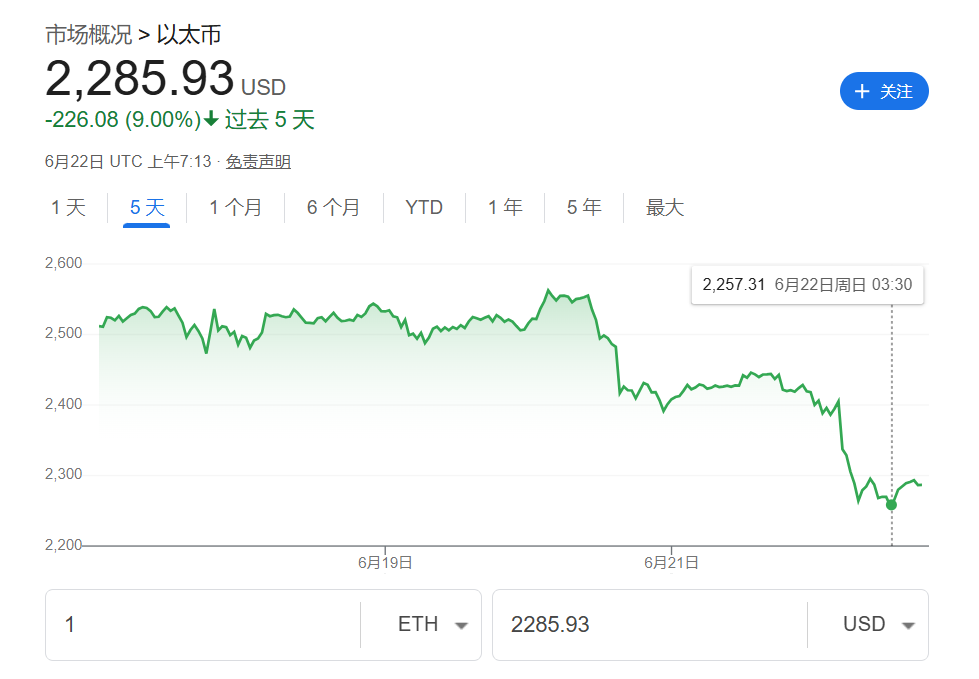
Core Viewpoint - The cryptocurrency market experienced a brief sell-off over the weekend, driven by rising geopolitical tensions, particularly following U.S. airstrikes on Iranian nuclear facilities, leading to increased investor risk aversion [1][9]. Group 1: Market Performance - Ethereum (ETH) saw the most significant decline, dropping to around $2,200, marking its lowest intraday level since May 9 of the previous year, with a peak drop of 7.7% during the Asian trading session [2]. - Bitcoin (BTC) briefly fell below $101,000 but showed relative stability compared to Ethereum, trading above $102,000 later in the day, with a slight recovery of about 0.6% [6][8]. - The market experienced a massive liquidation event, with approximately $679 million in cryptocurrency positions being forcibly closed within 24 hours, affecting over 171,000 traders [9]. Group 2: Geopolitical Impact - The ongoing geopolitical developments, particularly concerns over U.S. actions against Iran, have heightened market volatility and investor caution [5][8]. - Analysts suggest that the confirmation of airstrikes and a potential resolution of the situation may have allowed prices to find a temporary bottom [8]. Group 3: Market Dynamics - The liquidation event was characterized by significant amounts from both long and short positions, with $554 million and $67 million respectively being liquidated [9]. - The market's uncertainty and volatility were further exacerbated by the sell-off in AI-related tokens, with some experiencing declines exceeding 10%, indicating a shift of investor interest towards safer assets [9].