
瑞波币(XRP)

Search documents
Bitcoin remains in tight range under $70,000 ahead of Wednesday's U.S. jobs report
Yahoo Finance· 2026-02-10 16:01
Market Overview - Crypto markets experienced a sharp decline as U.S. stocks opened for trade, but most losses were quickly recovered. Bitcoin (BTC) was trading at $69,200, showing a marginal decrease from the previous day, while Ether (ETH) fell by 1.8%, along with similar declines in XRP and Solana [1]. Trading Dynamics - Bitcoin's current drawdown is the most significant since the 2024 halving, with low trading volumes during the decline indicating that retail investors are stepping back rather than selling aggressively. The market is approaching critical technical support levels that will determine the integrity of the four-year cycle framework [2]. - Trading firm Wintermute anticipates that Bitcoin will remain within the current price range as it is still in price discovery. Recent price movements have been influenced more by leveraged derivatives than by spot demand, with light spot volumes making prices sensitive to crowded positions. The firm noted that last Friday's rebound was a result of a short squeeze in perpetual futures, and the return of volatility surprised investors after a period of complacency [3]. Economic Indicators - The January Nonfarm Payrolls Report, originally scheduled for last Friday, is now set to be released on Wednesday morning, with forecasts predicting an addition of 70,000 jobs, an increase from 50,000 in December. The unemployment rate is expected to remain steady at 4.4% [4]. - White House trade counselor Peter Navarro suggested that expectations for job growth need to be significantly revised lower, echoing sentiments from White House economic adviser Kevin Hassett, who advised markets not to panic over weak jobs data [5]. Bond Market Reaction - The bond market has reacted to these comments, with the 10-year Treasury yield decreasing by 5 basis points to 4.14%. Typically, lower interest rates and easier Federal Reserve monetary policy are favorable for assets like Bitcoin; however, Bitcoin has declined even as the Fed has reduced rates by 75 basis points in recent months [6].
NCE外汇:比特币下探6万美元关口
Xin Lang Cai Jing· 2026-02-06 13:05
Group 1 - The cryptocurrency market is experiencing significant turmoil, with Bitcoin's price dropping over 10% in a single day, reaching a low of $63,000, the lowest since October 2024 [1][3] - This decline is viewed as a result of a global risk asset resonance rather than a mere technical correction, with Bitcoin's value halved from its peak of $126,000 in October last year [1][3] - February 5 is noted as a potential "darkest moment" in Bitcoin's history, with a daily drop of 10.5%, comparable to the market collapse triggered by the FTX bankruptcy [1][3] Group 2 - The sell-off has spread across various asset classes, with silver plummeting 14% in a day and down nearly 40% from last week's high, while gold fell 2% to $4,850 [1][3] - The overall market liquidity is sharply contracting, leading to a withdrawal of funds from high-beta assets, including cryptocurrencies, precious metals, and software stocks, such as the IGV ETF, which has dropped 24% this year [1][3] Group 3 - In the context of extreme market illiquidity, even small sell orders can trigger significant price declines, and there are currently no clear signals of a market bottom [2][4] - Investors are advised to focus on the price range of $58,000 to $60,000, which serves as a critical support level based on the 200-day moving average and the average cost line for holders [2][4] - The performance of altcoins, such as Ripple (XRP), has been even worse, with declines nearing 20%, significantly underperforming Bitcoin [2][4]
NCE平台:比特币重挫触及关键支撑
Xin Lang Cai Jing· 2026-02-06 13:05
Group 1 - The cryptocurrency market has experienced significant volatility, with Bitcoin dropping over 10% to around $63,000 within 24 hours, marking the most severe single-day decline since the FTX incident in November 2022 [1][3] - Bitcoin's price has halved since reaching a peak of $126,000 in October last year, indicating the fragility of investor sentiment in the current high-volatility environment [1][3] - A global asset sell-off has intensified panic, with silver plummeting 14% and gold retreating from historical highs, affecting the stock market, particularly tech stocks closely linked to crypto assets [1][3] Group 2 - Analysts attribute the price volatility to liquidity exhaustion, where insufficient market depth can trigger large-scale forced liquidations from small sell-offs [2][4] - The market is still in a bottom-seeking phase, with no clear signs of stabilization or reversal, and investors should monitor the 200-day moving average between $58,000 and $60,000 as a critical support level [2][4] - In the altcoin sector, the decline has been even more pronounced, with major tokens like XRP experiencing drops close to or exceeding 20% [2][4]
“跌疯了”的币圈“阴谋论满天飞”:美国政府“抢钱”,华尔街“做空”,甚至是“摩根大通大战特朗普”
Hua Er Jie Jian Wen· 2025-11-24 10:56
Core Viewpoint - A report from JPMorgan has ignited anger within the cryptocurrency community, leading to conspiracy theories about Wall Street's manipulation and government involvement in the recent Bitcoin crash [1][3]. Group 1: JPMorgan's Report and Its Implications - JPMorgan warned that MSCI is considering removing companies with significant Bitcoin holdings from its index, which could lead to a potential outflow of up to $8.8 billion from MicroStrategy [1][4][5]. - The report indicated that if MicroStrategy were removed from the MSCI index, it could trigger a passive sell-off of $2.8 billion, with total outflows potentially reaching $8.8 billion if other index providers follow suit [5]. - MicroStrategy's stock has underperformed Bitcoin, with its valuation premium significantly narrowing, reflecting market concerns over the index removal risk [5]. Group 2: Market Reactions and Conspiracy Theories - The cryptocurrency community reacted with outrage, launching a "Boycott JPMorgan" movement and accusing the bank of short-selling MicroStrategy [1][8]. - Some investors are calling for a repeat of the "GameStop" event, suggesting that retail investors could unite to drive up MicroStrategy's stock price against JPMorgan's alleged short positions [15][21]. - Conspiracy theories have emerged, suggesting that the U.S. government orchestrated the market crash to acquire Bitcoin and MicroStrategy at lower prices, with claims that the government aims to achieve a price-to-book ratio of 1.0 for MicroStrategy [17][18][20]. Group 3: Broader Financial Narrative - The situation has been framed as a battle between the "old monetary order," represented by JPMorgan and the Federal Reserve, and a "new digital framework" led by the Trump administration and Bitcoin [3][21]. - Speculation suggests that the U.S. government may strategically invest in MicroStrategy to gain control over its assets, with the ongoing monetary power struggle being a critical component of this narrative [22].


美国灰度“DOGE、XRP现货ETF”获批在纽交所挂牌上市
Sou Hu Cai Jing· 2025-11-24 10:21
Core Insights - Wall Street is entering a new chapter with the approval of Grayscale's Dogecoin (DOGE) and Ripple (XRP) spot ETFs, set to be listed on the NYSE on November 25, marking a significant acceptance of alternative crypto assets in mainstream finance [1][3]. Grayscale's ETF Approval - Grayscale successfully transformed its private trust products into publicly traded spot ETFs, allowing any investor with a securities account to trade DOGE and XRP like stocks, thus lowering investment barriers [3]. - The approval signifies a shift in the market, as these ETFs will hold actual DOGE and XRP, providing direct exposure to price fluctuations without the complexities of managing private keys [3]. Market Reactions and Predictions - Anticipation surrounds the new ETFs, with Bloomberg's Eric Balchunas predicting a first-day trading volume of approximately $11 million for the DOGE ETF, which, while modest compared to mainstream assets, represents a significant step for a meme-based cryptocurrency [4]. - DOGE's price is currently in a downward trend around $0.143, with the ETF launch expected to act as a catalyst for potential price movements [8]. XRP's Competitive Landscape - The XRP ETF enters a competitive market, with several institutions already launching their own XRP ETFs, indicating strong demand for compliant investment vehicles [11]. - Despite the positive news surrounding the ETFs, XRP's price has declined by about 18% since early November, suggesting profit-taking by early investors and concerns over market saturation [12]. Future Outlook - Following the DOGE and XRP ETFs, Grayscale is expected to launch a Chainlink (LINK) spot ETF soon, further expanding its portfolio of crypto assets available for public trading [15]. - The listing of these ETFs represents a decisive step towards the broader acceptance of cryptocurrencies in traditional finance, reflecting a maturing regulatory environment and creating new opportunities for long-term industry growth [15].

10月30日加密市场分析:市场血流成河!BTC失守11万、ETH跌破4000,山寨币动能竟创八月新低,背后真相何在?
Sou Hu Cai Jing· 2025-10-30 09:01
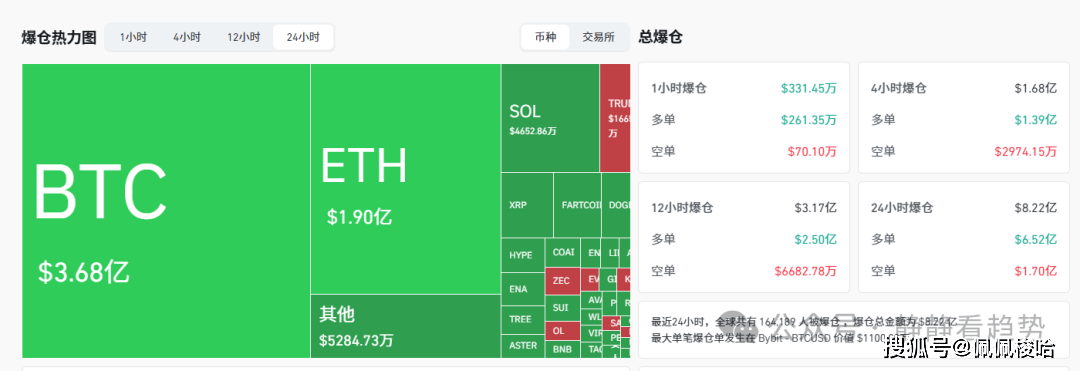
Core Insights - The cryptocurrency market has experienced a decline of 1.83% (approximately $70 billion) in the past 24 hours, continuing a monthly drop of 4.65% in October, driven by mixed macroeconomic signals and high market leverage [1] - Institutional interest in Solana and Ethereum's resilience indicates selective buying despite the overall market downturn [1] - Bitcoin is testing its 7-day moving average at $111,291.89, while other cryptocurrencies are in an oversold condition, raising questions about the impact of upcoming CPI data on market trends [1] Market Overview - Total cryptocurrency market capitalization stands at $3.76 trillion, with a 24-hour trading volume of $385.78 billion [12] - The Fear and Greed Index is currently at 34/100, indicating fear in the market, although it has improved from last week's 28 [12][14] - Bitcoin's market dominance has increased to 59%, while the altcoin season index has dropped to 31/100, reflecting a 48% decline in altcoin momentum over the past 30 days [15][16] Liquidation Data - In the last 24 hours, 164,189 traders were liquidated, totaling $822 million, with long positions accounting for $652 million and short positions for $170 million [3] Major Cryptocurrencies Performance - Bitcoin (BTC): Current price at $111,291.89, down 1.84% in 24 hours, with a market cap of $2.22 trillion [4] - Ethereum (ETH): Current price at $3,933.72, down 1.82% in 24 hours, with a market cap of $475.08 billion [6] - Binance Coin (BNB): Current price at $1,116.88, down 0.12% in 24 hours, with a market cap of $153.74 billion [9] - Ripple (XRP): Current price at $2.5849, up 0.10% in 24 hours, with a market cap of $155.16 billion [11] Notable Price Movements - Zcash (ZEC) has seen the largest increase, up 12.48% in 24 hours, while Plasma (XPL) has experienced the largest decrease, down 13.15% [17]
刘兴亮 | 极简区块链发展史
Sou Hu Cai Jing· 2025-10-14 10:49
Group 1: Economic Theories and Currency - Austrian economist Mises criticized excessive money issuance by governments and central banks as a form of indirect theft, leading to currency devaluation and loss of purchasing power for the public [1] - The issuance of currency should be independent of government control and tied to a free market system, with supply matching economic growth and export surpluses [1] - Historical context shows that limited supply of hard currency, like silver, maintained purchasing power, contrasting with government-issued paper money that can depreciate rapidly [3] Group 2: Blockchain and Cryptocurrency - Blockchain technology emerged alongside Bitcoin, created by Satoshi Nakamoto in 2008, serving as a public distributed ledger that solves the double-spending problem without a central authority [4][6] - Bitcoin's economic model, including a halving mechanism that limits total supply to 21 million coins, positions it as "digital gold," ensuring long-term value storage [12] - Ethereum introduced smart contracts and a decentralized computing environment, expanding blockchain capabilities beyond simple value transfer [14] Group 3: Development and Evolution of Blockchain - The development of cryptographic methods and consensus mechanisms, such as Byzantine Fault Tolerance, laid the groundwork for decentralized systems [7][8] - The introduction of Proof-of-Work (PoW) by Nakamoto created a competitive environment for maintaining the blockchain, deterring malicious activities [9][10] - Recent advancements in blockchain technology focus on scalability and efficiency, with many networks transitioning to Proof-of-Stake (PoS) to address energy consumption and performance issues [15][16] Group 4: Impact on Financial Systems - The rise of cryptocurrencies is disrupting traditional monetary systems and altering economic perceptions, aligning with Austrian economic ideals of a fully liberalized competitive market [16] - Various recognized cryptocurrencies, including Bitcoin, Ethereum, and others, are reshaping the landscape of digital finance and governance [16]

BTC, ETH, XRP, SOL Face Slow Bottoming Process After $16B Liquidation Shock
Yahoo Finance· 2025-10-11 06:57
Market Overview - The crypto market faced its largest liquidation event, resulting in leveraged bullish bets worth $16 billion being forced out across major cryptocurrencies like bitcoin, ether, and several altcoins, with some altcoins crashing between 20% to 40% [1] Recovery Process - The recovery following such a crash is expected to be gradual, testing the patience of bullish investors, as indicated by industry experts [2] - The initial phase involves the market "bleeding out," with liquidation orders flooding exchanges and pushing prices lower, leading to significant drops in altcoin values [2] - Market makers typically step back to manage risk during this phase, focusing on addressing price mismatches between spot and futures markets through arbitrage plays, which delays an immediate rebound [3] Data Stabilization - After a market crash, there is a phase where data feeds stabilize, allowing traders and market makers to rely on reliable information channels again, which may have experienced delays or outages during the crash [4] Absorption Phase - Once data feeds stabilize, market makers and large traders begin to absorb major sell orders to restore market equilibrium, capitalizing on liquidation orders that receive priority in order books [5] - Given the scale of forced liquidations, this absorption phase can take several days [5] Market Stabilization - The stabilization stage involves dealers and market makers closing out their long positions acquired at bargain prices while absorbing liquidation orders, aiming to profit from a potential market rebound [6] - As the market reaches equilibrium, dealers will start unwinding their positions, leading to a local maxima in prices for certain assets with tighter supply [6]
瑞波币钱包与XBIT Wallet在美联储政策与加密资产创新下把握金融新机遇
Sou Hu Cai Jing· 2025-09-27 11:30
Core Insights - The article discusses the current economic landscape characterized by inflation and uncertainty in monetary policy, prompting investors to seek asset management tools that can withstand market volatility and capture emerging growth opportunities [1][3] - Federal Reserve Governor Bowman emphasizes the need for decisive action to address signs of economic fragility, with recent data showing a 0.3% month-over-month increase in PCE inflation and a year-over-year rate of 2.7% [1][3] - The article highlights the significant differentiation within the cryptocurrency sector, particularly focusing on Ripple (XRP), which, despite regulatory pressures, is predicted to surge in price if it maintains its support level [1][3] Economic Context and Implications - The U.S. economy is experiencing a paradox of "sticky inflation" and resilient consumer spending, with core inflation remaining at 2.9% and consumer spending growth rising to 0.6% [3] - The Federal Reserve faces pressure to balance between premature rate cuts that could trigger inflation and delayed easing that may worsen labor market conditions, with expectations for a potential rate cut cycle in 2024 [3] - Historical trends indicate that a lowering interest rate environment tends to favor risk assets, including cryptocurrencies [3] Ripple and XBIT Wallet - Ripple (XRP) is positioned as a representative project in the cross-border payment space, boasting technological advantages such as instant settlement and a 60% reduction in transaction costs [3] - XBIT Wallet is presented as a decentralized Web3 wallet that supports multiple chains and integrates AI-driven market analysis, enhancing user experience and security [3][4] - The wallet's design allows users to maintain control over their private keys, mitigating risks associated with centralized exchanges [4] Security Features and Best Practices - The article emphasizes the importance of private keys and mnemonic phrases for asset security, detailing how XBIT Wallet generates and encrypts private keys locally [6] - Users are advised to back up their mnemonic phrases securely and avoid storing them on connected devices to prevent hacking risks [6][8] - Best practices for using hot wallets include implementing multi-factor authentication and regularly auditing DApp permissions to safeguard assets [7][8] Future Outlook and Strategy - As the interest rate cut cycle approaches, increased volatility in the cryptocurrency market is anticipated, with XRP potentially attracting more short-term traders if it surpasses the $4.20 mark [10] - XBIT Wallet's built-in decentralized exchange facilitates instant conversions, reducing slippage losses, and the wallet must adapt to cross-chain interoperability as tokenized assets gain traction [10] - Continuous education on security practices is crucial for users, with features like simulated trading in XBIT Wallet helping users practice recovery processes for their assets [10]

Crypto Markets Today: Major Tokens Slide, Altcoins Tumble More Than 10%
Yahoo Finance· 2025-09-22 12:00
Market Overview - The cryptocurrency market experienced significant losses early Monday, with major cryptocurrencies like bitcoin (BTC) and ether (ETH) contributing to a liquidation of leveraged bets worth $1.5 billion [1] - The decline followed a dovish Fed interest-rate cut, which was anticipated to lower the dollar index and promote risk-taking in crypto markets [1] Bitcoin Analysis - Recent signals indicate a downward trend for bitcoin, with BTCUSD falling out of its upward channel established since early September and dropping below key support levels and the 50-day moving average [2] - This combination of negative indicators suggests further declines are likely unless there is a fundamental shift in market sentiment [2] Derivatives Positioning - The top 20 tokens, excluding BTC and HYPE, have seen double-digit declines in futures open interest as overleveraged bets are liquidated [3] - Shorts are increasing in Binance-listed USDT futures, with open interest rising to 276K BTC, while funding rates for several altcoins are notably negative, indicating a bearish sentiment [3] - BTC front-month futures on the CME are trading at a $100 premium to the spot price, and a potential shift to a discount could signal increased selling pressure [3] Market Sentiment and Altcoins - The sell-off was exacerbated by a $1.6 billion liquidation cascade, with $500 million occurring in ether trading pairs [3] - Funding rates for ether have turned negative, indicating a shift in sentiment after a significant rally from $2,400 in July to $4,831 in late August [3] - Major cryptocurrencies like BTC, ETH, and SOL are at critical support levels, and a recovery could occur if traders are overly aggressive in short positions [3] - The average crypto token relative strength index (RSI) is at 28.4, suggesting heavily oversold conditions that may lead to a relief rally unless BTC and ETH break their support levels [3]