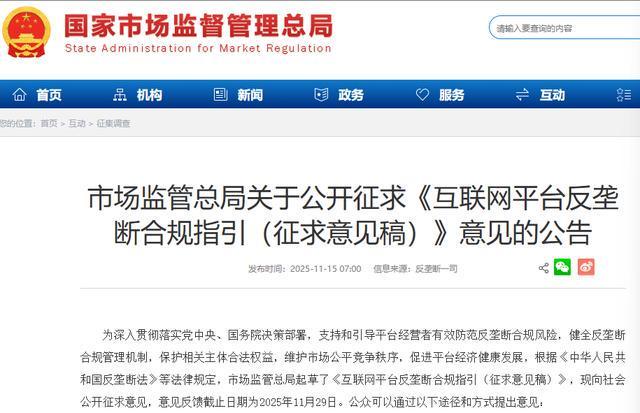
《互联网平台反垄断合规指引(征求意见稿)》

Search documents
给“内卷式”竞争开“组合药方”
Ren Min Ri Bao· 2026-01-14 22:51
Core Viewpoint - The "involution" competition is characterized by low price, low quality, and low-level competition, disrupting market signals and reducing resource allocation efficiency, which erodes long-term competitiveness of enterprises and affects the optimization and upgrading of industrial structure and high-quality development [1] Group 1: Regulatory Measures - The market regulatory authority has announced ten key regulatory measures to address "involution" competition, including a new Anti-Unfair Competition Law that targets malicious competitive behaviors such as forced low-cost sales and false transactions [2] - The implementation of a compulsory company deregistration system aims to orderly clean up dishonest entities [3] - The Fair Competition Review Regulation will ensure that policies related to industrial development and investment do not interfere with fair market competition [3] Group 2: Industry Standards and Compliance - The Internet Platform Antitrust Compliance Guidelines will support platform enterprises in managing antitrust compliance and identifying new monopoly risks [3] - Guidelines to enhance product and service quality on online trading platforms will focus on product innovation and standardization, promoting a shift from "involution competition" to "quality improvement" [3][4] - The action plan for enhancing standards in the new energy vehicle, lithium battery, and photovoltaic industries includes the development of 167 national standards to combat "involution" competition [4] Group 3: Implementation and Impact - The ten regulatory measures are designed as a comprehensive governance system, addressing market competition at various stages: preventing improper interventions, regulating enterprise behavior, and cleaning up dishonest entities [5] - Initial effects of these measures show a positive trend, with more rational market competition and a reduction in phenomena such as "subsidy wars" and "lowest price" strategies [6] - The measures are expected to drive enterprises to shift focus from price competition to quality and innovation [7]
如何推动企业从拼价格向拼质量拼创新转变?
Xin Lang Cai Jing· 2026-01-09 18:42
Core Viewpoint - The central economic work conference has prioritized the comprehensive rectification of "involutionary" competition, aiming to shift industries from low-quality competition to quality enhancement through a robust regulatory framework [1][2]. Group 1: Regulatory Framework - The Market Regulation Administration has developed a series of targeted and operational institutional standards to address "involutionary" competition, resulting in ten key institutional achievements for 2025 [1][2]. - New regulations include the revised Anti-Unfair Competition Law and guidelines for internet platform antitrust compliance, aimed at improving service quality and reducing disorderly competition [1][2]. Group 2: Specific Measures - The "Basic Requirements for Service Management of Takeaway Platforms" was introduced to regulate service management, merchant management, pricing behavior, and consumer rights protection, particularly addressing the "subsidy wars" in the takeaway sector [2]. - The "Guiding Opinions on Improving Product and Service Quality of Online Trading Platforms" was established to combat low-quality, low-price phenomena in online sales, promoting a virtuous cycle of "quality for price" [2]. Group 3: Industry Standards - The "Action Plan for Standard Enhancement in New Energy Vehicles, Lithium Batteries, and Photovoltaic Industries" was issued, focusing on developing 167 national standards to promote high-quality development in these sectors [2]. - The new Anti-Unfair Competition Law, effective from October 15, 2025, strengthens regulations against typical "involutionary" competition practices, addressing issues like false evaluations and malicious competition [3][4]. Group 4: Implementation and Impact - Initial implementation of these regulations has shown positive effects, leading to more rational and orderly market competition, curbing practices like "subsidy wars" and "lowest price" strategies [3]. - The new law prohibits various deceptive practices, including organizing false evaluations and maliciously undermining competitors, thereby enhancing market order and protecting legitimate business interests [4].
国家市场监督管理总局:完善长效治理机制整治“内卷式”竞争
Zheng Quan Ri Bao· 2026-01-09 16:48
Core Viewpoint - The National Market Supervision Administration (NMSA) is implementing a comprehensive reform to address "involutionary" competition by establishing a set of ten regulatory frameworks aimed at promoting high-quality competition and improving market efficiency [1][2]. Group 1: Overview of the Regulatory Framework - The ten regulatory frameworks include: the new Anti-Unfair Competition Law, the Implementation Measures for Mandatory Company Deregistration, the Implementation Measures for Fair Competition Review Regulations, the Draft Guidelines for Antitrust Compliance in Internet Platforms, Guidelines for Improving Product and Service Quality on Online Trading Platforms, Basic Requirements for Service Management of Food Delivery Platforms, Regulations for Quality and Safety Supervision of Key Industrial Products in Online Sales, Action Plan for Standard Upgrading in New Energy Vehicles, Lithium Batteries, and Photovoltaic Industries, Measures for Gradually Expanding Standard System Opening, and Announcement on Further Promoting "Same Line, Same Standard, Same Quality" for Domestic and Foreign Trade Products [2][3]. Group 2: Focus on Platform Economy and Food Delivery - The Draft Guidelines for Antitrust Compliance in Internet Platforms aim to support platform companies in enhancing antitrust compliance management, addressing new monopoly risks, and fostering innovation and healthy development within the platform economy [2]. - The Basic Requirements for Service Management of Food Delivery Platforms outline overall service management requirements, including merchant management, pricing behavior, delivery personnel rights protection, consumer rights protection, and complaint handling, aimed at improving service quality and reducing disorderly competition [2]. Group 3: Characteristics of the Regulatory Framework - The new regulations exhibit three distinct characteristics: they are problem-oriented, addressing societal concerns; they emphasize systematic integration to create a governance loop; and they reflect a classified approach, balancing regulation with development [2][3]. Group 4: Comprehensive Governance System - The ten regulations are interconnected, forming a comprehensive governance system that includes preventive measures through the Fair Competition Review Regulations, regulatory actions via the Anti-Unfair Competition Law, and post-event measures through the Mandatory Company Deregistration Implementation Measures, ultimately guiding industry upgrades through standards and quality improvement policies [3].
“全网最低价”,可能构成垄断协议行为!
Jin Rong Shi Bao· 2025-12-18 02:44
Core Viewpoint - The recently released "Antitrust Compliance Guidelines for Internet Platforms (Draft for Comments)" introduces eight new types of monopoly risks, providing practical compliance guidance for platform enterprises [1][2] Group 1: Purpose and Context - The purpose of the guidelines is to guide platform enterprises in enhancing risk identification, risk management, and compliance assurance to effectively prevent antitrust compliance risks and promote the innovative and healthy development of the platform economy [1] - The platform economy in China has developed rapidly, characterized by significant scale effects and network effects, leading to a "winner-takes-all" scenario where leading platform enterprises can easily engage in cross-industry competition and rapid expansion [1] Group 2: Key Risks and Compliance Guidance - The guidelines adopt a problem-oriented approach, combining specific rules with eight risk examples to provide practical compliance guidance for platform enterprises [2] - The guidelines highlight that platform enterprises with market dominance should avoid implementing "choose one from two" practices through punitive or incentivizing measures, based on enforcement experiences [2] - The guidelines warn that requiring merchants on platforms to sell goods at prices lower than those on competing platforms may constitute abuse of market dominance or monopolistic agreements [2] - The guidelines emphasize the importance of transparency in algorithms, identifying "algorithm collusion" as a risk, and encourage platform enterprises to conduct algorithm screening to prevent monopolistic behaviors from the source [2] Group 3: Regulatory Approach - The regulatory approach aims to balance regulation and development, accelerating the introduction of the guidelines, strengthening antitrust enforcement in the platform economy, and fostering a positive competitive ecosystem while protecting the legitimate rights and interests of relevant parties [2]
合规指引是合作治理新尝试
第一财经· 2025-11-16 15:48
Core Viewpoint - The article discusses the recent draft of the "Antitrust Compliance Guidelines for Internet Platforms" aimed at guiding platform operators to prevent antitrust compliance risks and promote fair competition in the platform economy [2][3]. Group 1: Antitrust Compliance Guidelines - The guidelines emphasize the need for platform operators to understand the complexities of the market structure and the challenges in identifying and regulating monopolistic behaviors [3][4]. - The guidelines aim to clarify the compliance boundaries for platform operators, helping them to avoid infringing on the legitimate rights of other parties while promoting fair competition [4][5]. Group 2: Market Dynamics and Challenges - The rapid development of the platform economy has increased resource allocation efficiency but also introduced new challenges in antitrust regulation, such as algorithm collusion and unfair pricing practices [3][4]. - The guidelines are designed to help both regulators and platform operators understand the implications of their actions, thereby reducing the regulatory burden associated with antitrust violations [4][5]. Group 3: Cooperative Governance - The guidelines represent a beneficial attempt at cooperative governance, signaling that regulators and platform participants share a common goal of achieving fair competition [5][6]. - There is a need to shift the perception of the relationship between regulators and regulated entities from adversarial to collaborative, focusing on the fairness and justice of rules [5][6]. Group 4: Protecting Vulnerable Parties - The article highlights the importance of protecting the legitimate rights of weaker parties in transactions, addressing issues such as high costs of rights protection and lack of transparent channels for legal recourse [6][7]. - Effective implementation of the guidelines requires the introduction of mechanisms like collective litigation and burden of proof reversal to lower the costs for consumers seeking to protect their rights [6][7].


互联网平台反垄断合规指引发布,八大场景成监管焦点
Huan Qiu Wang Zi Xun· 2025-11-15 03:50
Core Viewpoint - The article discusses the release of the "Antitrust Compliance Guidelines for Internet Platforms (Draft for Comments)" by the State Administration for Market Regulation, aimed at addressing new monopolistic risks in the platform economy and providing clear compliance pathways for platform operators [1][4]. Summary by Sections Introduction of Guidelines - The guidelines are a significant regulatory document in China's platform economy, focusing on problem-oriented approaches to new monopolistic risks [1][4]. High-Risk Scenarios - The guidelines identify eight high-risk scenarios, including algorithm collusion, unfair pricing, and discriminatory treatment, which cover critical aspects of platform operations such as data transmission and service pricing [3][4]. Compliance Principles - The guidelines emphasize four principles for compliance: targeted, comprehensive, penetrating, and continuous, requiring platforms to establish a full-chain compliance mechanism [3][4]. Nature and Purpose of Guidelines - The guidelines are characterized as non-binding compliance directives aimed at helping platforms proactively identify and mitigate risks, thereby reducing uncertainty costs and stabilizing market expectations [4][5]. Impact on Platform Economy - The ultimate goal of the guidelines is to foster innovation and healthy development in the platform economy by promoting fair competition and encouraging platforms to focus on high-quality research and service enhancement [5].