
年度经常性收入(ARR)

Search documents
【锋行链盟】A轮融资流程及核心要点
Sou Hu Cai Jing· 2026-02-27 20:05
Core Viewpoint - A-round financing is a crucial milestone for startups, typically occurring after seed/angel rounds and before B rounds, aimed at expanding teams, accelerating market growth, or optimizing products [2] Group 1: A-round Financing Core Process - The A-round financing process consists of five stages: preparation, financing initiation, due diligence, negotiation and signing, and fund disbursement [3] - The preparation stage focuses on self-diagnosis and material refinement to ensure the company is ready for financing and can convey its investability to investors [4] - The financing initiation stage emphasizes efficient roadshows and securing investor interest, establishing trust through communication [6] Group 2: Key Points of A-round Financing - A-round financing is critical for validating growth logic, with investors focusing on business verification and quality growth metrics [13] - Investors will assess whether the startup has a viable minimum viable model (MVM) and whether there is quality growth [13] - Key metrics for investor consideration include user retention rates, market validation, and product progress [8][14] - The valuation logic for A-round financing typically involves market size, expected penetration rates, and comparable company valuations [14] - The team’s capability to execute and adapt is essential, especially during the rapid expansion phase following A-round financing [14][15]


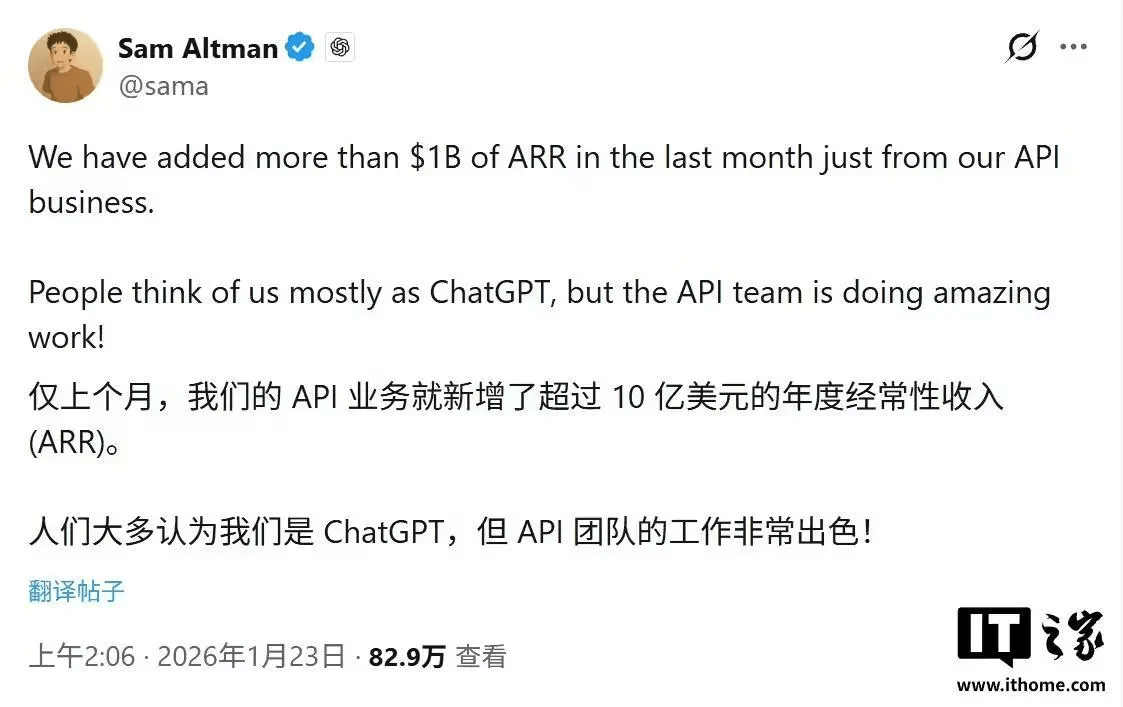
硅谷印钞机:奥尔特曼宣布OpenAI API业务增加10亿美元年度经常性收入
Sou Hu Cai Jing· 2026-01-23 12:05
Group 1 - OpenAI's CEO Sam Altman announced that the company's API business generated over $1 billion in annual recurring revenue (ARR) in December 2025 [1][2] - The ARR increase indicates that new contracts signed in the previous month will secure an additional $1 billion in guaranteed revenue for the company each year [2] - OpenAI's API services are being utilized by numerous high-profile startups in Silicon Valley, becoming a core infrastructure for their products [2] Group 2 - Examples of companies using OpenAI's models include Perplexity, which integrates the model into its search functionalities, and Harvey, a legal tech startup that assists lawyers with complex legal research and document drafting [2] - OpenAI faces significant financial pressure due to projected expenditures of approximately $1.4 trillion over the next few years, driven by rising computing and data center costs [2]
OpenAI最新公布:年度经常性收入达200亿美元
2 1 Shi Ji Jing Ji Bao Dao· 2026-01-20 08:40
Core Insights - OpenAI's annual recurring revenue (ARR) is projected to exceed $20 billion by 2025, with significant growth from $2 billion in 2023 and $6 billion in 2024 [2] - The company's computing power is expected to reach 1.9GW by 2025, up from 0.2GW in 2023, indicating a substantial increase in operational capacity [2] - OpenAI has diversified its partnerships with multiple cloud service providers and hardware suppliers, enhancing its service delivery capabilities [2] Financial Performance - OpenAI's ARR is forecasted to grow tenfold from 2023 to 2025, with a threefold increase from 2024 to 2025 [2] - The computing power growth is projected to be 9.5 times from 2023 to 2025, with a threefold increase in 2025 alone [2] Strategic Initiatives - The "Stargate" initiative, a collaboration involving OpenAI, Oracle, and SoftBank, aims to build a nationwide AI computing infrastructure in the U.S. with an initial investment of $100 billion and a total planned investment of $500 billion over four years [3] - OpenAI is expanding its service offerings beyond subscription models to include API services and ad-supported free versions, indicating a shift towards a multi-tiered service structure [3] Future Developments - OpenAI plans to launch its first hardware device in the second half of 2026, marking its entry into the AI hardware market [4] - The design philosophy of the upcoming AI device aims to provide a calming user experience, as articulated by OpenAI's CEO [4]

智谱面向开发者的API订阅业务,ARR过亿
Bei Ke Cai Jing· 2025-12-03 01:37
Core Insights - The company, Zhipu, has achieved an annual recurring revenue (ARR) exceeding 100 million RMB (approximately 14 million USD) from its software tools and models for developers (GLM coding plan) [1] - Zhipu is diversifying its revenue structure by shifting from government and enterprise clients to developers, with a goal to increase the revenue share from its API business to 50% [1] - The API platform currently serves over 2.7 million paying customers, including some of China's largest tech companies [1] Product Offering - In September, Zhipu launched an AI-driven coding tool subscription plan, priced as low as 20 RMB per month, which is about one-seventh of the price of Anthropic's Claude [2] - The coding tool plan has attracted over 150,000 users [2] Market Demand - Concerns regarding excessive investment in AI without clear profit pathways are acknowledged; however, the CEO stated that the Chinese market is still in a phase where the demand for high-quality AI services exceeds supply [3] - A critical and urgent issue is to find sufficient reasoning resources to meet the surging demand [3]
很多SaaS企业ARR的高增长,其实都是伪增长
Sou Hu Cai Jing· 2025-12-02 03:23
Core Insights - The article emphasizes the importance of sustainable growth in the SaaS industry, highlighting that high growth rates can often be misleading and may indicate underlying issues [1][3][27] Group 1: Growth Metrics - Many SaaS companies confuse "recurring revenue" with "sustainable growth," leading to potential pitfalls [5][21] - Sustainable ARR growth requires two key conditions: revenue purity and growth resilience [5][11] - Revenue purity refers to the proportion of recurring income in total ARR, with a healthy benchmark being above 85% [7][25] Group 2: Growth Resilience - Growth resilience is the ability to maintain ARR growth despite external challenges, such as economic downturns or increased competition [11][19] - Companies with high resilience experience less decline in ARR compared to industry averages during tough times [11][27] Group 3: Evaluation of Growth - A systematic approach is necessary to evaluate growth, including analyzing metrics, breaking down structures, and validating scenarios [15][19] - The annual growth rate ratio is a commonly used metric to assess quality growth, where a ratio above 1 indicates positive performance [15][17] Group 4: Risks of Unsustainable Growth - Companies focusing on short-term high growth may overlook significant underlying issues that can surface when growth slows [21][25] - Over-reliance on one-time custom services can lead to a cycle of neglecting core product development, ultimately harming long-term viability [21][23] Group 5: Strategies for Sustainable Growth - To achieve sustainable growth, companies should prioritize building a dynamic optimization system rather than chasing perfect metrics [25][27] - Key strategies include focusing on common customer needs in product iterations, monitoring customer health for retention, and allocating resources effectively in R&D [25][27]

从客服到客户成功:SaaS 增长的真正起点
3 6 Ke· 2025-11-28 01:49
Core Insights - Customer success is not merely an extension of the service department but is the core driver of growth for SaaS companies [1][3] - A robust customer success system must be built based on the current stage of the company, incorporating strategy design, data analysis, solution capabilities, and foundational services [1][3] - The CEO must take primary responsibility for customer success, emphasizing its importance as a long-term initiative [1][50][51] SaaS Delivery and Value - SaaS delivers value rather than just products, contrasting with traditional software which often fails to create ongoing value [3][4] - Key metrics for SaaS include Net Dollar Retention (NDR) and Annual Recurring Revenue (ARR), which reflect the sustainability and health of the business [3][21] Customer-Centric Approach - Understanding customer needs and aligning them with the company's KPIs is essential for ensuring customer retention and satisfaction [6][10] - A successful customer success team acts as a second sales team, focusing on driving self-growth rather than merely providing services [11][12] Customer Retention and Growth Strategies - Managing customer churn involves evaluating Customer Lifetime Value (LTV) against Customer Acquisition Cost (CAC) to ensure profitability [14][15] - Approximately 40% of customer churn is manageable, with unmet needs being the primary cause [17][18] - NDR is crucial for long-term growth, as it reflects the revenue growth from existing customers through renewals and upsells [21][22] Customer Management Practices - Large customer management requires setting clear revenue goals and conducting regular business reviews (QBR) to ensure alignment and progress [31][32] - Small customer operations focus on automation and lightweight SOPs, emphasizing early-stage engagement and training [33][34] Health Metrics and Demand Discovery - Customer health metrics are complex and require a combination of quantitative data and qualitative assessments to gauge customer status [36][38] - Understanding customer business goals through methods like GPCT helps in accurately identifying and addressing their needs [39][40] Team Management and Cultural Integration - The management of customer success teams should evolve with the company's growth stages, requiring diverse capabilities and clear performance metrics [41][44] - Building a customer-centric culture is essential, with leadership understanding that customer success is a long-term commitment [50][52] Conclusion - A mature customer success system is vital for transforming customers into partners for value creation, driving sustainable revenue growth [55]


金蝶国际(00268):2H24业绩回顾:上行潜力有限,进一步估值重塑的空间较小,重申“持有”评级
Huajing Securities· 2025-03-20 11:02
Investment Rating - The report maintains a "Hold" rating for Kingdee International (268 HK) with a target price of HK$14.94, indicating a potential downside of 1% from the current price of HK$15.14 [1][8]. Core Insights - The report highlights that Kingdee's stock has appreciated by 94% year-to-date, outperforming the Hang Seng Index, which rose by 23%. However, the company's fundamental recovery is lagging behind this valuation increase [6]. - For the second half of 2024, Kingdee's revenue grew by 9% year-on-year to RMB 3.39 billion, which was below market expectations. The annual recurring revenue (ARR) increased by 20% to RMB 3.43 billion, also falling short of projections [6][10]. - The report notes that Kingdee's cloud service revenue grew by 10% to RMB 2.72 billion, again underperforming against market expectations [6][10]. - The management anticipates a revenue growth acceleration in 2025, projecting a 14% increase compared to the 9% growth in the second half of 2024, supported by a low base and macroeconomic recovery [6][10]. Summary by Sections Investment Rating and Price Target - The target price has been raised from HK$6.38 to HK$14.94, reflecting a significant increase of 134% [2][12]. - The report adjusts the target price-to-sales (P/S) ratio to 7.0, aligning it with global peers in the ERP sector [12][13]. Financial Performance - Kingdee's revenue for 2025 is projected at RMB 7.15 billion, with a year-on-year growth of 14% [9][10]. - The report anticipates that Kingdee will achieve a breakeven point in operating profit and net profit in 2025, despite downward adjustments in earnings forecasts due to underperformance in 2H24 [6][10]. Earnings Forecast Adjustments - The earnings per share (EPS) estimates for 2025 and 2026 have been revised downwards to RMB 0.05 and RMB 0.11, respectively, reflecting a decrease of 61% and 36% from previous estimates [2][10]. - The ARR for 2025 is expected to grow by 22%, while the growth rate is projected to slow to 20% in 2026 [7][10]. Market Comparisons - Kingdee's market capitalization stands at approximately US$6.99 billion, with a three-month average daily trading volume of US$89 million [1][12]. - The report compares Kingdee's performance with global peers, noting that its current valuation is in line with similar companies that have larger customer bases and stronger profitability [8][12].