
强产业

Search documents
国盛宏观熊园:各部委各地学习中央经济工作会议“划重点”
Xin Lang Cai Jing· 2025-12-25 02:28
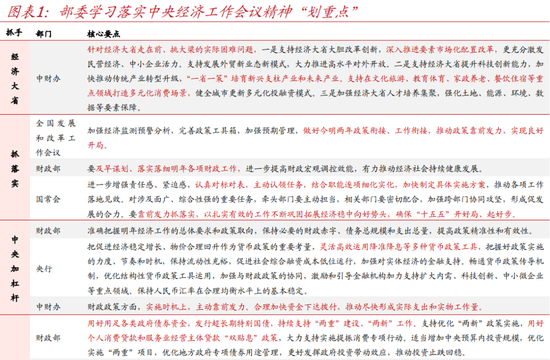
Core Viewpoint - The recent learning and communication of the Central Economic Work Conference's spirit by various departments and regions is an important window for tracking the implementation of the conference's spirit, revealing more details and actionable measures [2] Group 1: Policy Implementation - Various departments are focusing on the "stability while seeking progress, improving quality and efficiency" principle, with clear directions and highlighted priorities such as expanding domestic demand, strengthening technology, promoting reform, and stabilizing real estate [3][5] - The central government is expected to continue "leveraging" with specific scales to be determined at the 2026 National Two Sessions, emphasizing proactive measures and reasonable acceleration of fund disbursement [4][6] - Departments are prioritizing support for expanding domestic demand, utilizing various funds, and continuing to support "two new" and "two heavy" initiatives, including fostering trillion-level new consumption growth points [6][7] Group 2: Financial and Monetary Policies - The Ministry of Finance and the central bank are maintaining a "more proactive fiscal policy" and "moderately loose monetary policy," with a focus on maintaining necessary fiscal deficits and debt levels [6][8] - The central bank may consider lowering reserve requirements and interest rates in the first quarter of 2026, along with introducing more structural tools [2][4] - There is an emphasis on accelerating fiscal spending and issuing special bonds to support consumption and investment [6][7] Group 3: Industry and Innovation - There is a strong focus on industrial transformation, self-control, and innovation leadership, with initiatives to promote technology finance and the construction of international technology innovation centers in key regions [7][8] - The government is pushing for reforms to create a unified market, enhance the development of the private economy, and deepen state-owned enterprise reforms [8][9] Group 4: Risk Management - The financial system is focused on preventing risks, particularly in the real estate sector, while ensuring support for both residents and real estate companies [9][10] - Measures are being taken to stabilize the stock market and promote long-term investments, including accelerating reforms in the Sci-Tech Innovation Board and piloting commercial real estate REITs [10][11] Group 5: Local Implementation - Various regions are adapting the central economic work conference's spirit to their local contexts, emphasizing proactive measures and specific actionable tasks, with a focus on ensuring a good start for the 14th Five-Year Plan [13][14] - Local governments are expected to detail their plans and measures in the upcoming local two sessions in January 2026, with a strong emphasis on innovation and openness [13][14]

十大首席看2026中国经济
Xin Lang Cai Jing· 2025-12-22 03:08
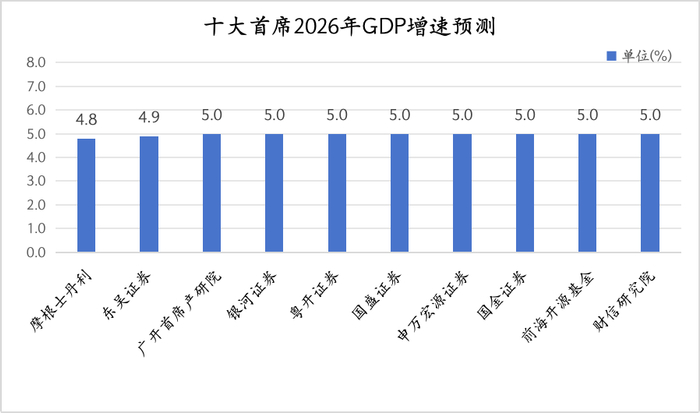
Economic Growth Outlook - In 2025, China's GDP is projected to grow by 5.2% year-on-year, laying a solid foundation for achieving the annual growth target of around 5% [1] - Economists predict that in 2026, China's GDP growth will continue to recover, with an expected growth rate of approximately 5.0% [2][4] Key Economic Drivers - The main drivers for economic growth in 2026 include stable export growth and a rebound in investment, particularly in infrastructure, supported by government policies [4][5] - The real estate market is expected to continue its bottoming process, with overall market risks considered manageable [4][8] Export and Trade Dynamics - Despite challenges from US-China trade tensions, China's exports are anticipated to maintain resilience, supported by new demands from emerging markets and global investments in AI [7] - Economists express cautious optimism regarding export stability, influenced by the global economic environment and potential easing of trade conflicts [7][6] Real Estate Market Trends - The real estate sector is projected to remain in a deep adjustment phase, with investment in real estate expected to decline by 15.9% year-on-year in 2025 [8] - Economists believe that while the real estate market will continue to face downward pressure, the rate of decline may gradually narrow due to previous policy measures [9][8] Price Level Expectations - Consumer Price Index (CPI) is expected to rise by 0.5% year-on-year in 2026, while Producer Price Index (PPI) is projected to decline by 0.9% [10] - The overall price levels are anticipated to remain low, with potential for gradual recovery influenced by supply and demand dynamics [12][10] Fiscal and Monetary Policy - The fiscal deficit rate for 2026 is expected to remain at 4%, consistent with 2025, with slight increases in special bonds and local government debt [14] - Economists forecast 1-2 interest rate cuts in 2026, with a reduction of 0.1-0.2 percentage points, and a potential decrease in the reserve requirement ratio [14][15] Policy Focus Areas - The policy focus for 2026 will include expanding domestic demand, strengthening industries, and promoting consumption through various subsidies and support measures [16] - Key areas of investment will include infrastructure, technology advancement, and stabilizing the real estate market through targeted policies [16][5]
中邮黄付生:市场三阶段演进,“强产业、起消费”引领2026
2 1 Shi Ji Jing Ji Bao Dao· 2025-12-17 09:20
Group 1 - The domestic market is undergoing three phases of evolution: the decline in bond market yields is driving the revaluation of dividend stocks; the "DeepSeek" moment is igniting the growth of technology stocks; and by 2026, there will be a recovery in manufacturing profits [1][2] - The first phase of value revaluation in the A-share market occurs from 2023 to 2024, characterized by a bull market in dividend stocks due to rapidly declining bond yields [2] - From the "9.24" event until 2025, the market will enter a growth stock boom, representing a repricing of China's technology industry [2] Group 2 - In 2026, the market will extend into a phase of recovery in manufacturing profits, driven by "anti-involution" policies that will restore industrial product prices and a "price for volume" inventory reduction phase for consumer goods [2] - The valuation of the "Seven Sisters" in the US stock market is approximately 35-40 times, which, while higher than the historical average, is significantly lower than the 80 times valuation seen during the 2000 internet bubble [2] - The ability to quickly build a self-controlled modern industrial system will directly impact the recovery of PPI and corporate profits, with 2026 being a critical year for the "14th Five-Year Plan" [3]