扩开放

Search documents
铁合金周报-节后降库模式开启,关注两会宏观强预期
Hua Rong Rong Da Qi Huo· 2026-02-24 00:40
Market Dynamics - During the Spring Festival, domestic focus is on stabilizing growth and promoting consumption, while overseas attention is on U.S. tariff changes and Federal Reserve interest rate cuts[2] - Silicon iron futures contract 2605 closed at 5492, down 0.90%, with a net capital inflow of 276 million yuan and an increase in positions by 12,966 contracts[2] - The average daily production of silicon iron decreased by 1.20% to 14,005 tons, with a weekly supply of 98,000 tons, down 1.21%[2] Supply and Demand Analysis - Weekly supply-demand mismatch for silicon iron is expanding, with a monthly supply surplus rate expected to decrease[2] - The operating rate of 136 independent silicon iron enterprises was 28.35%, a decrease of 0.96% week-on-week, indicating a supply contraction[2] - Steel mill silicon iron inventory increased to 17.52 days, up 13.69% from the previous month, indicating a rise in inventory levels[2] Core Logic - The expectation of lower prices for raw materials like anthracite is weakening, with industry losses ranging from 100 to 600 yuan per ton[4] - The demand reduction is expected to have diminishing negative impacts, suggesting a potential for valuation recovery[4] - Policy support is anticipated to stabilize the market, with a focus on post-holiday inventory adjustments[4]
融智投资FOF市场周报2026年01月第5周
私募排排网· 2026-02-03 01:40
Investment Rating - The report does not explicitly provide an investment rating for the industry Core Insights - The A-share market is experiencing a volatile adjustment, with major indices mostly declining, yet maintaining an average daily trading volume above 3 trillion yuan, indicating active market participation [2] - The market is shifting its focus from cyclical sectors to technology growth, with significant sector differentiation observed [5] - The adjustment in the market is influenced by two main factors: a sharp decline in precious metal prices and a return of the PMI data to contraction territory, raising concerns about the economic fundamentals [5] - The 10-year government bond yield has decreased by approximately 1.86 basis points to 1.81%, primarily due to the "stock-bond seesaw" effect from the equity market adjustment [5] - The report highlights a significant drop in gold prices, with London spot gold experiencing a single-day decline of over 9%, marking the largest drop in nearly 40 years [5] - Lithium carbonate prices have also fallen sharply, with a weekly decline of over 18%, driven by profit-taking and stricter regulatory measures [5] Market Overview - The A-share market is characterized by a mixed performance, with the Shanghai Composite Index slightly down by 0.44% and the Shenzhen Component Index down by 1.62%, while the ChiNext Index showed relative resilience [5] - The market's adjustment is attributed to the volatility in precious metals and economic data, particularly the PMI returning to a contraction phase, which has dampened overall risk appetite [5] - The report notes that the central bank's actions to inject liquidity through open market operations are aimed at stabilizing the funding environment ahead of the upcoming government bond supply peak [5] Sector Performance - The report indicates that sectors such as oil and petrochemicals, telecommunications, and coal have shown strong performance, while previously high-performing sectors like defense, electric equipment, and automotive have seen notable corrections [5] - The report emphasizes the need for investors to focus on sectors with genuine technological breakthroughs and solid order backing, particularly in the context of the commercial aerospace and artificial intelligence themes [9] Economic Indicators - The report mentions that the January PMI data has intensified market concerns regarding economic fundamentals, necessitating close attention to potential growth-stabilizing policies [9] - The report also highlights the importance of monitoring the central bank's liquidity management and government bond issuance pressures in the near term [5][9]
国盛宏观熊园:各部委各地学习中央经济工作会议“划重点”
Xin Lang Cai Jing· 2025-12-25 02:28
Core Viewpoint - The recent learning and communication of the Central Economic Work Conference's spirit by various departments and regions is an important window for tracking the implementation of the conference's spirit, revealing more details and actionable measures [2] Group 1: Policy Implementation - Various departments are focusing on the "stability while seeking progress, improving quality and efficiency" principle, with clear directions and highlighted priorities such as expanding domestic demand, strengthening technology, promoting reform, and stabilizing real estate [3][5] - The central government is expected to continue "leveraging" with specific scales to be determined at the 2026 National Two Sessions, emphasizing proactive measures and reasonable acceleration of fund disbursement [4][6] - Departments are prioritizing support for expanding domestic demand, utilizing various funds, and continuing to support "two new" and "two heavy" initiatives, including fostering trillion-level new consumption growth points [6][7] Group 2: Financial and Monetary Policies - The Ministry of Finance and the central bank are maintaining a "more proactive fiscal policy" and "moderately loose monetary policy," with a focus on maintaining necessary fiscal deficits and debt levels [6][8] - The central bank may consider lowering reserve requirements and interest rates in the first quarter of 2026, along with introducing more structural tools [2][4] - There is an emphasis on accelerating fiscal spending and issuing special bonds to support consumption and investment [6][7] Group 3: Industry and Innovation - There is a strong focus on industrial transformation, self-control, and innovation leadership, with initiatives to promote technology finance and the construction of international technology innovation centers in key regions [7][8] - The government is pushing for reforms to create a unified market, enhance the development of the private economy, and deepen state-owned enterprise reforms [8][9] Group 4: Risk Management - The financial system is focused on preventing risks, particularly in the real estate sector, while ensuring support for both residents and real estate companies [9][10] - Measures are being taken to stabilize the stock market and promote long-term investments, including accelerating reforms in the Sci-Tech Innovation Board and piloting commercial real estate REITs [10][11] Group 5: Local Implementation - Various regions are adapting the central economic work conference's spirit to their local contexts, emphasizing proactive measures and specific actionable tasks, with a focus on ensuring a good start for the 14th Five-Year Plan [13][14] - Local governments are expected to detail their plans and measures in the upcoming local two sessions in January 2026, with a strong emphasis on innovation and openness [13][14]

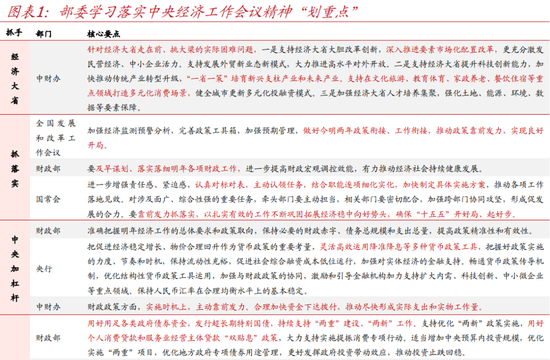
各部委各地学习中央经济工作会议“划重点”【国盛宏观熊园团队】
Xin Lang Cai Jing· 2025-12-24 16:47
Core Viewpoint - The recent learning and dissemination of the Central Economic Work Conference's spirit by various departments and regions is a crucial window for tracking the implementation of the conference's directives, revealing more details and actionable measures. There are several highlights and new proposals, including a focus on proactive measures, accelerating fund disbursement, supporting new consumption growth points, and emphasizing real and substantial growth without exaggeration [2][3][11]. Group 1: Overall Direction - All parties are refining their deployment around the Central Economic Work Conference's principle of "seeking progress while maintaining stability and improving quality and efficiency," with clear directions and highlighted priorities such as expanding domestic demand, strengthening technology, promoting reform, and stabilizing real estate [3][11]. - The emphasis is on policies that "act proactively" to ensure a good start to the year [3][11]. Group 2: Departmental Deployment - Each department has made detailed deployments based on their functional positioning, with the Central Financial Office providing the most comprehensive interpretation of the conference's spirit, revealing specific tasks and details [4][12]. - Signal 1: The continuation of "central leverage" is confirmed, with specific scales to be determined at the 2026 National Two Sessions, emphasizing proactive measures and reasonable acceleration of fund disbursement [4][12]. - Signal 2: Multiple departments will prioritize expanding domestic demand, utilizing various funds, and supporting "two new" and "two heavy" projects, with new focuses on cultivating trillion-level new consumption growth points and increasing investment in consumption infrastructure and livelihood projects [4][12][13]. Group 3: Industry Focus - Signal 3: There is a strong focus on industrial transformation, self-control, and innovation leadership, promoting the expansion and efficiency of technology finance, particularly in the Beijing-Tianjin-Hebei and Yangtze River Delta regions [5][14]. - Signal 4: The emphasis on reform includes advancing a unified market, combating "involution," and stabilizing the private sector, with more details on fiscal and tax reforms to be discussed in the upcoming National Fiscal Work Conference [6][15]. Group 4: Risk Management and Market Stability - Signal 6: There is a strict adherence to the "no explosion" bottom line for risk prevention, balancing the needs of residents and real estate companies, and reiterating the principles for debt resolution while increasing financial and fiscal support [8][17]. - Signal 7: Efforts to stabilize the stock market will continue, promoting the narrative of the Chinese stock market and accelerating reforms in the Sci-Tech Innovation Board and commercial real estate REITs [9][18]. Group 5: Local Implementation - Many regions have begun to learn and convey the spirit of the Central Economic Work Conference, tailoring key tasks to local conditions, with a focus on proactive measures and concrete actions, particularly in the lead-up to the January 2026 local two sessions [10][23]. - Localities like Zhejiang and Hainan are emphasizing innovation and openness, respectively, while ensuring that actionable measures are taken to support economic growth [10][23][24].
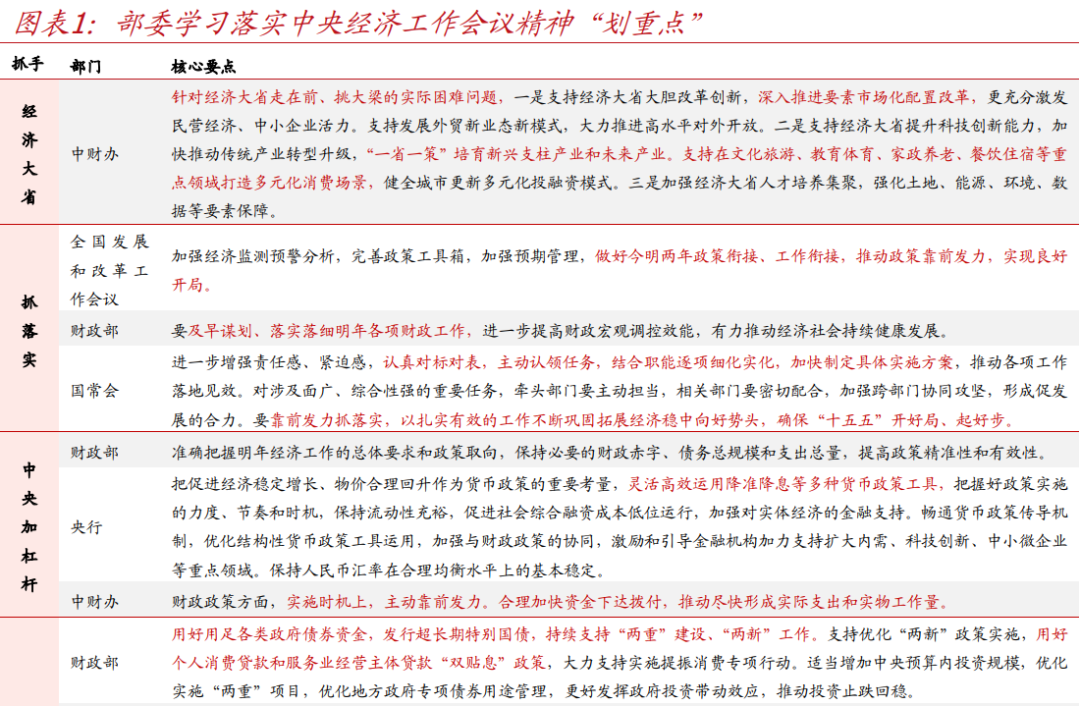
各部委各地学习中央经济工作会议“划重点”
GOLDEN SUN SECURITIES· 2025-12-24 14:18
Group 1: Policy Implementation - Various departments are refining their implementation of the Central Economic Work Conference's spirit, focusing on "stability while seeking progress" and "quality improvement" as the main themes[3] - Emphasis on accelerating the disbursement of funds and implementing major projects ahead of schedule to ensure a strong start in 2026[2] - The central government plans to maintain a necessary fiscal deficit and debt scale, with the overall fiscal deficit expected to be similar to that of 2025[4] Group 2: Economic Growth Strategies - Aiming to cultivate new consumption growth points worth trillions, with increased investment in consumer infrastructure and social welfare projects[6] - The government is focusing on expanding domestic demand, supporting "two new" and "two heavy" projects, and implementing the "15th Five-Year Plan" major projects[6] - The central bank may consider lowering reserve requirements and interest rates in the first quarter of 2026 to stimulate economic activity[2] Group 3: Risk Management and Market Stability - A commitment to prevent financial risks, ensuring that no major defaults occur, particularly in the real estate sector[10] - The government is taking measures to stabilize the real estate market while balancing the needs of residents and property companies[10] - Continuous efforts to promote the stock market narrative and attract long-term investments, including reforms in the Sci-Tech Innovation Board and commercial real estate REITs pilot programs[10]
关键窗口、关键应对——前瞻4月政治局会议|宏观经济
清华金融评论· 2025-04-23 10:30
Core Viewpoint - The upcoming political bureau meeting at the end of April is expected to adopt a more proactive and expansive policy stance, focusing on stabilizing expectations, growth, foreign trade, employment, stock market, and real estate, while also introducing new incremental policies [1][5][9]. Economic Outlook - The economic situation is anticipated to be acknowledged as stable with a good start in Q1, but challenges will be highlighted, particularly the complex external environment and insufficient domestic demand growth [3][5]. - The GDP growth rate for Q1 is reported at 5.4%, but indicators like CPI and PPI suggest weak demand characteristics remain unchanged, necessitating policy adjustments [5][9]. Policy Direction - The policy tone is expected to be more aggressive and expansive, with a focus on "real money" measures to stabilize various economic sectors [5][9]. - There is an emphasis on implementing existing policies while also introducing new measures to address external uncertainties [5][9]. Key Focus Areas - Specific areas of focus include central leverage, stabilizing foreign trade and employment, expanding domestic demand, promoting consumption, stabilizing the stock market and real estate, and enhancing industrial reform [9][10]. - Potential measures may include interest rate cuts, increased fiscal stimulus, and adjustments to the use of funds for existing policies [9][12]. Trade and Employment - The government is expected to emphasize support for foreign trade enterprises and employment, with significant backing for transitioning exports to domestic sales [11][15]. - The stock market may see increased support, with actions from central financial institutions to stabilize market confidence [11][15]. Infrastructure and Reform - More infrastructure projects are likely to be launched, focusing on urban renewal and water conservancy [12]. - Long-term reform efforts will continue, with attention to national market unification and state-owned enterprise reforms [12][13]. Recent Developments - Recent government actions include high-level visits to Southeast Asian countries to strengthen cooperation, and responses to increased tariffs from the U.S. [13][14]. - The government is actively supporting the transition of foreign trade enterprises to domestic markets through various platforms and initiatives [15][16].