
微纳机器人

Search documents
微创、高效、直达大脑!我国科学家开辟脑卒中病灶给药新路径
Huan Qiu Wang Zi Xun· 2026-01-17 23:43
Core Viewpoint - The research teams from Tsinghua University and Capital Medical University have developed a novel method to bypass the blood-brain barrier using nanoparticles to deliver drugs directly to stroke lesions, potentially overcoming a significant challenge in neurological disease treatment [1][3]. Group 1: Research Findings - The study reveals that the bone marrow within the skull is not a static structure but is connected to the meninges through microchannels, allowing immune cells to bypass the blood-brain barrier and enter the brain [3]. - The research team utilized a minimally invasive injection method to deliver albumin nanoparticles into the skull bone marrow, which were efficiently taken up by immune cells, forming "skull immune cell micro-nanobots" for targeted drug delivery [3][4]. - The nanoparticles demonstrated low systemic exposure, with minimal entry into peripheral blood and major organs, ensuring good biocompatibility and safety [3][4]. Group 2: Clinical Implications - In mouse models of acute ischemic stroke, the new delivery method significantly reduced infarct volume and edema, improved neurological function, and showed long-term benefits in reducing brain atrophy and enhancing survival rates [4]. - An exploratory clinical study involving 20 patients with malignant cerebral artery occlusion indicated that the procedure was well-tolerated, with no severe adverse events reported, and showed positive trends in neurological recovery [4][5]. Group 3: Future Prospects - The research suggests that this delivery pathway could extend beyond drug delivery, potentially integrating with brain-machine interface technologies to facilitate multi-directional exchanges of materials, energy, and information between the brain and artificial systems [5].


机构称医疗器械行业下行调整期结束,医疗器械ETF(562600)已连续15个交易日获得资金净流入
Sou Hu Cai Jing· 2025-11-18 06:12
Group 1 - The medical device sector is showing strong innovation momentum, with the introduction of the world's first remote surgery robot "TUMAI" and other pioneering products in the Zhangjiang Pharmaceutical Valley International Innovation Conference [1] - The medical device ETF (562600) has seen a continuous inflow of funds for 15 trading days, despite a slight decline of 0.66% as of 13:42 on November 18 [1] - According to Guojin Securities, the medical device sector's revenue is expected to grow by 10.65% year-on-year in the third quarter of 2025, indicating the end of the industry's downward adjustment phase [1] Group 2 - The long-term investment logic in the medical device sector is clear, with the medical device ETF (562600) providing a convenient way to invest in this field [2] - The ETF tracks the CSI All Index Medical Device Index, which includes 100 representative listed companies in medical devices, medical services, and medical information technology, capturing structural growth opportunities [2]
类器官打印 微纳机器人 医药新科技亮相高交会
Yang Shi Xin Wen· 2025-11-15 11:21
Core Viewpoint - The 27th China International High-tech Achievements Fair is currently being held in Shenzhen, showcasing over 5,000 new products, technologies, and achievements at the forefront of global technology [1] Group 1: Organoid Printing Technology - A new bioprinting technology enables the creation of beating heart organoids, which can be used to accelerate drug development [2] - These organoids are produced using a 3D bioprinter that utilizes "bio-ink" made from functional cells derived from pluripotent stem cells, allowing for the scalable production of specific organoids [2][3] - The bioprinter is the world's first automated, high-throughput device capable of producing over 100,000 organoids per day, representing the leading level internationally [3] Group 2: Micro-Nano Robots in Medical Treatment - Micro-nano robots are emerging as a new direction in medical treatment, functioning as drug delivery systems within the body [4] - A magnetic-controlled nano-robot cluster, composed of over 1 million nano-robots, can perform tasks such as targeted drug delivery for conditions like cerebral vascular occlusion and cancer treatment [4] - Recent breakthroughs include a embolization robot that can permanently block blood vessels using a magnetic field to aggregate particles coated with clotting factors [5] - These tiny robots can be designed in various sizes and shapes, with potential applications such as a patch that delivers precise medication for gastric ulcers [5]

“手到擒来”的微观“快递员”
Ren Min Ri Bao Hai Wai Ban· 2025-11-13 02:25
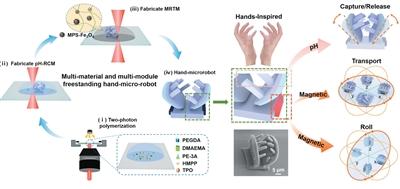
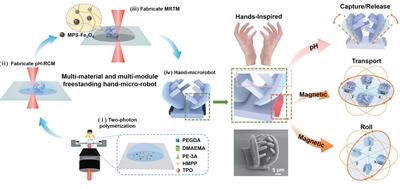
Core Insights - The article discusses the development of a 3D micro-nano robot by the Institute of Physics and Chemistry, Chinese Academy of Sciences, which can perform precise tasks in the microscopic world, paving the way for future advancements in precision medicine [1][7]. Group 1: Micro-Nano Robot Overview - Micro-nano robots are intelligent miniature machines that operate at the micro to nano scale, capable of movement, rotation, and manipulation of tiny particles or cells, thus enabling human interaction in the microscopic realm [2]. - The new design overcomes limitations of existing micro-nano robots, which often use single material systems and struggle with multi-step operations in complex environments [2][5]. Group 2: Design and Functionality - The micro-nano robot features a hand-like design that allows for flexible observation and manipulation of target particles, enhancing its operational capabilities [2]. - It is constructed using femtosecond laser direct writing technology, which allows for high-precision fabrication of various micro-nano structures with different functionalities [5]. Group 3: Operational Mechanism - The robot operates by responding to changes in pH levels in its environment, with its "hands" opening and closing like a flower in response to acidic or alkaline conditions [6]. - It can transport and release particles or cells with a maximum speed of 65.56 micrometers per second, demonstrating agility in navigating obstacles [6]. Group 4: Potential Applications - The micro-nano robot has significant potential in precision medicine, such as drug delivery and cellular manipulation, and could serve as an invisible assistant to doctors [7]. - Beyond medical applications, it can also be utilized in environmental remediation and micro-manufacturing, such as removing specific pollutants from water environments [7].
“手到擒来”的微观“快递员”(科技瞭望)
Ren Min Ri Bao Hai Wai Ban· 2025-11-12 23:10
Core Viewpoint - The article discusses the development of a 3D micro-nano robot by the Institute of Physics, Chinese Academy of Sciences, which can perform precise tasks in the microscopic world, paving the way for advancements in precision medicine [1][2]. Group 1: Micro-Nano Robot Overview - Micro-nano robots are intelligent miniature machines that can perform tasks such as movement, rotation, and the manipulation of small particles or cells, offering significant potential in fields like precision medicine, environmental remediation, and micro-manufacturing [2]. - The new design overcomes limitations of existing micro-nano robots, which often use single material systems and struggle with multi-stimulus control in complex environments [2][5]. Group 2: Design and Functionality - The robot is designed in the shape of a hand, allowing for flexible observation and manipulation of target particles, with a structure that opens and closes to enhance functionality [2][5]. - It utilizes femtosecond laser direct writing technology to create various micro-nano structures from different materials, enabling each part to have distinct functions [5]. Group 3: Operational Mechanism - The robot operates by responding to changes in pH levels in its environment, allowing its "hand" to open or close automatically, similar to a human hand reacting to heat [6]. - It can navigate around obstacles and accurately locate target particles or cells, successfully performing tasks such as grabbing and releasing under specific environmental conditions [6]. Group 4: Performance and Reliability - Experimental results show that the robot can successfully manipulate polystyrene microspheres and human kidney cancer cells, achieving a maximum speed of 65.56 micrometers per second while maintaining reliable performance after multiple cycles of pH changes [6][7]. - The robot's design addresses the limitations of traditional micro-nano robots, enabling more complex operations in the microscopic realm [7]. Group 5: Future Applications - The micro-nano robot has potential applications in medicine, such as targeted drug delivery and minimally invasive surgeries, as well as in environmental cleanup and micro-manufacturing [7]. - It could serve as a micro-operation platform for cell sorting, injection, and mechanical studies, contributing to advancements in both medical and scientific research [7].
天宫迎来小鼠“乘客”
Ke Ji Ri Bao· 2025-11-03 02:55
Group 1: Space Applications and Research - The Chinese Academy of Sciences is leading a project involving six scientific experiments in life sciences, fluid sciences, and materials sciences, with a total weight of 63.2 kilograms sent aboard the Shenzhou 21 manned spacecraft [1] - This mission marks the first time mice have been sent to the Chinese space station, which are important model organisms for life sciences research due to their high genetic homology with humans, small size, short reproductive cycle, and ease of genetic editing [1] - The project aims to study the effects of microgravity and confinement on mouse behavior, which is crucial for understanding the key technologies for breeding and monitoring small mammals in space [1] Group 2: Lithium-Ion Battery Research - The "Electrochemical Optical In-Situ Research of Lithium-Ion Batteries for Space Applications" project, developed by the Dalian Institute of Chemical Physics and the Astronaut Research and Training Center, focuses on in-situ optical observation experiments of lithium-ion batteries in microgravity [3] - The research aims to capture the entire process of lithium dendrite growth in microgravity, which is essential for the development and reliable application of lithium-ion batteries in future space missions [3] - Lithium-ion batteries are highlighted as a crucial power source for various space missions due to their lightweight and long lifespan [2]