
恐慌性抛售

Search documents
现货黄金至暗时刻!跌破4600美元关口,多头遭遇血洗
Sou Hu Cai Jing· 2026-02-03 05:34
Group 1 - The core trigger for the recent gold price crash is the nomination of Kevin Warsh, a hawkish figure, as the next Federal Reserve Chairman, which shattered market expectations for continued loose monetary policy [2] - Gold prices plummeted from over $5500 to a low of around $4584, marking a significant drop of over 16% in a short period [1][2] - The domestic futures market experienced severe losses, with the main gold contract on the Shanghai Futures Exchange dropping more than 11%, nearing the limit down [1] Group 2 - The market is facing a liquidity crisis as leveraged funds are forced to liquidate positions, exacerbating the price decline and creating a "liquidation cascade" effect [2] - Several institutions, including CITIC Securities and New Lake Futures, have issued high-risk warnings, suggesting that while the long-term bullish logic for gold remains, short-term market sentiment and liquidity issues dominate [2] - The physical gold recovery market has cooled significantly, with dealers lowering buyback prices and a noticeable decline in customer activity at gold stores [3]

陈峻齐:抛售延续 黄金继续破低下跌
Xin Lang Cai Jing· 2026-02-02 09:19
Core Viewpoint - The gold market experienced a significant crash, with prices dropping from nearly $5,600 to $4,682 in just two trading days, indicating a panic sell-off triggered by market sentiment reaching extreme levels [1][3]. Group 1: Market Movement - On February 2, gold prices fell sharply, with a drop of $500 on Thursday night followed by a nearly $800 decline on Friday [1][3]. - The market sentiment was noted to be at a peak before the crash, suggesting that the top often appears when market enthusiasm is highest [1][3]. - The volatility in gold prices has been extraordinary, with fluctuations of $300 observed in a single morning session [1][3]. Group 2: Trading Strategy - Following the breach of the $4,682 support level, further declines are expected, with a potential target of $4,500 for short positions [2][4]. - It is advised to be cautious of panic selling, as it may lead to a significant downward trend, but a rebound could follow after the initial sell-off [2][4]. - Traders are encouraged to wait for clear trading signals and to manage their positions carefully, as the current market conditions are highly unpredictable [1][3].
现货白银日内跌幅扩大至30%以上
财联社· 2026-01-30 18:30
Group 1 - The panic selling has swept through the precious metals market, with spot silver experiencing a daily decline of over 30%, breaking below $76 per ounce, and a total drop of 34.36% [1] - Spot gold has seen a daily decline of 12%, currently priced at $4,705.29 per ounce [1] - Spot platinum has dropped over 20%, while spot palladium has decreased by approximately 15% [1]

晚间利空!美联储公开1月份议息会议结果,黄金白银直线下降
Sou Hu Cai Jing· 2026-01-30 16:51
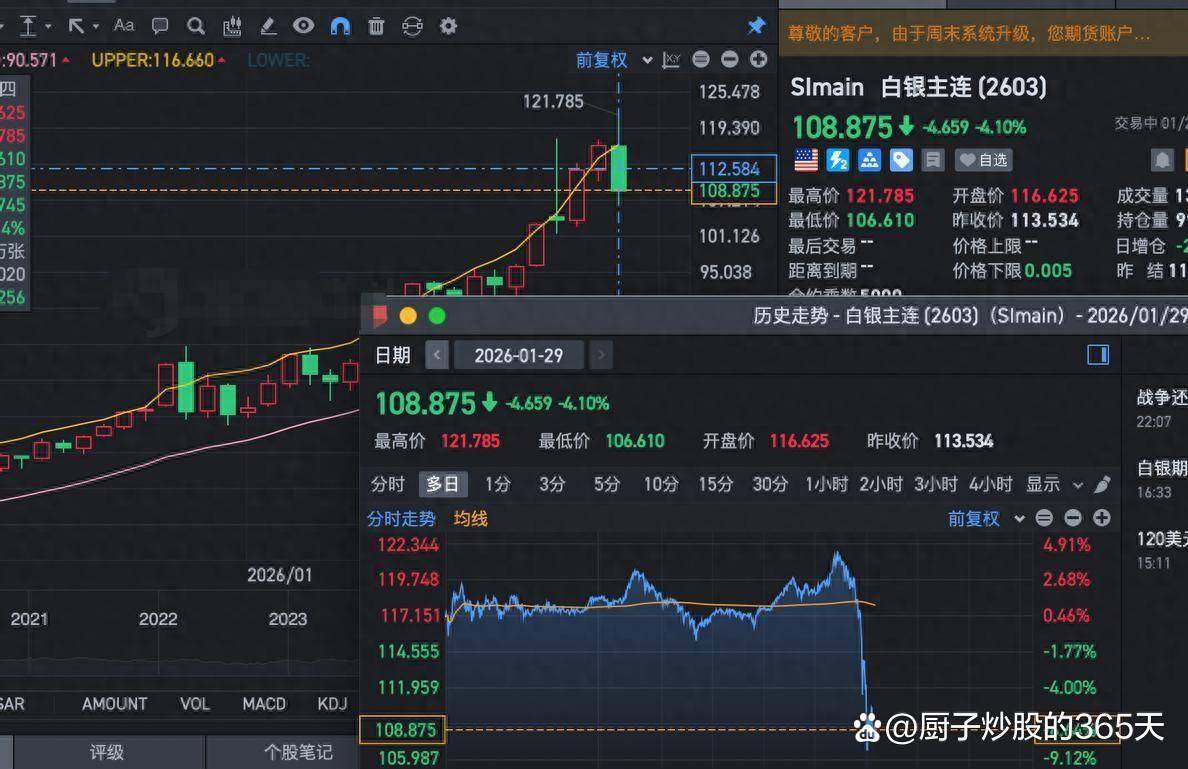
Core Viewpoint - The sudden drop in gold and silver prices on January 29, 2026, was triggered by a combination of factors including the Federal Reserve's hawkish signals and increased margin requirements for precious metals futures [3][4][14]. Group 1: Market Reaction - Silver futures plummeted from approximately $122, down 7% to below $108, marking a decline of over 12% [1] - Gold prices fell from around $5,600 per ounce, down 4% to $5,200, with a total drop of 10% from the peak [1] - The dollar index surged by 1%, while the 10-year U.S. Treasury yield rose by 4 basis points, and the 2-year yield increased by 2.3 basis points [3] Group 2: Federal Reserve's Influence - The Federal Reserve maintained the benchmark interest rate at 3.5%-3.75%, which was expected, but Chairman Powell's comments on persistent inflation due to tariff policies shocked the market [3] - Powell indicated that the anticipated quick return of inflation would not materialize, leading to a consensus that interest rates would remain high for an extended period [3] Group 3: Margin Requirement Changes - The CME Group announced an increase in margin requirements for silver and other precious metals futures, raising the margin for non-high-risk accounts from 9% to 11% and for high-risk accounts from 9.9% to 12.1% [4][5] - This was the second adjustment in a short period, following a change in the margin calculation system that effectively raised trading thresholds [6] Group 4: Speculative Dynamics - In 2025, silver prices rose over 140%, and in January 2026 alone, they increased by over 58%, driven by high leverage speculation [8][9] - The increase in margin requirements led to many leveraged traders facing margin calls, forcing them to sell contracts to reduce risk, which triggered a liquidity crisis in the market [11] Group 5: Market Valuation and Sentiment - Prior to the crash, gold and silver prices had reached unsustainable levels, with gold rising over 34% and silver soaring 234% from their respective starting points [12][14] - The market was characterized by a significant speculative bubble, and the combination of external bearish signals led to a rush to realize profits, resulting in massive sell-offs [14] Group 6: Broader Market Impact - The crash affected global markets, with related stocks and ETFs experiencing significant declines [18][26] - The volatility in the precious metals market led to increased anxiety among investors regarding the value of companies holding large amounts of gold and silver [19][26] - The event highlighted the interconnectedness of liquidity, leverage, and market sentiment, demonstrating how quickly market conditions can shift from euphoria to panic [26]
美元强势压制,黄金还能翻身吗?恐慌性抛售VS主力吸筹,黄金跌势何时能止?Richard正在直播解读中,点击马上观看!
news flash· 2025-05-29 13:00
Core Viewpoint - The article discusses the current challenges facing the gold market, particularly the impact of a strong US dollar and the dynamics between panic selling and institutional buying [1] Group 1 - The strong US dollar is exerting pressure on gold prices, raising questions about the potential for a rebound in the gold market [1] - There is a contrast between panic selling by retail investors and strategic accumulation by institutional players, indicating a complex market environment [1] - The article poses the question of when the downward trend in gold prices might stabilize, reflecting uncertainty in market sentiment [1]