高杠杆

Search documents
《太平年》的财富密码:“南财神”柴荣的理财智慧 | 螺丝钉带你读书
银行螺丝钉· 2026-02-28 13:52
Core Viewpoint - The article discusses the investment insights derived from the historical narratives of two families in the drama "Tai Ping Nian," focusing on the financial wisdom of the Southern God of Wealth, Chai Rong, and the investment legacy of the Qian family from Wu Yue [5][6][8]. Group 1: Chai Rong's Investment Philosophy - Chai Rong, known as the "Southern God of Wealth," started his career in business by engaging in high-margin trades, particularly in tea and porcelain [15][12]. - His approach to establishing a profitable business can be summarized in three paths: high margin, high turnover, and high leverage, with high margin being the most suitable for startups [16][17]. - Chai Rong's significant contributions to state finance included the innovative decision to melt down copper Buddha statues to create currency, addressing liquidity crises during the Five Dynasties and Ten Kingdoms period [18][10]. Group 2: Economic Policies and Reforms - Chai Rong emphasized the importance of logistics and trade, implementing waterway improvements and reducing commercial taxes to facilitate trade and economic growth [21][28]. - He encouraged private enterprise by allowing commercial buildings in the capital, which led to the flourishing of markets and commerce in the Northern Song Dynasty [30][32]. - His policies aimed to create a dynamic economy where money could flow freely, thus generating value and wealth for society [37][33]. Group 3: The Qian Family Legacy - The Qian family, with a history spanning from the late Tang Dynasty to modern times, produced notable figures such as Qian Xuesen and Qian Weichang, showcasing their long-standing investment acumen [39][38]. - The article hints at exploring how the Qian family managed to maintain their investment success and legacy over centuries, indicating a deep-rooted understanding of financial principles [40].


你还想靠白银暴富?从暴涨到崩盘仅用三天,这轮疯涨坑了多少人?
Sou Hu Cai Jing· 2026-02-26 16:49
Core Viewpoint - The silver market experienced extreme volatility in early 2026, with prices soaring from over $80 to $120 per ounce before plummeting back below $80, while gold prices increased by over 30% to surpass $5500 before also declining [1][5]. Group 1: Market Dynamics - The initial trigger for the market upheaval was speculation regarding the potential replacement of the Federal Reserve Chairman, leading to heightened investor anxiety about the independence of the central bank and the safety of the dollar [1][5]. - Three major speculative groups contributed to the silver price surge: hedge funds targeting the already tight silver supply, Chinese retail investors hoarding physical silver during the Spring Festival, and new cryptocurrency investors using high leverage to enter the market [3][5]. - The global silver production is significantly higher than gold, but only a small fraction is available for investment, with the majority used in industrial applications, making the silver market more volatile [3][5]. Group 2: Policy and Market Reaction - The announcement of Kevin Warsh as the new Federal Reserve Chairman marked a turning point, as his hawkish stance and proposed tightening measures led to a loss of confidence in precious metals [5][7]. - The CME raised margin requirements for gold and silver futures, causing a spike in leverage costs and triggering a wave of liquidations among high-leverage investors, particularly in the cryptocurrency derivatives market [5][8]. - The recent turmoil serves as a reminder that market success is not solely dependent on boldness, especially in high-leverage scenarios, and emphasizes the importance of understanding the long-term fundamentals of assets [8]. Group 3: Long-term Outlook - Precious metals like silver and gold remain essential tools for hedging against currency risk, with central banks continuing to purchase gold amid a trend of de-dollarization and increasing global debt issues [7][8]. - The underlying value of precious metals has not changed despite recent volatility, indicating that they will continue to play a critical role in the financial system [7][8].

一夜崩盘!白银一天跌掉16%,比特币跌破7万美元,一条新规,让所有高杠杆瞬间崩塌
Sou Hu Cai Jing· 2026-02-06 16:28
Core Viewpoint - The global financial markets experienced a rare simultaneous decline across various asset classes, including stocks, gold, oil, and cryptocurrencies, indicating a widespread sell-off driven by multiple factors [1][12]. Group 1: Market Reactions - On February 6, 2026, major asset classes such as stocks, gold, and cryptocurrencies all saw significant declines, which is unusual as they typically exhibit a "see-saw" effect [1]. - The Nasdaq index, heavily influenced by technology stocks, experienced a drop of 1.59%, with major companies like Alphabet planning to invest $185 billion in data centers and AI, raising concerns about short-term profitability [7][9]. - The Dow Jones index fell nearly 600 points, and the S&P 500 index lost all gains made in 2026, reflecting a broader market downturn [9]. Group 2: Commodity Market Dynamics - The Shanghai Futures Exchange announced an increase in margin requirements and price limits for various futures contracts, particularly gold and silver, leading to panic selling in the precious metals market [3][5]. - Gold futures saw their price drop below $4,722 per ounce, while silver prices plummeted over 16% from nearly $80 to around $67 per ounce, marking the largest single-day decline in years [5][11]. - The increase in margin requirements raised trading costs and forced leveraged traders to either add funds or liquidate positions, exacerbating the sell-off [3][4]. Group 3: Currency and Economic Factors - A rumor regarding a hawkish candidate for the next Federal Reserve chair raised concerns about potential interest rate hikes, which could tighten dollar liquidity and negatively impact asset prices [5][7]. - The strengthening of the U.S. dollar further pressured dollar-denominated commodities like gold and oil, contributing to the downward trend in these markets [7][11]. Group 4: Cryptocurrency Market Impact - The cryptocurrency market, known for its volatility, was severely affected, with Bitcoin dropping below $70,000 and experiencing a nearly 10% decline in a single day [9][11]. - Over 430,000 trading accounts were liquidated within 24 hours due to forced sell-offs triggered by price volatility, indicating a loss of interest from traditional institutional investors [9][11]. Group 5: Broader Economic Implications - The simultaneous tightening of trading rules, expectations of reduced liquidity, and rising corporate expenditure forecasts led to a collective reassessment of asset values across the board [12]. - The geopolitical landscape also shifted, with easing tensions in the Middle East contributing to a decline in oil prices, as concerns over supply disruptions diminished [11][12].
V 型反弹惊魂一幕:亚太市场止跌背后的波动逻辑与风险启示
Sou Hu Cai Jing· 2026-02-06 07:22
Core Viewpoint - The recent market volatility, characterized by a rapid switch between panic and recovery, highlights the fragility of the current market environment, driven by high valuations, high leverage, and strong asset interconnectivity [2] Group 1: Causes of Volatility - The current market adjustment is not triggered by a single event but is a culmination of multiple risk factors, including weak U.S. employment data and the high valuations of technology stocks over the past six months, which have led to capital withdrawal [3] - The strong interconnectivity among core assets and high-leverage trading have amplified panic, with technology stocks acting as the "leading engine of decline," directly impacting related markets like cryptocurrencies, where the correlation coefficient between Bitcoin and tech stocks has remained above 0.8 [3] - Over $2.3 billion in long positions in the Bitcoin market were liquidated within 24 hours, exacerbated by rising margin requirements for silver, leading to a "liquidation-style sell-off" [3] Group 2: Stabilization Factors - The rapid recovery in the Asia-Pacific market is attributed to three main factors: the exhaustion of selling pressure in technology stocks, the triggering of technical buy orders at key support levels, and a marginal easing of regulatory policy expectations [4] - After the overnight sell-off, some technology giants saw their price-to-earnings ratios revert to near their one-year averages, attracting long-term capital for bargain hunting [4] - Bitcoin rebounded after breaking below the $60,000 mark, hitting a previous high transaction area, while gold also saw a rebound after dropping below the $4,700 support level [4] Group 3: Market Outlook - The market is likely to maintain a volatile pattern in the short term, as technology stock valuations still require time to adjust, and the high-leverage risks in cryptocurrencies and precious metals have not been fully released [7] - Long-term, the technological advancements in the tech industry and global demand for safe-haven assets will support the long-term value of core assets, but investors should remain cautious of "valuation corrections" and "policy adjustments" that may exert short-term pressure [7] - The recent V-shaped rebound serves as a typical manifestation of the rapid release of panic in capital markets, signaling the need for investors to adhere to principles of low leverage, diversification, and a focus on fundamentals in a high-volatility environment [7]

金银暴跌带崩全场!亚洲股市遭遇黑色星期一:都是“高杠杆”惹的祸
智通财经网· 2026-02-02 09:34
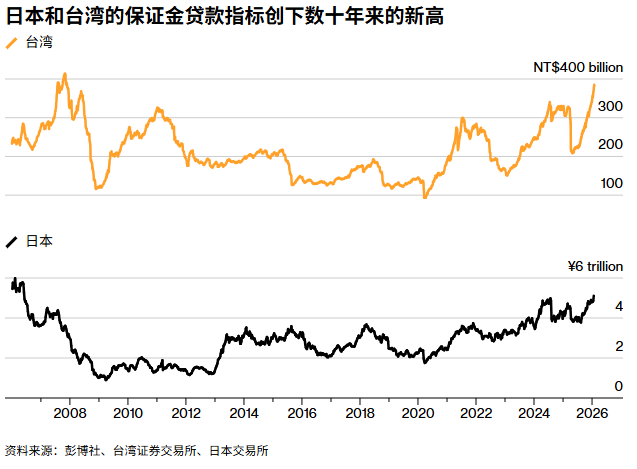
Core Insights - The scale of margin debt used for stock purchases has reached a historical high since the global financial crisis, providing key insights into the recent sharp declines in Asian stock markets following sell-offs in precious metals [1][5] - The outstanding margin trading debt in Chinese stock exchanges has surged to a record high, coinciding with a significant inflow into gold and silver ETFs [1][5] Group 1: Margin Debt and Market Reactions - The outstanding margin debt in Chinese stock exchanges has reached a record high, indicating increased leverage in the market [1][6] - Margin debt indicators in Taiwan and Japan have also surged to levels not seen since the 2008 financial crisis, when gold, silver, and global stock markets peaked [1][5] - The rapid sell-off in precious metals and stocks has led to speculation that leveraged investors are being forced to liquidate assets to meet financing needs [5] Group 2: Market Performance and Strategies - Precious metals experienced their largest single-day drop in over a decade, contributing to widespread sell-offs in Asian stock markets [5] - The South Korean market, heavily weighted in technology stocks, saw a decline of over 5% in the KOSPI index, while stock index futures in Taiwan, the US, and Europe fell by more than 1% [5] - Nick Ferres, CIO of Vantage Point Asset Management, noted that the rapid liquidation across multiple asset classes signals that leveraged funds are exiting the market, prompting a shift towards defensive strategies with increased allocations to short-term bonds [5]
晚间利空!美联储公开1月份议息会议结果,黄金白银直线下降
Sou Hu Cai Jing· 2026-01-30 16:51
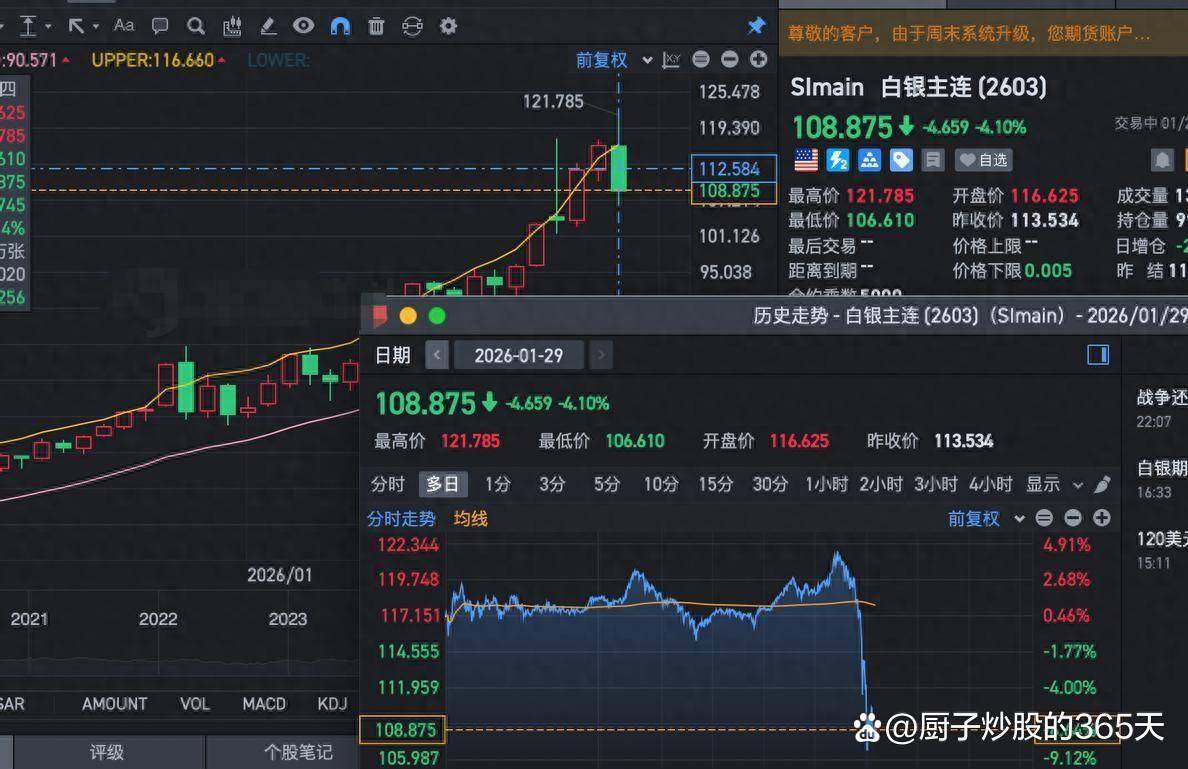
Core Viewpoint - The sudden drop in gold and silver prices on January 29, 2026, was triggered by a combination of factors including the Federal Reserve's hawkish signals and increased margin requirements for precious metals futures [3][4][14]. Group 1: Market Reaction - Silver futures plummeted from approximately $122, down 7% to below $108, marking a decline of over 12% [1] - Gold prices fell from around $5,600 per ounce, down 4% to $5,200, with a total drop of 10% from the peak [1] - The dollar index surged by 1%, while the 10-year U.S. Treasury yield rose by 4 basis points, and the 2-year yield increased by 2.3 basis points [3] Group 2: Federal Reserve's Influence - The Federal Reserve maintained the benchmark interest rate at 3.5%-3.75%, which was expected, but Chairman Powell's comments on persistent inflation due to tariff policies shocked the market [3] - Powell indicated that the anticipated quick return of inflation would not materialize, leading to a consensus that interest rates would remain high for an extended period [3] Group 3: Margin Requirement Changes - The CME Group announced an increase in margin requirements for silver and other precious metals futures, raising the margin for non-high-risk accounts from 9% to 11% and for high-risk accounts from 9.9% to 12.1% [4][5] - This was the second adjustment in a short period, following a change in the margin calculation system that effectively raised trading thresholds [6] Group 4: Speculative Dynamics - In 2025, silver prices rose over 140%, and in January 2026 alone, they increased by over 58%, driven by high leverage speculation [8][9] - The increase in margin requirements led to many leveraged traders facing margin calls, forcing them to sell contracts to reduce risk, which triggered a liquidity crisis in the market [11] Group 5: Market Valuation and Sentiment - Prior to the crash, gold and silver prices had reached unsustainable levels, with gold rising over 34% and silver soaring 234% from their respective starting points [12][14] - The market was characterized by a significant speculative bubble, and the combination of external bearish signals led to a rush to realize profits, resulting in massive sell-offs [14] Group 6: Broader Market Impact - The crash affected global markets, with related stocks and ETFs experiencing significant declines [18][26] - The volatility in the precious metals market led to increased anxiety among investors regarding the value of companies holding large amounts of gold and silver [19][26] - The event highlighted the interconnectedness of liquidity, leverage, and market sentiment, demonstrating how quickly market conditions can shift from euphoria to panic [26]
高人预测:如果不出意外,2026年楼市将迎来3个“趋势”,太真实
Sou Hu Cai Jing· 2026-01-28 11:45
Group 1 - The core sentiment around home buying has shifted from urgency to concern about potential losses and resale value, indicating a significant change in market psychology [2] - The real estate market is expected to evolve along three clear trends by 2026, reflecting a new market logic [2] Group 2 - Price declines in the housing market are no longer uniform; a stark differentiation is emerging, with significant disparities between cities and property types [4] - A phenomenon of "structural decline" is becoming evident, where core areas in first-tier and strong second-tier cities maintain stable prices, while weaker areas face severe price drops [6][8] Group 3 - The traditional high-leverage, high-turnover model of real estate development has been fundamentally disrupted, leading to widespread debt defaults among numerous developers [10][12] - Stronger companies, such as Longfor and China Resources, have diversified their operations and established stable cash flows through commercial and long-term rental properties, allowing them to weather the downturn [12][14] Group 4 - The shift towards "current sales" instead of pre-sales is gaining momentum, aimed at reducing the risk of unfinished projects and enhancing buyer confidence [16][18] - Nearly 40 cities have begun piloting or implementing policies for current sales, with a significant increase in the proportion of new homes sold as current properties, rising from approximately 10% in 2019 to about 35% by early 2025 [19][21] Group 5 - The transition to current sales poses a significant challenge for developers, as they can no longer rely on pre-sale funds for project financing, leading to longer capital recovery cycles [23]

香港药妆零售之王龙丰集团欲在港上市,是机会还是风险?
Sou Hu Cai Jing· 2026-01-12 15:46
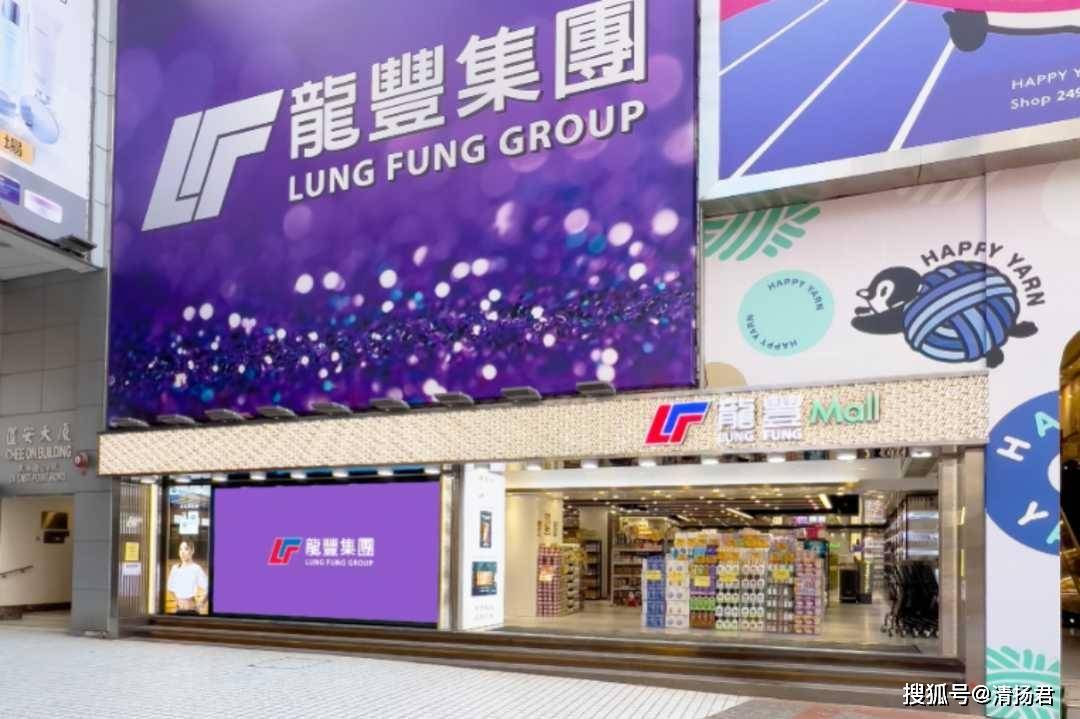
Core Viewpoint - Long Fung Group Holdings Limited, a well-known drugstore chain in Hong Kong, has submitted its application for an IPO on the Hong Kong Stock Exchange, raising questions about whether this is a chance for value reassessment or a high-leverage gamble given the current market conditions [1] Financial Performance - Long Fung Group is projected to achieve a revenue increase from HKD 1.094 billion to HKD 2.460 billion from fiscal year 2023 to 2025, with a compound annual growth rate (CAGR) of 50% [3] - Gross profit margin is expected to rise from 24.9% to 31.6% during the same period, with net profit turning positive at HKD 145 million in fiscal year 2024 and increasing to HKD 170 million in fiscal year 2025 [3] - In the first quarter of fiscal year 2026, profits surged by 130.7% year-on-year, indicating strong growth momentum [3] Market Position - Long Fung Group holds a 5.2% market share, making it the largest pharmaceutical retailer in Hong Kong, and has the highest average SKU count per store at approximately 6,500 [3] - The flagship store in Mong Kok, spanning 17,500 square feet, exemplifies its "supermarket-style drugstore" model, combining pharmaceuticals, beauty products, and daily necessities [3] Financial Structure and Risks - As of June 30, 2025, Long Fung Group's net current liabilities reached HKD 332 million, with short-term borrowings of HKD 625 million and cash equivalents of only HKD 33.6 million, indicating a reliance on supplier credit and bank financing [4] - The company has a staggering debt-to-asset ratio of 809.4%, with negative net assets, as nearly all assets are mortgaged for financing [4] - Revenue is heavily dependent on the Hong Kong market, with 97.2% coming from physical stores concentrated in tourist areas, making it vulnerable to fluctuations in tourist traffic [4] Online Presence and Competition - Online revenue for fiscal year 2025 is projected at only HKD 43 million, accounting for 1.7% of total revenue, and has been declining for three consecutive years [5] - The company’s online strategy lacks effective user engagement, contrasting sharply with competitors like Watsons and Mannings [5] Governance and Management Concerns - The governance structure raises concerns, with the family of the founder holding 100% control through TTK Holding, leading to frequent related-party transactions [5] - As of 2025, receivables from related parties amounted to HKD 289 million, nearly 40% of current assets, and significant dividends were paid to core subsidiaries before the IPO [5] Growth Drivers - The recovery of tourism spending post-2023 and the expansion from 13 to 29 stores are key growth factors, along with an increase in proprietary brand sales to 13.6%, enhancing overall gross margins [6] Competitive Advantages - Long Fung Group benefits from a deep understanding of local consumer culture, a vast SKU assortment, a professional team of pharmacists and beauty consultants, and a procurement office in Japan, creating competitive barriers [7] Future Expansion Challenges - The company plans to open up to 11 new stores by 2029, but faces challenges due to rising vacancy rates and high rental costs in Hong Kong [8] - Same-store sales growth has dropped from 64% to 5.6%, indicating diminishing returns on expansion efforts [8] - The potential for growth in the Greater Bay Area remains unproven, raising questions about the sustainability of its "drugstore king" title beyond Hong Kong [8]
恒大梦魇:起底夏海钧的20亿薪酬、财务造假与跨国追责
Xin Lang Cai Jing· 2026-01-05 03:37
Core Viewpoint - The legal troubles of Xia Haijun, former CEO of Evergrande Group, are closely tied to the company's collapse, with a global Mareva injunction preventing him from transferring or disposing of assets worth HKD 60 billion [2][3]. Group 1: Legal and Financial Issues - The Mareva injunction is a cross-border asset freezing measure aimed at preventing the defendant from transferring or disposing of assets during litigation, ensuring the enforcement of final judgments [3]. - The injunction prohibits Xia from transferring HKD 60 billion in assets within Hong Kong and from disposing of proceeds from the sale of his luxury property [3]. - Xia's attempts to lift the injunction have been unsuccessful, with multiple court rejections from July 2024 to January 2026 [3]. Group 2: Compensation and Corporate Governance - Xia Haijun received approximately HKD 2 billion in compensation during his 15 years at Evergrande, with his salary peaking at HKD 270 million in 2016 [4]. - His compensation growth was closely linked to the company's rapid expansion, which raised concerns about the alignment of executive incentives with long-term risk management [4][8]. Group 3: Financial Misconduct - Xia played a central role in financial fraud at Evergrande, overseeing the preparation of false financial reports that inflated revenues and profits significantly in 2019 and 2020 [5][6]. - The inflated financial data was used as a basis for issuing over HKD 20 billion in corporate bonds, raising questions about the integrity of the company's financial practices [5]. - Following the exposure of Evergrande's debt crisis, Xia engaged in significant asset liquidation, selling bonds and shares at steep discounts, which was perceived as an attempt to mitigate personal risk [6]. Group 4: Broader Implications - Xia's strategies contributed to the aggressive leverage model that defined Evergrande's rapid growth, which ultimately proved unsustainable when market conditions shifted [8]. - The ongoing legal proceedings against Xia reflect broader systemic issues within the Chinese real estate sector, where accountability for the crisis remains a contentious topic [9].

恒大前总裁夏海钧资产冻结案持续发酵,司法机关四次驳回其上诉
Jing Ji Guan Cha Wang· 2026-01-04 04:16
Core Viewpoint - The former president of Evergrande Group, Xia Haijun, has been attempting to transfer his substantial assets in Hong Kong amid the company's debt crisis, but Hong Kong's judicial system has consistently blocked these efforts, indicating a firm stance against evasion of legal responsibilities [2][3]. Group 1: Legal Proceedings - On January 2, 2026, the Hong Kong Court of Appeal rejected Xia Haijun's application to lift a global Mareva injunction aimed at preventing asset transfers, which was originally issued in 2024 to protect the interests of Evergrande's liquidators [2]. - This injunction restricts Xia from transferring assets valued at up to HKD 60 billion and freezes the proceeds from the sale of specific properties [2]. - The court's decision marks the fourth time Hong Kong's judiciary has denied Xia's attempts to revoke or lift the asset freeze, demonstrating a commitment to holding executives accountable during the Evergrande debt crisis [2][3]. Group 2: Asset Disposal and Financial Irregularities - Xia Haijun's unusual asset disposal activities have raised alarms, including his attempt to sell a Hong Kong property at a significant loss, indicating a potential effort to evade accountability [3]. - The liquidators of Evergrande filed for the Mareva injunction after discovering Xia's plan to sell a luxury villa for HKD 82 million, a nearly 50% loss from its purchase price of approximately HKD 160 million [3]. - Xia's professional history is closely tied to Evergrande's rise and fall, having played a crucial role in the company's operations and capital management, which contributed to its high-leverage business model [4]. Group 3: Regulatory Actions and Financial Penalties - The China Securities Regulatory Commission found that Xia Haijun was involved in fabricating financial reports, leading to inflated profits of over RMB 40 billion and RMB 50 billion in 2019 and 2020, respectively [4]. - As a result, he was fined RMB 15 million and banned for life from the securities market, with the regulatory body describing his actions as particularly severe [4]. - Evergrande is also pursuing the recovery of approximately USD 6 billion in salaries, bonuses, and dividends paid to Xia and other former executives from 2017 to 2020, highlighting the financial misconduct during his tenure [4].