情感大模型

Search documents
AI陪伴公司自然选择完成3000万美元融资,阿里蚂蚁等机构加持
机器人圈· 2026-01-22 09:17
Group 1 - The core viewpoint of the article is that Nature Select, an AI companionship company, has successfully completed a new funding round exceeding $30 million, with investments from major firms including Alibaba and Ant Group [1] - Nature Select was founded in February 2024 by Zhang Xiaofan, a serial entrepreneur in the AI companionship sector, who is also the CEO of the game developer Mirage Games [1] - The company's primary product is a female-oriented project called "EVE," which is described as the world's first 3D AI intelligent companionship application, aiming to create deep emotional connections similar to the experience depicted in the movie "Her" [1] Group 2 - Nature Select has introduced a position called "Emotional Interaction Designer" to enhance the emotional intelligence of its AI [1] - The company launched its first emotional large model, Echo-N1, this year, proposing a new emotional model training method and a benchmark specifically designed to measure emotional intelligence, marking the first application of reinforcement learning in the subjective emotional domain [1] - In 2024, Nature Select proposed a long-term memory solution with 128 dynamic memory slots, and by 2025, it enhanced the memory system with a multi-dimensional graph-based retrieval augmented generation (graphRAG) [1]


「自然选择」融资3000万美元,阿里、蚂蚁布局AI陪伴
暗涌Waves· 2026-01-20 00:57
Core Insights - The article discusses the recent funding round of AI companionship company "Nature Select," which raised over $30 million from investors including Alibaba and Ant Group [2] - The AI companionship sector faced challenges in 2025, with products like C.ai being perceived as having low growth potential and commercialization difficulties [3] - "Nature Select" has redefined AI companionship through five dimensions, including proactive engagement, emotional intelligence, long-term memory, high immersion, and breaking the dimensional barrier between virtual and real life [4] Funding and Investment - "Nature Select" completed a funding round exceeding $30 million, with participation from notable investors such as Alibaba, Ant Group, and others [2] - The investment is driven by the company's innovative approach to AI companionship, particularly its proactive agent interaction model [7] Product Development - The company launched its AI product "EVE," which features a unique interaction model that combines emotional intelligence and long-term memory capabilities [4][7] - EVE's memory system has evolved to include 128 dynamic memory slots and a multi-dimensional graph-based memory system [7] Market Position and Competitive Advantage - "Nature Select" stands out in the increasingly crowded AI companionship market due to its combination of AI expertise and a background in gaming, allowing for advanced 3D visuals and gamified design [7] - The company aims to create a new interactive experience that accumulates user context and memory through a natural and engaging interface [7] Future Vision - The ultimate goal of "Nature Select" is to create a world where silicon-based life forms coexist with humans, indicating a long-term vision for the integration of AI into daily life [8]

腾讯研究院AI速递 20251211
腾讯研究院· 2025-12-10 16:01
Group 1 - OpenAI's new image models Chestnut and Hazelnut are set to debut alongside GPT-5.2, but initial tests show they lag behind Google's Nano Banana Pro in generating high-quality images, particularly in facial rendering [1] - Mistral AI has released its next-generation code models, Devstral 2 and Devstral Small 2, achieving 72.2% and 68.0% on SWE-bench Verified, respectively, with a cost efficiency seven times higher than Claude Sonnet [2] - Zhiyu has launched the GLM-ASR-2512 cloud model and GLM-ASR-Nano-2512 edge model, achieving a CER of 0.0717, marking a significant advancement in speech recognition technology [3] Group 2 - Alibaba's Tongyi Lab introduced the Qwen-Image-i2L open-source tool, allowing personalized style transfer with just one sample, and offers various model variants optimized for different applications [4] - The Echo-N1 emotional model, with 32 billion parameters, outperformed a 200 billion parameter commercial model in multi-turn emotional support tasks, showcasing advancements in AI emotional intelligence [6] - The formation of the Agentic AI Foundation by major tech companies aims to establish interoperability standards for AI agents, with OpenAI contributing foundational standards already adopted by over 60,000 open-source projects [7] Group 3 - AI tools have been successfully utilized to design antibody-like molecules, with companies like Nabla Bio and Chai Discovery producing drug-like antibodies that target various diseases [8] - Anthropic's 14,000-word "AI Constitution" aims to guide AI behavior towards positive values, with a small team monitoring its real-world applications and potential risks [9]


大模型「有心了」:首个情感大模型Echo-N1,32B胜过200B
机器之心· 2025-12-10 02:09
Core Insights - The article discusses the breakthrough of Team Echo in developing the first emotional large model, Echo-N1, which successfully applies reinforcement learning (RL) to the subjective domain of emotions, overcoming the limitations of traditional models [3][10]. Group 1: Emotional Model Challenges - Traditional large language models (LLMs) struggle with emotional understanding, often providing generic responses that lack depth [2]. - Existing models face three main issues: inability to quantify emotions, reward hacking leading to superficial responses, and evaluation distortion where models cannot distinguish human-like expressions from AI-generated ones [7][8]. Group 2: Innovations in Emotional Training - Team Echo introduced a new training method that incorporates a "heart" into RL, resulting in Echo-N1 achieving a success rate of 46.7% in emotional tasks, significantly outperforming other models [10]. - The team proposed an "Empathy Psychophysical Model" (EPM) that quantifies empathy, transforming it into a calculable physical process [19][22]. Group 3: Generative Reward Model - Echo-N1 utilizes a generative reward model that requires the model to generate a logical emotional reasoning path before producing responses, enhancing the accuracy of emotional feedback [14][15]. - The model incorporates human-like rewards and empathy rewards to ensure responses are context-aware and resonate with users' emotional needs [16]. Group 4: Evaluation and Performance - The evaluation of AI empathy has shifted from static scoring to dynamic interaction assessments, with EPM providing a scientific measure for empathy and healing [18][19]. - In rigorous testing, the base model Qwen3-32B failed with a 0% success rate, while Echo-N1 excelled, demonstrating the necessity of specialized training for genuine empathetic capabilities [26][30]. Group 5: Future Implications - The emergence of Echo-N1 indicates that AI's emotional intelligence can be quantified and optimized, paving the way for more emotionally aware AI companions [37][39]. - This research opens new possibilities for applying RL in subjective and unquantifiable areas, potentially transforming AI interactions into more meaningful experiences [38].
字节藏了一手“牌”
虎嗅APP· 2025-07-12 09:27
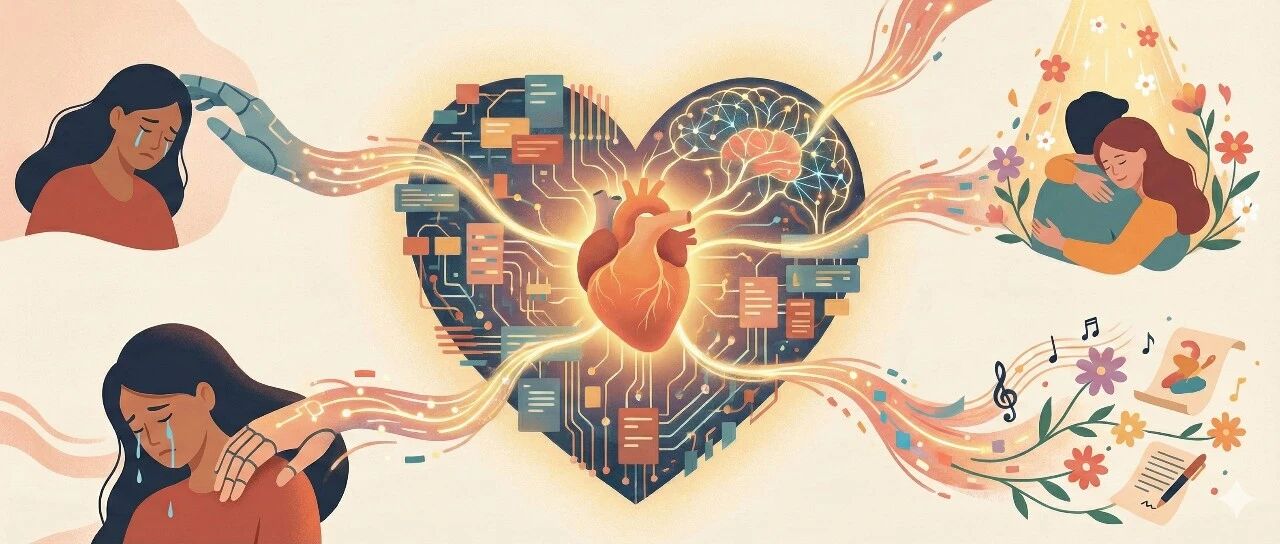
Core Viewpoint - The article discusses the emerging trend of "emotional large models" in AI, highlighting their potential to enhance user interaction by understanding and responding to human emotions, thus transforming AI from mere tools to emotional companions [3][5][6]. Group 1: Emotional Large Models Overview - "Emotional large models" differ from traditional chatbots by focusing on user emotional experiences, utilizing techniques to analyze tone, pauses, and expressions to generate emotionally appropriate responses [5][6]. - The technology evolution of "emotional large models" is driven by two paths: enhancing multimodal emotional computing capabilities on general models and developing specialized generative models focused on emotional understanding [7][8]. Group 2: Market Potential and Growth - The emotional AI companion market is expected to experience explosive growth, with the number of active users increasing 30 times from 2018 to 2023, and the global market size projected to rise from $30 million in 2023 to $150 billion by 2030, reflecting a compound annual growth rate of 236% [8][9]. - Character.AI has seen significant user engagement, with mobile downloads exceeding 34.32 million and web visits reaching 310 million in a single month, indicating strong market interest [9]. Group 3: Technical Aspects and Implementation - Emotional large models require more NLP experts and a different computational approach compared to traditional models, with a 30%-50% higher computational demand during training to maintain effectiveness [10]. - The development of emotional models in China is approximately one year behind that of international counterparts, with advancements in multimodal learning and mixed expert models [10]. Group 4: Industry Applications and Innovations - Companies are launching various AI companions and toys, such as Miko's AI partner and Curio's AI toys for children, indicating a trend towards integrating emotional AI into consumer products [12]. - ByteDance plans to leverage emotional large models to double the monthly active users of its product "Doubao" by 2025, focusing on entertainment, social interaction, and personalized services [14]. Group 5: Future Directions and Challenges - The emotional large model trend is expected to accelerate the upgrade of consumer robots, with global shipments projected to reach 47 million units in 2024, and a compound growth rate exceeding 20% over the next five years [16]. - Challenges remain, including non-linear growth in computational demands, long-term memory capabilities, and data privacy concerns, which could serve as barriers or protective measures for businesses in the future [16].

字节藏了一手“牌”
Hu Xiu· 2025-07-12 07:27
Core Insights - ByteDance is focusing on "emotional large models" to provide API calls and AI dialogue solutions for enterprises, indicating a strategic shift towards enhancing user emotional experiences in AI interactions [1][2][4] - The development of "emotional large models" is seen as a significant trend in AI, moving from mere tools to emotional companions, which opens new application scenarios [5][7] Group 1: Emotional Large Models Overview - "Emotional large models" differ from traditional chatbots by emphasizing emotional understanding and user experience, utilizing voice tone, pauses, and expressions to generate appropriate responses [3][4] - The technology evolution of "emotional large models" is driven by two paths: enhancing multimodal emotional computing capabilities on general large models and focusing on generative models specifically for emotional applications [5][6] Group 2: Market Trends and Growth Potential - The AI companionship market is expected to see explosive growth, with the number of active users increasing 30 times from 2018 to 2023, and the global market size projected to rise from $30 million to $150 billion between 2023 and 2030, with a CAGR of 236% [7] - Character.AI exemplifies the potential of "emotional large models" by enabling interactive AI character experiences, with significant user engagement reflected in its mobile downloads and web traffic [8][10] Group 3: Technical Aspects and Challenges - "Emotional large models" require more NLP experts and have different parameter and computational needs compared to traditional models, with training requiring 30%-50% more computational power [10][11] - The current gap in development between domestic and international "emotional large models" indicates that domestic advancements are approximately one year behind [11] Group 4: ByteDance's Strategic Positioning - ByteDance plans to leverage various vertical large models to double the monthly active users of its product Doubao by 2025, focusing on entertainment, social, and gaming scenarios [14] - The integration of "emotional large models" with hardware like smart speakers and AI companions is part of ByteDance's strategy to enhance user interaction and experience [14][15]