技术依赖

Search documents
贺克斌:迈向碳中和,技术依赖成全球能源竞争新焦点
2 1 Shi Ji Jing Ji Bao Dao· 2025-12-18 11:56
Core Insights - The world economy is shifting from "resource dependence" on energy to "technology dependence," with key technologies determining future development [1] - China's dual carbon action is essential not only for climate change mitigation but also for addressing conventional environmental pollution, enhancing industrial upgrades, and improving economic competitiveness [1] Group 1: China's Renewable Energy Leadership - By the end of 2024, China's renewable energy installed capacity is expected to reach nearly 1.9 billion kilowatts, with energy storage capacity at 70 million kilowatts, leading globally [2] - In the first half of 2025, global renewable energy generation is projected to surpass coal power for the first time, with China contributing 55% of the new capacity [2] - China aims to peak coal and oil consumption during the 14th Five-Year Plan and has submitted its 2035 Nationally Determined Contribution (NDC 3.0), committing to a 7%-10% reduction in greenhouse gas emissions from 2030 to 2035 [2] Group 2: Key Technology Directions for Carbon Neutrality - Achieving carbon neutrality requires support from hundreds of technologies, categorized into four core areas: silicon energy, energy storage, hydrogen energy, and smart technologies [2] - China has established a leading advantage in silicon energy (solar and wind power) but faces challenges in international industrial collaboration [2] - Emerging disruptive technologies such as high-altitude wind energy, nuclear fusion, and carbon dioxide resource utilization could create new market opportunities [2] Group 3: Challenges in Global Carbon Neutrality - The transition to carbon neutrality faces three significant challenges: 1. Technological innovation, with about half of the technologies needed for the 2050 carbon neutrality goal not yet commercialized [3] 2. Supply chain and resource challenges, as demand for critical minerals (like lithium, cobalt, and rare earths) will surge, potentially leading to resource constraints and price volatility [3] 3. Regulatory and mechanism challenges, including new international coordination issues such as green trade barriers [3] Group 4: China's Path and Drivers for Carbon Neutrality - To achieve carbon neutrality, China needs to promote around 300 key technologies, with about half currently in demonstration or laboratory stages, and 70% in the industrial sector [4] - The transition from "energy consumption dual control" to "carbon emission dual control" during the 14th Five-Year Plan is a critical policy driver that will significantly impact local development and industrial layout [4] - The national carbon market is a core lever for balancing technology costs, with future carbon price increases expected to enhance the economic viability of low-carbon technologies [4]
企业家人工智能应用报告④|数据安全、投资回报最受企业关注
Sou Hu Cai Jing· 2025-07-29 12:36
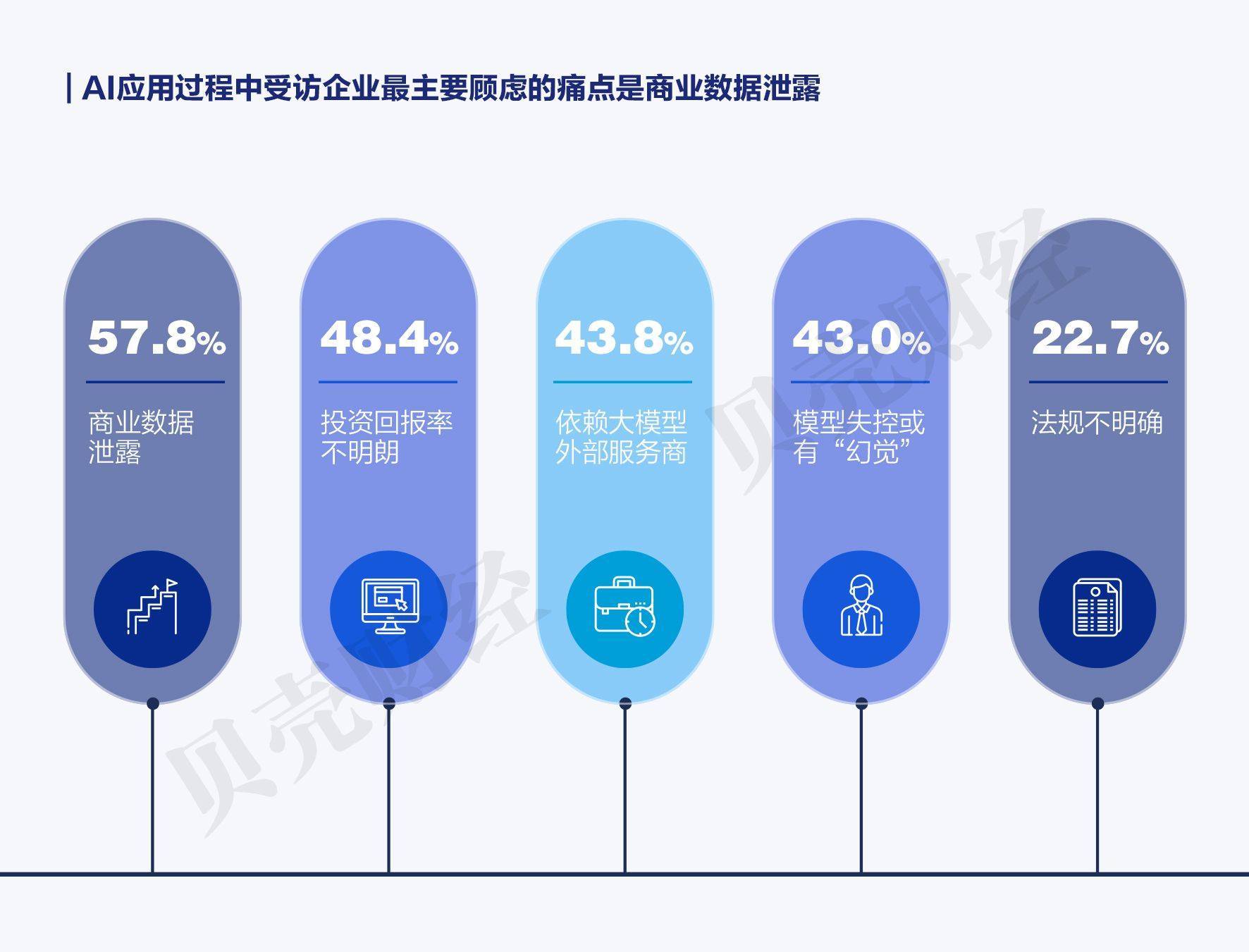
Core Insights - The integration of artificial intelligence (AI) into business management is accelerating, transforming from an auxiliary tool to a new "productivity system" in the context of a restructured global trade landscape and a stable Chinese economy [1] - The "2025 New Beijing News Beike Finance Annual Conference" revealed the top ten trends in AI application among Chinese enterprises, based on a survey covering 18 industries and 128 business leaders [1] Group 1: AI Application Concerns - Enterprises are primarily concerned about "data risks," "economic returns," and "technological dependence" in AI implementation [2][3] - 57.81% of enterprises express concerns regarding "data security and compliance," while 43.75% worry about "over-reliance on large model platform providers" [3][6] - The focus on "input-output ratio" indicates a shift from mere AI pilot projects to a demand for tangible benefits and resource efficiency [6] Group 2: Policy Expectations - 62.5% of enterprises call for enhanced training for AI application, 60.16% seek subsidies for small and medium-sized enterprises (SMEs), and 51.56% emphasize the need for data security and compliance guidelines [8][11] - The demand for AI training reflects a recognition that successful AI deployment requires widespread organizational capability, not just technical expertise [11] - The shift in policy expectations from "visionary guidance" to "practical tools" indicates that enterprises are ready to move from observation to active AI implementation [12]