技术成熟度曲线

Search documents
【广发宏观文永恒】技术浪潮驱动,产业范式重构:中长期宏观环境展望
郭磊宏观茶座· 2026-02-12 02:09
Core Viewpoint - Each technological revolution initially enhances production efficiency, subsequently leading to changes in economic structure, industry patterns, and asset allocation models. The driving force behind technology's evolution from inception to widespread adoption is not merely a breakthrough in a single technology, but rather the penetration, diffusion, and deep integration of new technologies within the economic system [1][13]. Group 1: Technological Revolution Phases - Since the Industrial Revolution, global economies experience a "great wave" driven by significant technological clusters approximately every 50-60 years, establishing a new "technology-economy paradigm" that optimizes production, organization, and management models [2][17]. - Each technological revolution can be divided into two main phases: the Installation Period and the Deployment Period. The Installation Period is characterized by infrastructure reconstruction, trial-and-error business models, and financial capital accumulation, further divided into the outbreak and frenzy stages. The Deployment Period features comprehensive technology dissemination and the establishment of economic paradigms, further divided into the synergy and maturity stages [2][17]. Group 2: Capital Forms and Their Roles - The "great wave" theory distinguishes between two forms of capital: financial capital and production capital. Financial capital is adept at trend identification, flexibility, speculation, and short-term profit orientation, while production capital focuses on industry realization, stability, path dependence, and long-term investment orientation. During the Installation Period of technological revolutions, financial capital typically takes the lead, while production capital assumes a dominant role during the Deployment Period [3][20]. Group 3: Economic Impacts of Technological Revolutions - In the Installation Period of a technological revolution, the overall economy may face pressure, and the differentiation between new and old industries may widen. New technologies are still in the nurturing phase and may not broadly stimulate related industries, employment, or productivity [5][29]. - During the Deployment Period, overall economic pressure is expected to ease, and the differentiation between new and old industries may narrow. New technologies become widely applied, leading to new products, business forms, and industries, which can create new employment forms [5][30]. Group 4: Global Dynamics and Catch-Up Opportunities - The "great wave" theory indicates that the Installation Period of each technological revolution provides critical catch-up windows for latecomer countries. Historical examples include Germany and the U.S. surpassing the U.K. before World War II, and the post-war rise of Japan and other economies [7][40]. - Latecomer countries can leverage their "latecomer advantage" by utilizing labor cost and technology transfer advantages to achieve leapfrog development, mastering key core technologies that drive the development of leading industries [7][40]. Group 5: Future Implications and Trends - The emergence of AI as the core technology of the sixth technological revolution is expected to enhance productivity across all sectors, breaking traditional growth bottlenecks. The scenario of AI's application is anticipated to evolve significantly, particularly in countries with favorable conditions for technology integration [10][12]. - The theory also suggests that macroeconomic policies should promote overall rebalancing, including actively expanding total demand and ensuring employment stability during the technological revolution's Installation Period [12][13].


AI为什么还没有替代你的工作?
Hu Xiu· 2025-05-30 05:48
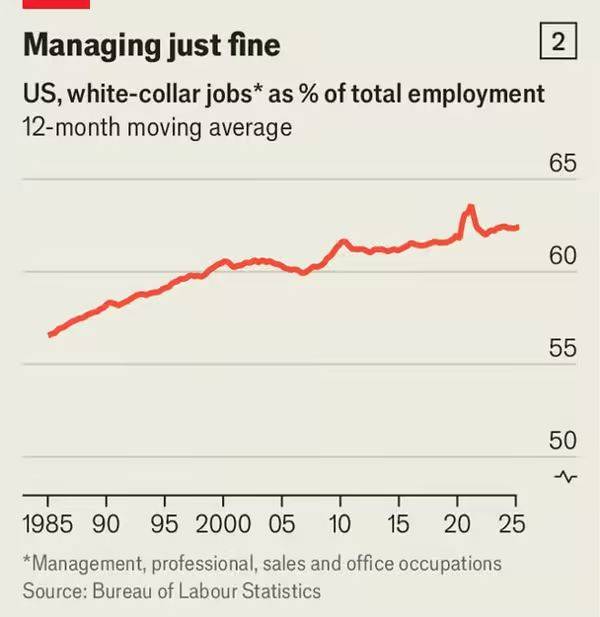
Group 1: Employment Trends - Despite concerns about automation leading to job losses, the number of professionals in interpreting and translation has increased by 7% over the past year in the U.S., indicating that AI may enhance efficiency and create new demand in certain sectors [1] - The unemployment rate for recent graduates is approximately 4%, which is historically low, suggesting that attributing job market challenges solely to AI lacks sufficient evidence [5] - Employment in white-collar jobs has slightly increased over the past year, even in roles considered most susceptible to AI impact [5] Group 2: Corporate Attitudes Towards AI - A notable shift in attitude is observed in companies like Klarna, where the CEO emphasized the continued necessity of human intervention in customer service despite AI automation [3] - Less than 10% of U.S. companies have scaled AI applications in core business processes, indicating that while enthusiasm for AI is high, practical implementation remains limited [7] - AI is primarily enhancing existing employee productivity rather than directly replacing jobs, allowing workers to focus on more creative and strategic tasks [7] Group 3: Investment and Market Sentiment - The capital market has shifted from initial enthusiasm for AI to a more cautious stance, with many companies feeling pressure after failing to achieve expected returns on AI investments [9] - The percentage of companies abandoning AI pilot projects has risen from 17% to 42% over the past year, reflecting challenges in effectively integrating AI into existing business models [9][12] - Major tech companies face significant challenges during this "trough of disillusionment," including data integration issues, talent shortages, high implementation costs, and compliance risks [12] Group 4: Long-term Economic Perspectives - The "Productivity J-Curve" theory suggests that the positive impacts of AI on productivity may not be immediately visible and could initially lead to stagnation as companies invest in necessary adjustments [14] - The "Modern Productivity Paradox" indicates that despite rapid advancements in AI, macroeconomic productivity growth remains sluggish, highlighting a potential disconnect between technological progress and productivity statistics [15] - Historical patterns show that transformative technologies often undergo phases of initial disappointment before leading to significant economic and social changes [16] Group 5: Societal Implications of AI - The focus on whether AI will replace human jobs may distract from more critical discussions about how AI can enhance productivity and overall wealth creation [17] - The historical context of the Industrial Revolution illustrates that while machines replaced many jobs, they also significantly increased overall productivity and wealth [18] - The core question surrounding AI's future is whether it will contribute to overall economic growth or exacerbate wealth distribution issues, impacting societal equity [19][20] Group 6: Future Considerations - Current discussions about AI often center on immediate concerns like job displacement and ethical considerations, potentially overlooking broader strategic issues [21] - The future of AI requires collaborative efforts from businesses, researchers, policymakers, and the public to create supportive frameworks for its development [22] - The ongoing evolution of AI presents both challenges and opportunities, necessitating a collective approach to ensure it serves the greater good of society [23]