金融资本

Search documents
成都市多措并举推进重点产业链高质量发展
Xin Lang Cai Jing· 2026-02-24 14:10
Group 1 - Chengdu is advancing high-quality development of key industrial chains, focusing on major enterprises, industries, and solidifying large-scale industries through technology innovation and financial support [1][3] - In the past year, Chengdu established 32 government-enterprise liaison groups, accelerated 36 key industrial projects, and achieved double-digit revenue growth in 9 out of 13 key manufacturing industry chains, with two chains reaching over 100 billion in revenue [3] - By 2026, Chengdu aims to set goals in five areas: stable growth in industrial economy, project investment, revenue from industrial chains, nurturing enterprises, and digital transformation, while focusing on three main directions for industrial quality improvement [3] Group 2 - Chengdu plans to build a Western technology innovation center, implement initiatives like "industry posing questions, technology providing answers," and appoint university professors as "technology vice presidents" in enterprises to foster technology-driven companies [4] - Financial capital will be optimized to support key sectors such as aerospace, artificial intelligence, and biomedicine, with plans to create a cluster of future industry funds exceeding 100 billion [4] - By 2026, Chengdu aims for over 10 billion in external investments from city and district-level funds, direct investments in over 100 projects, and to leverage over 30 billion in social capital, while adding five new listed or approved companies [4]

【广发宏观文永恒】技术浪潮驱动,产业范式重构:中长期宏观环境展望
郭磊宏观茶座· 2026-02-12 02:09
Core Viewpoint - Each technological revolution initially enhances production efficiency, subsequently leading to changes in economic structure, industry patterns, and asset allocation models. The driving force behind technology's evolution from inception to widespread adoption is not merely a breakthrough in a single technology, but rather the penetration, diffusion, and deep integration of new technologies within the economic system [1][13]. Group 1: Technological Revolution Phases - Since the Industrial Revolution, global economies experience a "great wave" driven by significant technological clusters approximately every 50-60 years, establishing a new "technology-economy paradigm" that optimizes production, organization, and management models [2][17]. - Each technological revolution can be divided into two main phases: the Installation Period and the Deployment Period. The Installation Period is characterized by infrastructure reconstruction, trial-and-error business models, and financial capital accumulation, further divided into the outbreak and frenzy stages. The Deployment Period features comprehensive technology dissemination and the establishment of economic paradigms, further divided into the synergy and maturity stages [2][17]. Group 2: Capital Forms and Their Roles - The "great wave" theory distinguishes between two forms of capital: financial capital and production capital. Financial capital is adept at trend identification, flexibility, speculation, and short-term profit orientation, while production capital focuses on industry realization, stability, path dependence, and long-term investment orientation. During the Installation Period of technological revolutions, financial capital typically takes the lead, while production capital assumes a dominant role during the Deployment Period [3][20]. Group 3: Economic Impacts of Technological Revolutions - In the Installation Period of a technological revolution, the overall economy may face pressure, and the differentiation between new and old industries may widen. New technologies are still in the nurturing phase and may not broadly stimulate related industries, employment, or productivity [5][29]. - During the Deployment Period, overall economic pressure is expected to ease, and the differentiation between new and old industries may narrow. New technologies become widely applied, leading to new products, business forms, and industries, which can create new employment forms [5][30]. Group 4: Global Dynamics and Catch-Up Opportunities - The "great wave" theory indicates that the Installation Period of each technological revolution provides critical catch-up windows for latecomer countries. Historical examples include Germany and the U.S. surpassing the U.K. before World War II, and the post-war rise of Japan and other economies [7][40]. - Latecomer countries can leverage their "latecomer advantage" by utilizing labor cost and technology transfer advantages to achieve leapfrog development, mastering key core technologies that drive the development of leading industries [7][40]. Group 5: Future Implications and Trends - The emergence of AI as the core technology of the sixth technological revolution is expected to enhance productivity across all sectors, breaking traditional growth bottlenecks. The scenario of AI's application is anticipated to evolve significantly, particularly in countries with favorable conditions for technology integration [10][12]. - The theory also suggests that macroeconomic policies should promote overall rebalancing, including actively expanding total demand and ensuring employment stability during the technological revolution's Installation Period [12][13].

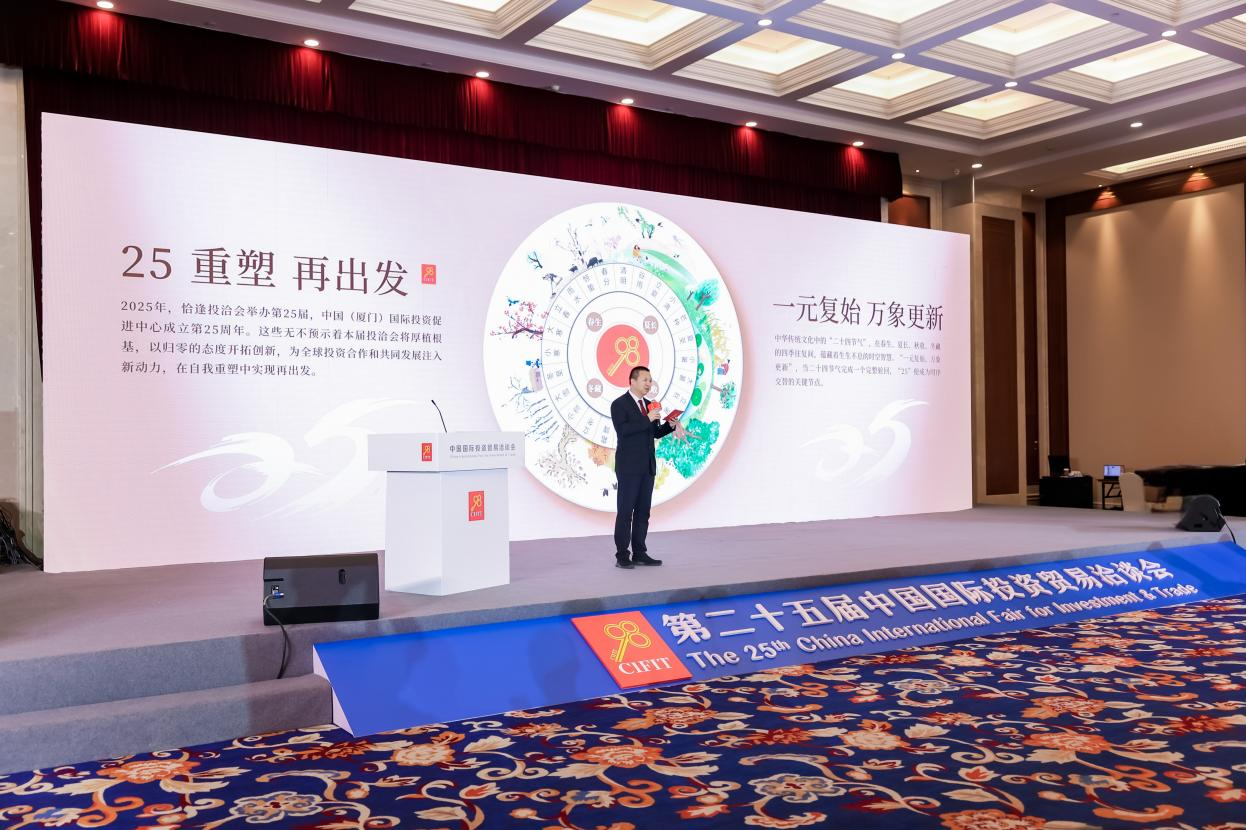
商务部投资促进局于广生:第25届投洽会上国际合作主题将更突出
Bei Ke Cai Jing· 2025-04-17 12:24
Core Viewpoint - The 25th China International Investment and Trade Fair (CIFIT) aims to enhance global investment cooperation and promote China's role in international investment, showcasing its commitment to open cooperation and free trade [3][5]. Group 1: Event Overview - The first promotional event for the 25th CIFIT was successfully held on April 17, 2023, in Beijing, attended by representatives from 21 countries and regions [1]. - The main event will take place from September 8 to 11, 2023, in Xiamen, Fujian, featuring various forums and exchange activities [3]. Group 2: Economic Context - The Deputy Director of the Cooperation Department of the Ministry of Commerce, Cao Wen, highlighted the rising instability and uncertainty in the global economy, emphasizing the need for countries to work together for mutual development and prosperity [3]. - Since 2013, Chinese enterprises have contributed over $550 billion in various taxes to host countries, creating an average of 2 million jobs annually [3]. Group 3: Investment Contributions - Chinese investment not only brings capital, technology, and management experience but also enhances local human resource development, industrial cooperation, and global market opportunities, thereby improving the welfare and economic development of host countries [4]. - The CIFIT will further increase the focus on Chinese investment, innovating and upgrading its activities to better serve international cooperation [4]. Group 4: CIFIT Characteristics - The CIFIT will feature a more pronounced dual investment orientation, a greater emphasis on financial capital, and a stronger theme of international cooperation, integrating exhibition and negotiation [5]. - The event will revolve around three main sections: "Investing in China," "Chinese Investment," and "International Investment," with specialized exhibition areas and various investment cooperation activities planned [5].