
技术-经济范式

Search documents
【广发宏观文永恒】技术浪潮驱动,产业范式重构:中长期宏观环境展望
郭磊宏观茶座· 2026-02-12 02:09
Core Viewpoint - Each technological revolution initially enhances production efficiency, subsequently leading to changes in economic structure, industry patterns, and asset allocation models. The driving force behind technology's evolution from inception to widespread adoption is not merely a breakthrough in a single technology, but rather the penetration, diffusion, and deep integration of new technologies within the economic system [1][13]. Group 1: Technological Revolution Phases - Since the Industrial Revolution, global economies experience a "great wave" driven by significant technological clusters approximately every 50-60 years, establishing a new "technology-economy paradigm" that optimizes production, organization, and management models [2][17]. - Each technological revolution can be divided into two main phases: the Installation Period and the Deployment Period. The Installation Period is characterized by infrastructure reconstruction, trial-and-error business models, and financial capital accumulation, further divided into the outbreak and frenzy stages. The Deployment Period features comprehensive technology dissemination and the establishment of economic paradigms, further divided into the synergy and maturity stages [2][17]. Group 2: Capital Forms and Their Roles - The "great wave" theory distinguishes between two forms of capital: financial capital and production capital. Financial capital is adept at trend identification, flexibility, speculation, and short-term profit orientation, while production capital focuses on industry realization, stability, path dependence, and long-term investment orientation. During the Installation Period of technological revolutions, financial capital typically takes the lead, while production capital assumes a dominant role during the Deployment Period [3][20]. Group 3: Economic Impacts of Technological Revolutions - In the Installation Period of a technological revolution, the overall economy may face pressure, and the differentiation between new and old industries may widen. New technologies are still in the nurturing phase and may not broadly stimulate related industries, employment, or productivity [5][29]. - During the Deployment Period, overall economic pressure is expected to ease, and the differentiation between new and old industries may narrow. New technologies become widely applied, leading to new products, business forms, and industries, which can create new employment forms [5][30]. Group 4: Global Dynamics and Catch-Up Opportunities - The "great wave" theory indicates that the Installation Period of each technological revolution provides critical catch-up windows for latecomer countries. Historical examples include Germany and the U.S. surpassing the U.K. before World War II, and the post-war rise of Japan and other economies [7][40]. - Latecomer countries can leverage their "latecomer advantage" by utilizing labor cost and technology transfer advantages to achieve leapfrog development, mastering key core technologies that drive the development of leading industries [7][40]. Group 5: Future Implications and Trends - The emergence of AI as the core technology of the sixth technological revolution is expected to enhance productivity across all sectors, breaking traditional growth bottlenecks. The scenario of AI's application is anticipated to evolve significantly, particularly in countries with favorable conditions for technology integration [10][12]. - The theory also suggests that macroeconomic policies should promote overall rebalancing, including actively expanding total demand and ensuring employment stability during the technological revolution's Installation Period [12][13].


AI投资狂潮下,如何分清泡沫与机遇?
3 6 Ke· 2026-01-29 23:10
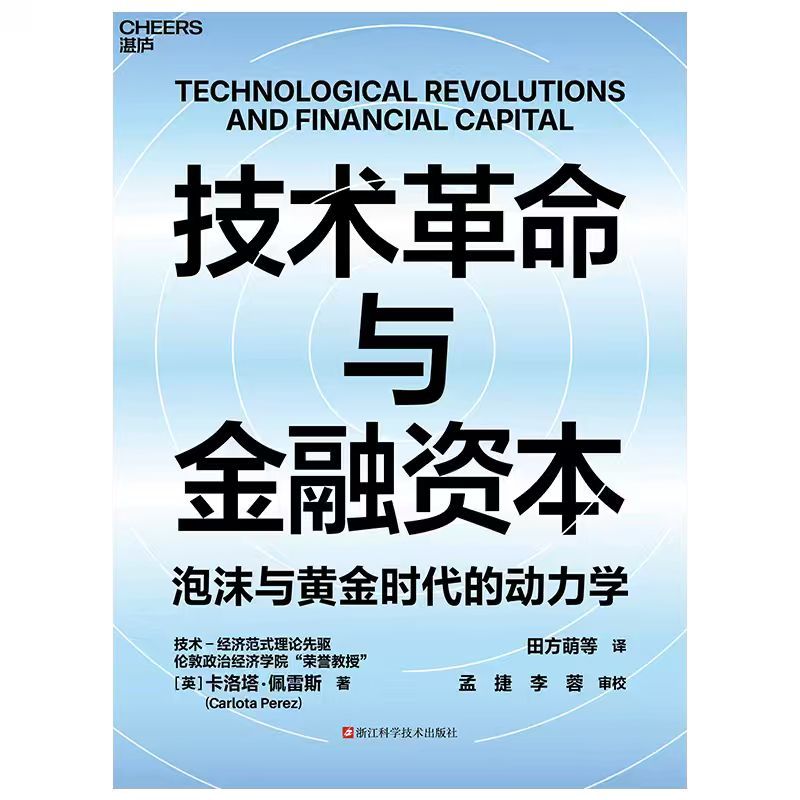
Core Insights - The book "Technological Revolutions and Financial Capital" by Carlota Perez provides a framework for understanding the cyclical nature of capitalism driven by technological revolutions and financial capital [4][10] - It emphasizes the interplay between technological innovation and financial speculation, highlighting how each technological revolution leads to a cycle of boom and bust, followed by institutional restructuring and a new golden age [5][8] Group 1: Technological Revolutions - Perez identifies five major technological revolutions over the past 200 years, each leading to significant societal and economic transformations [4][8] - Each revolution is characterized by a shift in the "efficiency paradigm," influencing management practices, social institutions, and cultural values [7][10] Group 2: Financial Capital Dynamics - Financial capital plays a dual role as both a catalyst for innovation and a source of speculative bubbles, often leading to economic crises [6][9] - The cyclical nature of capitalism involves periods of financial exuberance followed by crises, which serve as mechanisms for institutional renewal and adaptation [5][9] Group 3: Institutional Restructuring - After a financial crisis, new institutional frameworks emerge, including regulations and social policies that align with technological advancements, facilitating a new phase of economic stability [9][10] - This process of "recoupling" between technology and social institutions is essential for harnessing the potential of new innovations [9][10] Group 4: Historical Perspective - The book advocates for a historical perspective on economic thought, emphasizing the importance of understanding the interactions between technology, finance, and societal structures [10][12] - It suggests that economic fluctuations are not random but rather a result of the misalignment between technological progress and institutional evolution [10][12]

金融与技术的千年共舞:为什么每次技术革命,都伴随泡沫与重构?
3 6 Ke· 2026-01-18 23:21
Core Insights - The book "Technological Revolutions and Financial Capital" by Carlota Perez provides a framework for understanding the cyclical nature of capitalism driven by technological revolutions and financial capital [4][10] - It emphasizes the interplay between technological innovation and financial speculation, highlighting how each technological revolution leads to a cycle of boom and bust, followed by institutional restructuring and a new golden age [5][8] Group 1: Technological Revolutions - Perez identifies five major technological revolutions over the past 200 years, each leading to significant societal and economic transformations [4][8] - Each revolution is characterized by a shift in the "efficiency paradigm," influencing management practices, social institutions, and cultural values [7][10] Group 2: Financial Capital Dynamics - Financial capital plays a dual role as both a catalyst for innovation and a source of speculative bubbles, often leading to economic crises [6][9] - The cyclical nature of capitalism involves phases of financial exuberance followed by crises, which serve as mechanisms for institutional renewal [5][9] Group 3: Institutional Restructuring - After a financial crisis, new institutional frameworks emerge, adapting to the new technological landscape and facilitating economic stability [9][10] - This process of "recoupling" aligns technological logic with social institutions, allowing for a new phase of economic growth [9][10] Group 4: Historical Perspective - The book advocates for a historical approach to economic analysis, viewing economic fluctuations as results of the misalignment between technology and institutions [10][11] - It suggests that understanding these cycles can inform current policy decisions, especially in the context of emerging technologies like AI and clean energy [10][12]
宏观周度述评系列:技术进步两阶段的宏观效应-20260118
GF SECURITIES· 2026-01-18 09:26
Group 1: Macroeconomic Effects of Technological Progress - The macroeconomic effects of technological progress can be divided into two phases: the "Installation Period" and the "Deployment Period" [8] - During the "Installation Period," there is often a temporary increase in total pressure, and the differentiation between new and old industries expands [9] - In the "Deployment Period," total pressure tends to ease, and the differentiation between new and old industries narrows as new technologies are widely applied [9] Group 2: Market Performance and Trends - Global equity markets experienced fluctuations, with U.S. stocks showing resilience in consumer, energy, and small-cap sectors, while technology stocks faced valuation pressure due to rising U.S. Treasury yields [12] - The S&P 500 fear and greed index dropped to 41.2, indicating a shift in market sentiment [12] - The A-share market saw a weekly increase of 0.49%, with the 10-year government bond yield decreasing by 3.6 basis points to 1.82% [19] Group 3: Commodity and Currency Movements - Gold prices rose by 2.61% to $4,611.05 per ounce, while silver prices surged by 16.2% [14] - The U.S. dollar index rebounded by 0.23% to 99.38, reflecting its safe-haven status amid market uncertainties [17] - Brent crude oil futures increased by 1.25%, while copper prices faced a decline of 1.5% [15] Group 4: Economic Indicators and Predictions - The Atlanta Fed's GDPNow model predicts a 5.3% annualized growth rate for Q4 based on resilient consumer spending and stable manufacturing data [3] - The probability of the Federal Reserve maintaining interest rates in March is estimated at 78.9%, with a 20.3% chance of a 25 basis point cut [52]