
押注式投资

Search documents
宝盈基金张天闻"押注"半导体 熬到行业春天清仓式卸任
Zhong Guo Jing Ji Wang· 2025-12-19 07:56
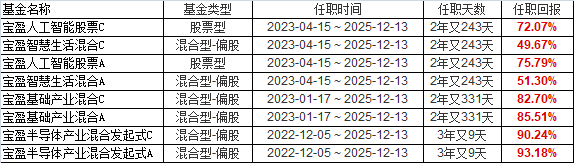
Core Viewpoint - Zhang Tianwen, the fund manager of Baoying Fund, has resigned from managing four funds, raising concerns about his concentrated investment strategy in the technology sector, particularly in TMT and hard technology, which may amplify risks associated with a single sector [1][2]. Fund Performance - Zhang Tianwen's managed funds have generally achieved high positive returns, with Baoying Semiconductor Industry Mixed Fund A returning 93.18% and the same fund's C share at 90.24%. Other funds like Baoying Basic Industry Mixed A and C returned 85.51% and 82.70%, respectively [1]. - In the artificial intelligence and smart living theme funds, Baoying Artificial Intelligence Stock A achieved a return of 75.79%, while C shares returned 72.07%. Baoying Smart Living Mixed A and C returned 51.30% and 49.67%, respectively [1]. Investment Strategy Concerns - There are sharp criticisms regarding Zhang Tianwen's management style, which is perceived as "style drift" and "betting-style investment." Despite the funds' names covering various themes, the investment scope is highly overlapping within TMT and hard technology sectors, leading to a concentrated holding strategy that increases single-sector risk [1][2]. Fund Management Background - Zhang Tianwen has a background in the semiconductor industry and finance, having worked as a researcher in electronic (semiconductor) sectors before joining Baoying Fund in March 2021 [2]. Fund Performance Timeline - The performance of Zhang Tianwen's funds was notably concentrated between late 2022 and early 2023, with significant returns observed during this period [2]. Fund Holdings and Market Trends - The Baoying Semiconductor Industry Mixed Fund A, established on December 5, 2022, had its top ten holdings primarily in semiconductor and integrated circuit-related companies. The fund experienced a significant decline, with a maximum drawdown of 37% from its peak [6][10]. - The semiconductor sector began to recover in the second half of 2024, contributing to improved performance for Zhang Tianwen's funds, although the overall annual growth remained modest due to prior declines [10]. Quarterly Performance Analysis - The quarterly performance of Baoying Semiconductor Industry Mixed Fund A showed fluctuations, with a notable 32.55% increase in Q4 2024, but overall annual growth was limited to 14% due to earlier losses [10][12].

宝盈基金“科技悍将”张天闻清仓式卸任,科技赛道“押注式投资”引争议
Hua Xia Shi Bao· 2025-12-17 13:53
Core Viewpoint - The sudden resignation of fund manager Zhang Tianwen from four funds at Baoying Fund has raised concerns in the industry, especially given his previous success in managing funds focused on technology sectors [2][3]. Group 1: Fund Manager's Performance - Zhang Tianwen managed funds that achieved significant returns, with the Baoying Semiconductor Industry Mixed Fund A (017075) returning 93.18% and the Baoying Basic Industry Mixed Fund A (010383) returning 85.51% during his tenure [3]. - Other funds under his management, such as Baoying Artificial Intelligence Stock A (005962) and Baoying Smart Life Mixed A (011170), also showed strong performance, with returns of 75.79% and 51.30% respectively [3]. Group 2: Concerns Over Investment Strategy - There are concerns regarding a potential "style drift" and "betting-style investment" in Zhang's managed funds, as they heavily overlap in the TMT (Technology, Media, Telecommunications) and hard technology sectors [5][6]. - The concentrated holding strategy in these funds amplifies risks associated with a single sector, making performance highly dependent on market trends rather than the fund manager's active management skills [6]. Group 3: Company Response - Baoying Fund stated that each fund managed by Zhang Tianwen adhered to its specific investment logic and strategy, emphasizing that the funds are not merely overlapping but have distinct focuses within the technology sector [7].

永赢基金“押注式”投资科技赛道迎来业绩绽放,如何做到真正的永赢?
Sou Hu Cai Jing· 2025-12-08 11:05
Core Viewpoint - Yongying Fund's stock funds have underperformed compared to peers over the past six months, despite some individual funds experiencing significant gains due to concentrated investments in technology sectors [1][6]. Group 1: Fund Performance - Yongying Fund's stock funds have consistently lagged behind the average returns of similar funds over the past five years, three years, and one year, failing to outperform the CSI 300 index [1][6]. - As of December 4, 2023, Yongying Technology Select Fund (022364) achieved a remarkable annual return of 200.34%, ranking first among 18,728 funds, significantly outperforming the second-best fund, AVIC Opportunity Navigator (140.43%) [1][2]. - Approximately 40% of Yongying Fund's active equity products are currently in a loss position, with over 30% of these products experiencing cumulative losses exceeding 30% [1][8]. Group 2: Investment Strategy - The recent surge in performance is attributed to a concentrated investment strategy in the technology sector, particularly cloud computing, which has yielded high returns in a favorable market environment [5]. - This "betting" investment strategy, while effective in the short term, poses risks of increased volatility and potential significant losses if the market conditions change adversely [5][6]. - Yongying Fund has multiple technology-themed funds, referred to as the "Yongying Seven Brothers," which also employ similar concentrated investment strategies [5]. Group 3: Fund Management and Costs - Yongying Fund has seen a significant increase in its public fund management scale, reaching 552.718 billion yuan, with a growth of 430 billion yuan over five years [3]. - The fund's high turnover rate among managers, with an average tenure of only 3.6 years, raises concerns about the stability and continuity of investment strategies [9]. - The fund's trading costs are notably high, with the commission-to-management fee ratio for passive index funds reaching 1.22, which is nearly five times the industry average [13].

重仓,all in!押注式投资的是非成败
Zhong Guo Zheng Quan Bao· 2025-07-30 15:11
Group 1 - The article discusses the resurgence of "betting-style" investment strategies among public funds in the A-share market, driven by structural market conditions [1][5] - Some actively managed equity funds are concentrating their holdings in specific sectors, often deviating significantly from their performance benchmarks, which are typically broad indices like the CSI 300 [1][4] - A case study of a fund that has doubled its net asset value within a year highlights its concentrated investment in the innovative drug sector, with over 95% of its top ten holdings in this area [2][3] Group 2 - The article notes both successes and failures of the "betting-style" strategy, with some funds performing well in sectors like innovative drugs and gold, while others, such as those heavily invested in real estate and traditional liquor stocks, have underperformed [3][4] - The trend of modifying funds to focus on popular sectors is prevalent among smaller public fund companies, aiming to attract more investments [5][6] - The regulatory environment is shifting, with an emphasis on strengthening the constraints of performance benchmarks, which may lead to clearer investment directions for these funds and higher expectations for fund managers' foresight [6][7]