提前还贷潮

Search documents
12.8万亿天量提前还贷!老百姓扛不住,楼市救市这次真的要来了?
Sou Hu Cai Jing· 2026-01-01 10:40
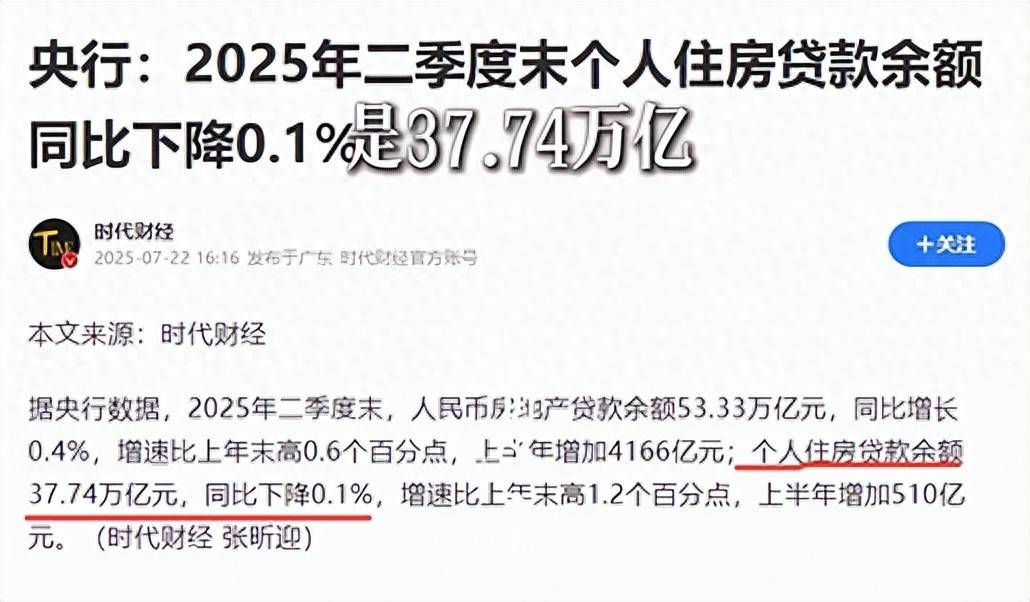
Core Insights - The trend of early mortgage repayment in China has surged, with a total of 12.8 trillion yuan repaid in four years, indicating a significant shift in consumer behavior and financial strategy [2][6][21] - The total balance of personal housing loans has decreased from 38.32 trillion yuan at the end of 2021 to 37.74 trillion yuan by mid-2025, despite a theoretical need for new loans due to high new home sales [4][6] - The decline in mortgage balances is attributed to rising early repayment trends, driven by high existing loan interest rates compared to lower new loan rates [7][9] Mortgage Market Dynamics - The average mortgage interest rates have seen a significant drop, with new loans at around 3.25% starting in 2024, while existing loans remain at higher rates, prompting borrowers to repay early [7][9] - The financial calculations favor early repayment, as the interest on savings and investment products has decreased, making it less attractive to keep funds in banks [9][19] - The phenomenon of early repayment is viewed as a risk management strategy by households amid economic uncertainty and fluctuating property values [9][21] Banking Sector Implications - Banks are facing challenges as the net interest margin has dropped to 1.42%, significantly below the international warning line of 1.8%, due to the disparity between high existing loan rates and lower new loan rates [13][21] - The early repayment trend poses liquidity risks for banks, as they lose significant interest income and must adapt to a changing financial landscape [13][21] - The banking sector is shifting from relying solely on mortgage income to a more diversified approach, necessitating adjustments in asset-liability management [21][25] Policy and Market Outlook - The policy focus has shifted from rescuing property prices to stabilizing the market and preventing systemic risks, with measures like lowering down payment ratios and optimizing purchase restrictions [15][17] - The recent policy changes have shown some positive effects, with an increase in new mortgage loans in early 2025, indicating a slight recovery in market activity [17][19] - The future of the real estate market is expected to be characterized by slow adjustments and structural changes, moving away from speculative investments towards a focus on quality housing [25][27]


12.8万亿天量提前还贷!老百姓扛不住,楼市救市,这次真的要来了
Sou Hu Cai Jing· 2025-12-29 13:14
Core Viewpoint - The article highlights a significant shift in the financial ecosystem due to a decline in national mortgage balances despite high new home sales, driven by a wave of early mortgage repayments totaling 12.8 trillion yuan, raising questions about consumer behavior and the effectiveness of market rescue policies [1][29]. Group 1: Mortgage Trends - By the end of 2021, the national personal mortgage balance reached a historical high of 38.32 trillion yuan, but by mid-2025, it is projected to drop to 37.74 trillion yuan, indicating a persistent decline [3]. - Over the past four years, new home sales have consistently remained above 10 trillion yuan annually, accumulating over 40 trillion yuan, yet the mortgage balance has decreased by 600 billion yuan [5][3]. Group 2: Early Repayment Phenomenon - The estimated early repayment amount of 12.8 trillion yuan reflects a conscious decision by households to pay off loans earlier, driven by lower interest rates and a desire for financial security amid declining property values [5][10]. - Many homeowners are opting for early repayments despite lower mortgage rates (as low as 3.5%), indicating a preference for locking in guaranteed returns rather than facing potential losses from declining property values [7][8]. Group 3: Impact on Banks - Personal mortgages constitute about 40% of banks' overall loan business, which has historically been a stable income source for banks; however, the current trend of early repayments and declining property values is eroding this stability [14][12]. - The net interest margin for banks has fallen to approximately 1.43%, below the international warning line of 1.8%, indicating a weakening of banks' profitability and risk-bearing capacity [16]. Group 4: Policy Responses - Starting in the second half of 2024, various policies have been introduced to stabilize the housing market, including lowering down payment ratios and adjusting mortgage rates, aimed at preventing further market decline [22][24]. - The early repayment trend has begun to cool, with a noticeable reduction in the decline of mortgage balances in 2025, suggesting that policy measures are having a stabilizing effect on the market [24]. Group 5: Future Considerations - The future trajectory of the housing market will depend on three key variables: banks' ability to recover profitability, the reliance of local governments on land sales for revenue, and the willingness of consumers to invest in housing rather than repay loans [26][28]. - The ongoing early repayment trend signifies a critical choice made by households during a period of property value adjustment, which is reshaping the banking revenue structure and prompting accelerated policy interventions [29].
长沙银行半年报:逾期贷款 个贷不良率“双增” 机构持股比例下滑
Xi Niu Cai Jing· 2025-09-05 08:18
Core Viewpoint - Changsha Bank's 2025 semi-annual report indicates a steady growth in total assets and liabilities, but faces challenges in profitability and asset quality due to narrowing net interest margins and rising non-performing loans [2][3]. Financial Performance - As of June 30, 2025, total assets reached 1,247.385 billion RMB, a year-on-year increase of 13.72% - Total liabilities amounted to 1,165.090 billion RMB, up 13.58% year-on-year - Total loans stood at 602.692 billion RMB, reflecting a 12.95% increase year-on-year - Total deposits were 759.184 billion RMB, growing by 11.23% year-on-year - For the first half of 2025, operating income was 13.249 billion RMB, a 1.59% increase year-on-year - Net profit reached 4.329 billion RMB, up 5.05% year-on-year [2][4]. Asset Quality - As of June 30, 2025, non-performing loan balance was 7.046 billion RMB, an increase of 0.662 billion RMB from the end of the previous year - Non-performing loan ratio remained stable at 1.17%, with a slight decrease of 1 basis point from the previous quarter - Personal loan non-performing ratio increased significantly to 2.20%, up 33 basis points from the end of the previous year - Overdue loan balance was 13.405 billion RMB, a substantial increase of 36.02% from the end of the previous year [3][6]. Capital Adequacy - Capital adequacy ratios for Changsha Bank showed a slight decline compared to the end of the previous year, but remained compliant with regulatory standards [3]. Institutional Shareholding - As of June 30, 2025, the proportion of institutional shareholders who increased or newly entered their holdings rose by 0.82%, while those who reduced or exited their holdings decreased by 1.90%, resulting in a net reduction of 1.18% in institutional shareholding [6]. Market Challenges - The bank faces challenges in expanding personal loans and corporate deposits due to a slow growth rate in housing mortgage loans and adjustments in deposit structure - There is an increasing pressure on credit risk management as overdue and attention-class loans have risen [6].