
收益率曲线趋平

Search documents
历史次高!外资1月狂扫日债6.04万亿日元 高收益率成“吸金石”
智通财经网· 2026-02-20 06:55
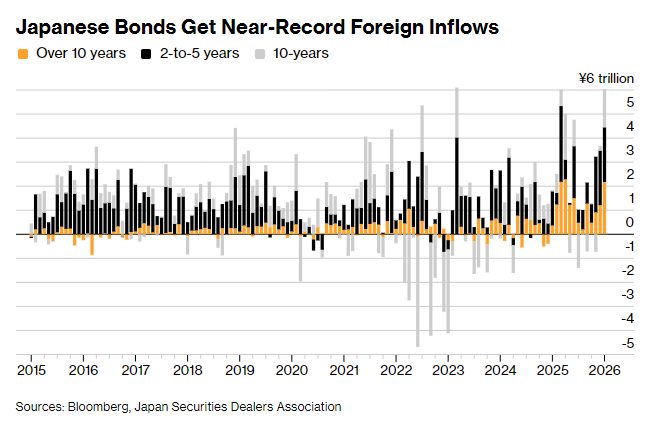
Group 1 - Foreign investors' net purchases of Japanese government bonds in January reached 6.04 trillion yen (approximately 389 billion USD), marking the second-highest level in history, only behind the peak of 6.08 trillion yen in March 2023 [1] - The increase in bond purchases is attributed to higher yields compensating for concerns over government fiscal expansion risks, with the yield on Japanese government bonds peaking on January 20 [1][4] - Domestic investors, particularly Japanese insurance companies, reduced their holdings of ultra-long-term government bonds by 721.8 billion yen, the second-largest reduction on record, indicating a divergence in attitudes between domestic and foreign investors [4] Group 2 - Global asset management firms expect that the government under Prime Minister Kishida will not pursue reckless fiscal expansion policies, as indicated by the active allocation of foreign capital to Japanese government bonds during the yield increase phase [4] - The International Monetary Fund (IMF) stated there is no evidence that foreign investors are reducing their demand for Japanese government bonds due to fiscal concerns [6] - Foreign investors are constructing a flattening yield curve position by shorting short-term bonds and buying long-term bonds, anticipating a reduction in the issuance of ultra-long-term bonds starting in April [6]

拍卖需求持续稳健 日本国债市场企稳
智通财经网· 2026-02-19 06:47
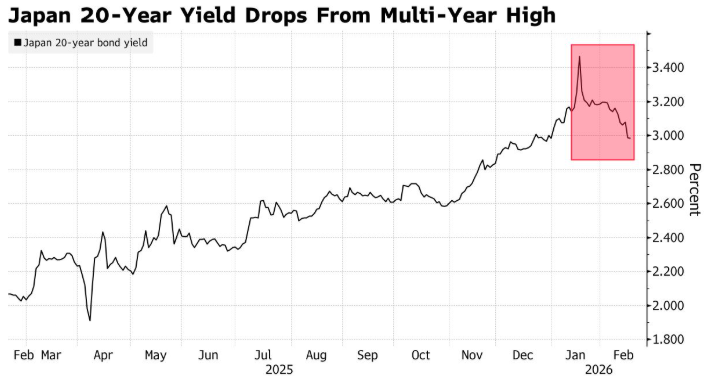
Core Viewpoint - Despite a decline in demand for the 20-year Japanese government bond auction, the Japanese bond market remains stable, indicating strong investor confidence [1] Group 1: Auction Results - The subscription ratio for the 30-year Japanese government bond fell to 3.08, below the previous issuance level and the average of the past 12 months [1][4] - The yield on the 20-year Japanese government bond is currently around 2.97%, significantly down from the peak of 3.46% last month, which was the highest level since 1997 [1] - The auction coverage ratio was lower than the last auction at 3.19 and below the average of 3.29 over the past 12 months, marking the lowest level since May [4] Group 2: Market Reactions - The yield on the benchmark 10-year Japanese government bond rose by 1 basis point, while bond futures prices slightly declined [1] - The bond market is under pressure globally, influenced by cautious comments from Federal Reserve officials regarding interest rate cuts and robust U.S. economic data [4] - Japanese bond traders can refocus on the theme of yield curve flattening after the completion of the 20-year bond issuance, with all indicators falling within recent expectations [4] Group 3: Investor Sentiment - Strong short-covering demand supported the auction, with expectations that pension funds will sell stocks and buy bonds for portfolio rebalancing amid rising stock prices [1] - The proposed accounting standard changes for insurance companies regarding fixed-income securities holdings may provide additional support for Japanese government bond prices [6] - The sentiment in the market improved following a successful auction of 5-year Japanese government bonds, as expectations for early interest rate hikes by the Bank of Japan have diminished [6] Group 4: Risks and Challenges - The four major life insurance companies in Japan have seen unrealized losses on their holdings of Japanese government bonds, highlighting the risks associated with investing in a volatile bond market [5] - Investors are awaiting further clarification from the Japanese Prime Minister on how to balance tax cuts with increased defense and strategic industry spending [4]
TS Lombard建议押注美联储下半年降息力度低于预期
Xin Lang Cai Jing· 2026-02-18 16:11
Core Viewpoint - TS Lombard macro strategists suggest that as the labor market recovers, traders should bet on fewer interest rate cuts by the Federal Reserve in the second half of the year than the market expects, which will weaken enthusiasm for the steepening of the U.S. Treasury yield curve [1][2] Group 1 - Under the leadership of Waller, the Federal Reserve is unlikely to overlook a resurgence in the labor market unless there are strong signals of productivity improvement [2] - If this trend continues, the market is more likely to reduce rather than increase short-term easing bets, especially considering the loosening financial environment and strong fiscal impulses that may raise inflation risks later this year [2] - TS Lombard recommends shorting the December 2026 3-month SOFR futures contract (SFRZ6), currently priced at 96.89, with a stop-loss set at a 10 basis point decline in yield [2] Group 2 - If Waller cannot build consensus within the Federal Open Market Committee (FOMC) to implement looser policies due to a potential rebound in the labor market and lack of conclusive evidence for broad productivity improvement, the reduction in short-term easing bets may flatten the yield curve [2] - The market is expected to maintain the view that the 'neutral rate' is close to 3%, which would only push back the timeline for the FOMC to reach that rate, thereby limiting the upside potential for the 10-year Treasury yield [2]
美国债市:国债在股市反弹之际维持跌势 收益率曲线趋平
Xin Lang Cai Jing· 2026-02-06 21:27
Core Viewpoint - The strong preliminary consumer confidence index from the University of Michigan for February has led to a decline in U.S. Treasury yields, partially reversing the bullish trend observed on Thursday [1][9]. Group 1: Market Reactions - The U.S. stock market saw strong buying interest on dips, while Treasury yields ended slightly below their daily highs [1][9]. - Short-term Treasury yields rose approximately 4 basis points during the day, with the 2s10s and 5s30s yield spreads flattening by about 2 basis points [10]. Group 2: Trading Activity - The flattening of the yield curve was driven by two large risk-weighted matching futures trades involving 2-year and super 10-year Treasury futures contracts [11]. - As the stock market rebounded and swap spreads stabilized, the decline in Treasury prices expanded, particularly after the Michigan survey results exceeded expectations [11]. - By 3 PM, the trading volume of U.S. Treasury futures was about 90% of the 20-day average, with 2-year Treasury futures being the most active, showing a 25% increase in volume compared to the average [11]. Group 3: Yield Changes - As of 4:14 PM Eastern Time, the 2-year Treasury yield increased by 4.51 basis points to 3.4955% [12]. - The 5-year Treasury yield rose by 3.63 basis points to 3.755% [13]. - The 10-year Treasury yield increased by 2.39 basis points to 4.204% [14]. - The 30-year Treasury yield rose by 1.23 basis points to 4.853% [15]. - The yield spread between the 2-year and 10-year Treasuries decreased by 1.91 basis points to 70.645 basis points [16]. - The yield spread between the 5-year and 30-year Treasuries decreased by 2.23 basis points to 109.802 basis points [17].
先锋资管反向布局日本债市 押注央行加息促收益率曲线趋平
智通财经网· 2025-10-20 03:04
Core Insights - Despite political instability in Japan, Vanguard Asset Management maintains its investment strategy, anticipating potential profits if the Bank of Japan raises interest rates and flattens the yield curve [1] - Vanguard's International Rates Head, Ales Koutny, is preparing for a possible rate hike in December, adjusting positions by shorting short-term bonds while buying long-term bonds [1] - This stance contrasts with the prevailing market sentiment, which expects the Bank of Japan to maintain its current policy for a longer period due to political uncertainties [1] Group 1 - Koutny believes the market is underestimating the timing of the next rate hike, creating opportunities for repositioning trades [2] - He estimates a 50% probability of a rate hike this month, acknowledging that political turmoil may delay it until December [1][2] - Current market expectations show only a 23% probability of a rate hike at the October 30 meeting and a 62% probability by December 19 [1] Group 2 - Koutny has increased bets on rising two-year swap rates and added a new trade of shorting five-year Japanese government bonds while going long on 25-year bonds [2] - The yield spread between five-year and 30-year Japanese government bonds is currently about 190 basis points, down from a peak of 216 basis points last month [5] - This spread is significantly higher than the approximately 140 basis points before the last rate hike in January, indicating potential for narrowing before the next hike [5] Group 3 - Koutny has long advocated for a flattening of the Japanese yield curve and has increased holdings in long-term Japanese government bonds [6] - Despite the lack of returns from this strategy since the Bank of Japan paused rate hikes in January, Vanguard remains committed to its positions [6] - RBC BlueBay Asset Management, also bullish on long-term bonds, has taken a direct short position in 10-year Japanese government bonds to hedge against risks in their yield curve flattening trades [6]
供应下降缓解市场紧张情绪 全球长期债券重回投资者视野
Zhi Tong Cai Jing· 2025-09-26 06:58
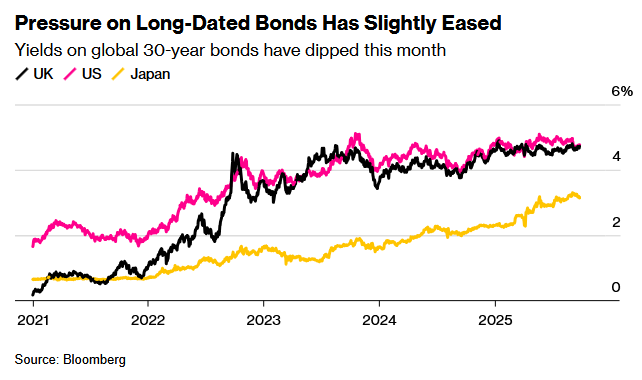
Group 1 - The global long-term bond market is experiencing a rebound as investors seek buying opportunities after a sell-off, with U.S. and Japanese 30-year bond yields dropping approximately 20 basis points since early September, and UK yields falling over 10 basis points [1] - The recent decline in long-term bond yields is partly driven by reduced supply, as some countries shift their issuance focus to cheaper short-term bonds, with Japan proposing to cut long-term bond issuance and the UK central bank reducing long-term bond sales in its quantitative tightening plan [1][2] - There is a growing optimism in the long-term bond market, highlighting the significant role of supply concerns in recent sell-offs, despite ongoing worries about rising fiscal deficits [2] Group 2 - Strong economic growth globally is alleviating concerns about fiscal deficits and prompting investors to reconsider long-term interest rate trends, with recommendations for Australian investors to adopt positions that benefit from a flattening yield curve [3] - The Bloomberg Global Aggregate Index indicates that bets on long-term bonds are starting to pay off, with 10-year and longer bonds returning 0.7% this month, outperforming shorter-term bonds [6] - Recent auctions show strong demand for long-term bonds, with Japan's 40-year bonds seeing enthusiastic buying and the strongest demand for 20-year bonds since 2020 [6]
分析师:美联储按兵不动是正确的
news flash· 2025-07-03 12:55
Core Viewpoint - The Federal Reserve's decision to maintain its current stance is deemed correct in light of strong non-farm payroll data, which contrasts with recent weak economic indicators [1] Group 1: Economic Data Analysis - Strong non-farm employment report indicates resilience in the labor market, overshadowing recent weak economic data [1] - Hard data is perceived as more reliable than soft data in the current economic context, suggesting a positive outlook for the economy [1] Group 2: Market Implications - Market changes are leading to a flattening of the yield curve, which may continue as popular steepening trades are unwound [1] - The current market dynamics reflect a shift in investor sentiment and strategy in response to economic data [1]
美国非农数据强于预期 美债跌至盘中低点 收益率曲线趋平
news flash· 2025-07-03 12:54
Core Viewpoint - US Treasury futures prices fell to intraday lows, with 2-year to 5-year Treasury yields rising by more than 10 basis points on the day [1] Summary by Relevant Categories Market Performance - Yields generally increased by 6 to 10 basis points, indicating a trend of rising interest rates [1] - The yield curve flattened, with the 2s10s and 5s30s spreads narrowing by 3 basis points and 4 basis points respectively [1]
美国非农就业数据公布后,美国国债2年期/10年期收益率曲线趋平
news flash· 2025-07-03 12:38
Group 1 - The core point of the article highlights the flattening of the U.S. Treasury yield curve following the release of non-farm payroll data, with the latest spread between the 2-year and 10-year yields reported at 45.9 basis points, down from 49.1 basis points prior to the data release [1]