政府关门对经济的影响

Search documents
沪银价格持续下跌 美政府“停摆”将平纪录
Jin Tou Wang· 2025-11-06 06:08
Group 1 - The U.S. government shutdown has significantly impacted the airline industry, with over 3.2 million passengers affected by flight delays or cancellations since October 1 due to air traffic control staffing issues [1] - The shutdown has entered its 34th day, nearing the record of 35 days, with emergency funds being utilized to maintain some food assistance programs, which have faced unprecedented disruptions [1] - The Supplemental Nutrition Assistance Program (SNAP) has halted benefits for the first time in 60 years, despite previous shutdowns not affecting its disbursement [1] Group 2 - Goldman Sachs analysts predict that the current government shutdown could have a record-breaking impact on the economy, potentially lasting longer than previous shutdowns [2] - If the shutdown continues for about six weeks, it could reduce the annualized growth rate by 1.15 percentage points in Q4 2025, with further declines expected in Q1 2026 due to spillover effects on federal procurement and investment [2] Group 3 - Silver futures are currently trading below 11,304, with a recent high of 11,504 and a low of 11,282, indicating a bearish short-term trend [1] - The silver market is experiencing a consolidation phase, with key support levels at 11,200 and resistance at 11,600, suggesting potential for upward movement if resistance is broken [3]
KCMTrade分析师Tim汇评:日元和欧元困境保护美元免受政府关门担忧的影响
Sou Hu Cai Jing· 2025-10-15 08:48
Group 1: Currency Market Insights - The US dollar typically does not gain during a government shutdown, but it has risen by 0.9% since the latest shutdown began, influenced by market expectations that the shutdown may last weeks rather than months [1] - The USD/JPY exchange rate increased by 3% this week due to the results of the Japanese Liberal Democratic Party elections, which may delay the Bank of Japan's interest rate hikes [1] - Political uncertainty in Europe, particularly following the resignation of French Prime Minister Le Maire, has contributed to the decline of the euro, further supporting the dollar [3] Group 2: Gold Market Dynamics - Gold prices have benefited from increased political uncertainty in Europe, Japan, and the US, with current trading prices around $4000 [3] - The relationship between gold and the dollar has been negative historically, but both assets have risen simultaneously this week due to market dynamics [3] - Key support levels for gold are at $3954, $3925, and $3874, while resistance is around $4005, indicating potential short-term risks if profit-taking occurs near $4000 [3] Group 3: Oil Market Overview - OPEC+ is set to increase production by 137,000 barrels per day starting in November, which is limiting the decline in crude oil prices [4] - US crude oil prices have remained in the lower half of the $60-$66 range since June, with moderate support at $60.92 and stronger support at $60.20 [4] - The upper resistance level for crude oil is at $62.75, indicating a potential price ceiling in the near term [4] Group 4: Federal Reserve Outlook - The market is closely watching the Federal Open Market Committee (FOMC) meeting minutes for clues on the Fed's potential dovish stance in the coming months [6] - The ongoing government shutdown has created uncertainty regarding the release of key US economic data, including the delayed Non-Farm Payroll (NFP) data [6] - Comments from Fed officials will be critical for investors to assess the likelihood of one or two interest rate cuts by the end of the year [6]


法案未获通过,美国政府继续“关门”!白宫官员:美经济每周损失约150亿美元
Feng Huang Wang· 2025-10-07 02:48
Core Points - The U.S. Senate voted on October 6 against a Democratic funding bill aimed at ending the government shutdown, with a result of 45 votes in favor and 50 against, leading to the continuation of the shutdown [1] - A subsequent vote on a temporary funding bill proposed by the Republican party also failed to meet the necessary threshold for approval, further extending the government shutdown [1] Economic Impact - According to Kevin Hassett, the Director of the White House National Economic Council, the government shutdown is causing a weekly economic loss of approximately $15 billion [1] - The shutdown is projected to reduce the U.S. GDP by about 0.1 percentage points each week, with a potential additional unemployment of around 43,000 individuals if it lasts for a month [1] - Consumer spending is expected to decrease by $30 billion due to the ongoing shutdown [1] - The Congressional Budget Office previously estimated that the last government shutdown during Trump's first term resulted in an economic loss of $11 billion, with about $3 billion being a permanent loss [1]
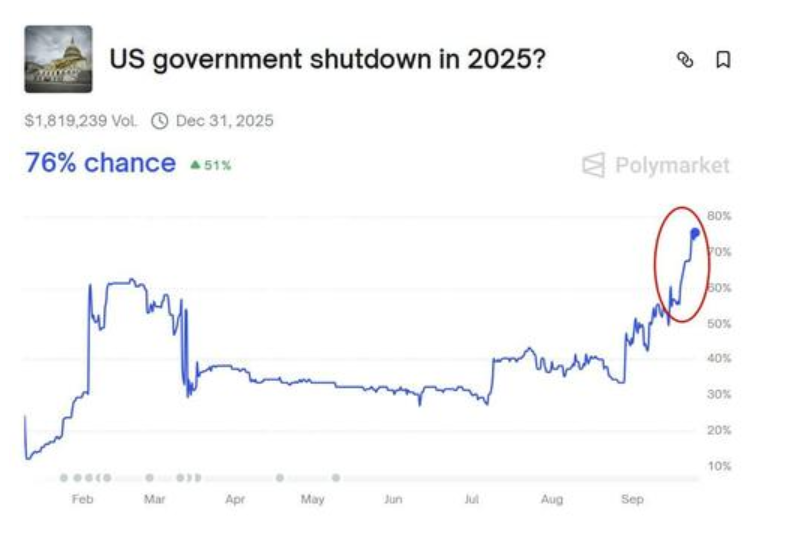
民主党这次“立场坚定”,美国政府距离关门“越来越近”
Hua Er Jie Jian Wen· 2025-09-26 00:56
Core Viewpoint - The U.S. government is rapidly approaching a shutdown due to a political stalemate between the two parties, with no signs of resolution as the deadline nears [1][3]. Group 1: Political Stalemate - House Republicans proposed a temporary spending bill to avoid a government shutdown on October 1, but it does not include healthcare funding demanded by Democrats, leading to increased tensions [1][6]. - Senate Minority Leader Chuck Schumer has taken a firmer stance, indicating that Democrats will not be intimidated by threats from the Trump administration regarding federal workforce cuts [1][6]. - The last opportunity to avoid a shutdown is seen as the Senate's return on September 29, but the likelihood of a bipartisan agreement is considered low [3][6]. Group 2: Economic Impact - Goldman Sachs estimates that each week of government shutdown could reduce quarterly GDP growth by 15 basis points, with a potential three-week shutdown leading to a 45 basis point reduction [2][7]. - The shutdown would create a "data vacuum," delaying the release of key economic indicators such as non-farm payrolls and CPI, complicating the Federal Reserve's policy assessments [2][9]. Group 3: Legislative Dynamics - The current impasse centers around healthcare funding, with Democrats viewing this as a critical legislative opportunity, contrasting with their previous support for Republican proposals [6]. - The White House's strategy to pressure Democrats has intensified the conflict, with accusations of "mob-style extortion" from Democratic representatives [6][9].