政策失误

Search documents
Exness: 宏观分化、联储独立性危机与美元的结构性前景
Sou Hu Cai Jing· 2026-02-11 06:46
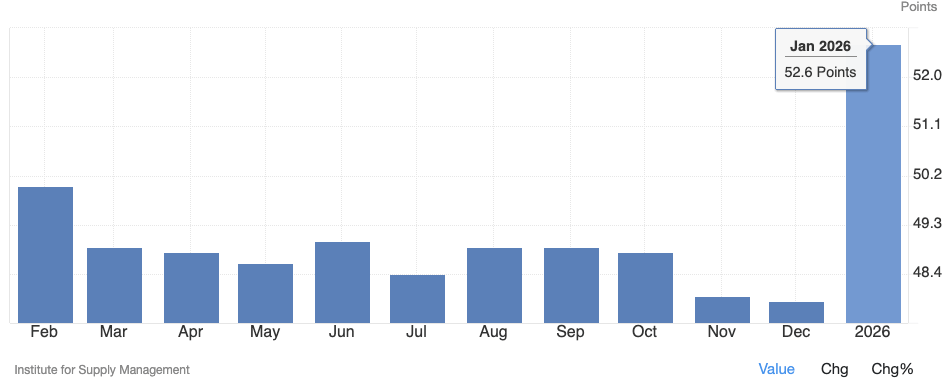
Group 1: Manufacturing Sector - The ISM Manufacturing PMI for January recorded at 52.6, significantly higher than the previous value of 47.9, indicating a shift into the expansion zone [1] - The surge in the new orders index suggests a proactive inventory replenishment by businesses, indicating a solid demand for future production [3] - The stability in the prices index, despite the recovery in demand, presents a favorable scenario for the Federal Reserve, as it indicates economic growth without immediate inflationary pressures [3] Group 2: Consumer Confidence - The Conference Board's consumer confidence index plummeted to 84.5, the lowest level since May 2014, signaling a significant psychological alarm despite the manufacturing sector's strength [6] - The Michigan Consumer Sentiment Index showed a slight rebound to 57.3, but this reflects more on the wealth effect from rising stock markets rather than the broader middle-class sentiment [8] - The key "expectations index" fell to 65.1, historically indicating a potential recession when below 80, highlighting consumer pessimism despite stable unemployment rates [11] Group 3: Economic Implications - Consumer spending, which constitutes 70% of the US GDP, is at risk if low confidence translates into reduced retail sales, potentially undermining the manufacturing recovery [13] - The upcoming retail sales data is critical, as a validation of the confidence index's decline could lead to a rapid loss of the dollar's growth premium [13] - The labor market data, particularly the non-farm payroll (NFP) report, is delayed, creating uncertainty in market expectations regarding employment and economic health [14] Group 4: Labor Market Dynamics - The consensus expectation for January's NFP is a weak 70,000 jobs, significantly below the 150,000 to 200,000 needed to maintain labor market balance, raising concerns about potential downward revisions of previous employment data [14][15] - The JOLTS data indicates a sharp decline in job openings to 6.54 million, the lowest in over five years, suggesting a cooling demand in the labor market [17] - If the NFP data confirms the downward trend in job openings, it could lead to a significant reassessment of the Federal Reserve's interest rate policies and negatively impact the dollar [17][21] Group 5: Federal Reserve and Monetary Policy - The Federal Reserve's current stance of maintaining higher interest rates is under pressure from political and economic uncertainties, potentially leading to a more cautious approach to rate cuts [18][21] - The market is pricing in a potential shift in monetary policy, with the probability of a rate cut in March being closely monitored [20][21] - The dual pressures of political noise and economic data deterioration could challenge the Fed's resolve to keep rates high, impacting the dollar's strength [22]

美国九月非农就业数据超预期,强化美联储推迟降息倾向!机构:市场正开始将黄金视为对冲美联储“政策失误”的工具
Sou Hu Cai Jing· 2025-11-21 06:36
Group 1 - The core viewpoint of the article is that the unexpected strength of the U.S. non-farm payroll data in September reinforces the Federal Reserve's inclination to delay interest rate cuts, raising questions about how the Fed can make accurate decisions in the absence of data [1] - There are indications that the market is beginning to view gold as a hedge against potential "policy mistakes" by the Federal Reserve, despite a high interest rate environment that typically would be bearish for gold [1] - If the Federal Reserve decides to maintain its current stance in December but later data suggests that not cutting rates was a mistake, it could undermine market confidence in the dollar, making gold a more reliable "safe haven" [1]

风险未除,波动先降!美国股债汇集体进入“异常平静期”
Zhi Tong Cai Jing· 2025-08-13 12:49
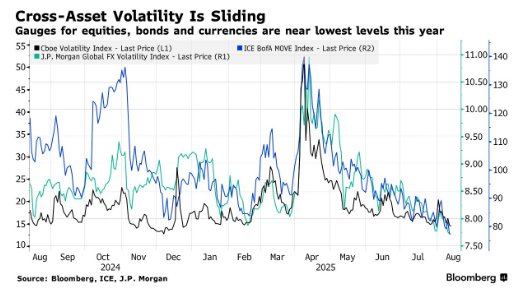
Market Volatility and Economic Indicators - Various volatility indicators across stock, bond, and currency markets have dropped to their lowest levels of the year, with the VIX index reaching a new low since December of last year [1] - Despite a macro environment filled with risks such as geopolitical tensions and persistent inflation, the market is betting on limited price fluctuations [1][3] - Jefferies International's chief economist attributes this calm to a significant amount of sidelined capital ready to buy on dips, which suppresses selling behavior [1] Investor Behavior and Market Sentiment - Investors are increasingly participating in the market despite acknowledging existing risks, driven by a fear of missing out on potential gains [3] - The market experienced brief turbulence due to disappointing employment data and tariff policies, but the VIX index quickly rebounded [3] - The S&P 500 index has reached new highs, supported by mild inflation data that reinforces expectations for interest rate cuts by the Federal Reserve [3] Economic Outlook and Risks - There are warnings from institutions regarding blind optimism in the market, with historical precedents indicating that low volatility can precede significant spikes [3][4] - Fidelity International's global head of macro and strategic asset allocation warns of a potential economic downturn, estimating a 20% probability of a cyclical recession due to the impact of tariff escalations [4] - The increasing debt burden and spending levels of the U.S. government may compel the Federal Reserve to adopt unconventional measures, which could distort bond prices and lead to market volatility [4][5]