
数字化教学

Search documents
技能型高校“国家队”,这样打造
Xin Lang Cai Jing· 2025-12-22 20:23
Core Viewpoint - The second phase of the "Double High Construction Plan" has been launched, aiming to enhance vocational education in China by establishing a broader coverage of schools and integrating education with industry needs, thereby improving the quality of skilled talent training. Group 1: Overview of the "Double High Construction Plan" - The second phase includes 220 schools, an 11.68% increase from the first phase, achieving nationwide coverage across all 32 provinces, including previously unrepresented regions like Qinghai, Tibet, and Xinjiang Production and Construction Corps [8][9] - The new plan emphasizes high-level educational capabilities and high-quality integration of industry and education, transitioning vocational schools from merely having good foundations to effectively serving national and regional strategic needs [8][9] Group 2: Service Development and Industry Integration - The second phase targets 278 national-level parks and aligns with major regional industries, with service proportions for trillion, hundred billion, and billion-level industries at 26.8%, 43.9%, and 22.9% respectively [10] - The plan promotes a demand-driven approach, enhancing the alignment of vocational education with national strategies and regional leading industries, thereby facilitating a new model of industry-education integration [10] Group 3: Reform and Innovation in Vocational Education - The plan aims to innovate the integration mechanisms between education and industry, establishing joint entities and collaborative platforms to enhance the adaptability of vocational education to regional economic needs [14] - Key educational elements such as curriculum, teaching materials, and faculty training will undergo comprehensive reforms, with a focus on dynamic optimization and alignment with industry standards [15] Group 4: Digital Transformation and International Cooperation - The initiative emphasizes building a digital teaching ecosystem, enhancing digital infrastructure, and integrating AI into teaching methods to support the transformation of vocational education [16] - The plan also aims to expand international cooperation, enhancing the global influence of Chinese vocational education through initiatives like the "Luban Workshop" and establishing standards for international vocational education [17][18]

产教融合 向新突破
Qi Lu Wan Bao· 2025-11-27 22:04
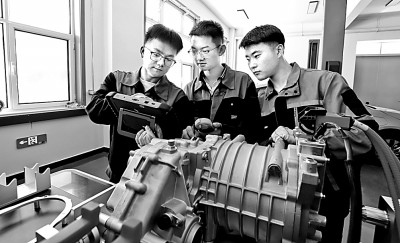
Group 1: Talent Development and Industry Alignment - The focus is on enhancing the alignment of talent cultivation with the development needs of emerging industries in Jinan, particularly in strategic sectors like intelligent connected vehicles and low-altitude economy [1][7] - Establishment of the Jinan New Energy Vehicle Application R&D Center in collaboration with companies like BYD and Geely to create a dual education model that integrates practical training within the industry [1] - Implementation of a curriculum that aligns with industry standards and job requirements, including the development of integrated courses for various technical fields and collaboration with companies to ensure students are equipped with the latest skills [1][2] Group 2: Digital Transformation in Education - The initiative aims to explore AI teaching pathways and integrate information technology deeply into educational practices, creating a new ecosystem for intelligent, immersive, and personalized learning [3] - Development of a digital teaching resource library utilizing modern technologies to enhance interactivity and effectiveness in teaching, with over 1,366 online teaching resources created [3][4] - Introduction of immersive classroom experiences using VR and AR technologies to facilitate complex learning scenarios, such as virtual fault diagnosis and repair processes in automotive education [4] Group 3: Collaborative Platforms and Industry Partnerships - Formation of the Jinan Technical Education Alliance to promote resource sharing and collaborative development among educational institutions and industry stakeholders [5][6] - Establishment of the Jinan Craftsman Academy to integrate various resources for talent training, vocational training, and technical innovation, significantly increasing the scale of social training [6] - Development of industry-specific courses and training programs in collaboration with companies like Geely and BYD, resulting in the training of over 2,000 skilled workers in the automotive sector [7]
聚焦“教育强国”战略下应用型外语人才培养的创新实践
Yang Shi Wang· 2025-10-13 07:19
Core Concept - The "Education Strong Nation" strategy aims to support and lead Chinese-style modernization by cultivating a large number of high-quality talents, with foreign language talents being crucial for global governance and cultural exchange [1] Group 1: Concept Innovation - The core contradiction in cultivating applied foreign language talents has shifted from "language skill shortage" to "insufficient cross-cultural empowerment ability" [2] - The focus must transition from training "tool users" to "empowerers" who can effectively communicate China's narrative and participate in international rule-making [2] - A three-pronged educational framework of "value shaping, ability cultivation, and knowledge transmission" is proposed to support this transition [2] Group 2: Curriculum Innovation - A modular, project-based, and interdisciplinary "Foreign Language +" curriculum system is essential to meet the demand for composite foreign language talents [3] - The curriculum should integrate "Foreign Language + Professional," "Foreign Language + Technology," and "Foreign Language + Chinese Studies" to enhance practical application and cultural understanding [3] Group 3: Model Innovation - The strategy emphasizes deepening industry-education integration and advancing digital education to bridge the gap between classroom learning and workplace requirements [4] - Project-based learning (PBL) will be implemented to align educational content with real-world business needs, creating a closed-loop mechanism involving enterprises and educators [4] - Collaborative education involving government, industry, academia, and research will create a diverse educational community [4] Group 4: Faculty Innovation - The quality of the teaching staff is critical, necessitating the establishment of a "dual-teacher" international teaching team with global perspectives and practical experience [5] - Teachers are required to have industry experience and obtain relevant qualifications to enhance their teaching capabilities [6] Group 5: Evaluation Innovation - A multi-dimensional evaluation system is needed to assess the composite abilities and practical skills of applied foreign language talents, moving beyond traditional examination methods [6] - The evaluation should combine process and outcome assessments, incorporating feedback mechanisms to improve educational outcomes [6] Group 6: Overall Strategy - The innovation in cultivating applied foreign language talents is a systematic project that requires breaking down barriers and integrating across disciplines to produce talents proficient in foreign languages and international rules [7]
@全体教师 想要提升数字化教学水平? 国家给你安排上了!
Yang Shi Xin Wen· 2025-07-07 05:34
Core Viewpoint - The Ministry of Education has launched a digital empowerment initiative aimed at enhancing teachers' digital capabilities and facilitating their transition into the digital age [1] Group 1: Digital Literacy Enhancement - The initiative will establish a standard system for teachers' digital literacy, including standards for intelligent literacy and digital capabilities for school leaders and higher education teachers [2] - A comprehensive training program will be implemented through the National Training Program for Teachers, focusing on artificial intelligence and digital literacy [2] - Continuous assessment and tracking of teachers' digital literacy will be conducted, with regular reports published to improve local mechanisms for digital literacy enhancement [2][3] Group 2: Infrastructure Development - Support will be provided for the construction of digital campuses and the upgrading of smart education centers to facilitate digital teaching and learning [2] - Collaboration with enterprises and research institutions will be encouraged to develop digital tools that transform teaching methods and promote advanced digital applications [2] Group 3: Teacher Training and Resource Development - Digital education content will be integrated into teacher training programs, utilizing AI to enhance teaching practices and resource allocation [3] - New digital resources, including AI teacher manuals and immersive training systems, will be developed to support teachers [3] - Digital literacy will become a key assessment criterion for teacher qualification exams [3] Group 4: International Collaboration - The initiative includes the establishment of a global teacher development platform to facilitate international cooperation in digital education and contribute to the formulation of international standards [4] Group 5: Implementation and Oversight - A regional expert guidance mechanism will be established to ensure effective implementation of the initiative, with a focus on targeted research and support [5] - The "Hundred Districts, Thousand Schools, Ten Thousand Teachers" initiative aims to create specialized digital empowerment zones and schools, enhancing the overall impact of digital technology on education [5]
探秘未来课堂——北京化工大学数字化教学未来中心见闻
Zhong Guo Hua Gong Bao· 2025-05-23 03:14
Core Insights - Beijing University of Chemical Technology is undergoing an educational transformation, integrating modern teaching methods and technologies to enhance traditional learning experiences [1][3] - The university has established 256 smart classrooms equipped with advanced technologies such as "Internet + Big Data + Artificial Intelligence," facilitating real-time interaction and resource sharing across campuses [1][2] - The digital intelligent teaching future center features a giant 8-meter curved screen and VR technology, allowing students to experience over 90% of chemical practical scenarios in a virtual environment [2][3] Group 1 - The smart teaching control center acts as the "brain" of the smart teaching system, managing the operation and maintenance of classrooms for over 20,000 faculty and students [2] - Virtual reality technology enhances the learning experience in ideological and political education, making historical events more engaging and accessible [3] - The integration of information technology in education is reshaping the entire talent cultivation process, showcasing the future of education [3]