数字市场法案(DMA)

Search documents
因监管部门已启动新调查 谷歌(GOOG.US,GOOGL.US)撤回对微软(MSFT.US)欧盟反垄断投诉
Zhi Tong Cai Jing· 2025-11-28 15:03
Core Points - Google has withdrawn its antitrust complaint against Microsoft's cloud computing business following the European Commission's new investigation into Microsoft's cloud services under the Digital Markets Act (DMA) [1] - The complaint was initially filed in September 2024, alleging unfair licensing practices in Microsoft's Azure cloud services [1] - The European Commission has launched three investigations under the DMA, focusing on whether Amazon AWS and Microsoft Azure should be classified as "gatekeepers" in the cloud computing sector [1][2] Summary by Sections Antitrust Complaint Withdrawal - Google retracted its complaint against Microsoft after the European Commission initiated a formal investigation into Microsoft's and Amazon's market power in cloud computing [1] - The initial complaint was based on claims of unfair licensing policies in Azure, submitted in September 2024 [1] European Commission Investigations - The Commission has started three investigations under the DMA framework, assessing the market positions of Amazon AWS and Microsoft Azure [1] - The first two investigations will evaluate if these services qualify as "gatekeepers," which are critical digital service gateways for businesses and consumers [2] - Although AWS and Azure do not currently meet the DMA's thresholds for scale, user numbers, and market position, the Commission deems further scrutiny necessary [1][2] Market Impact and Regulatory Actions - The European Commission aims to complete the investigations within 12 months and release a final report in 18 months [2] - If Amazon or Microsoft is identified as a gatekeeper violating DMA regulations, they will have six months to rectify their cloud business practices [2] - This regulatory scrutiny indicates an escalation in the EU's examination of competition dynamics, technological barriers, and data control in the cloud computing industry, potentially affecting the business strategies of the three major tech giants in Europe [2]


欧盟升级科技监管,对亚马逊与微软云业务展开反垄断调查
Hua Er Jie Jian Wen· 2025-11-19 16:05
Core Points - The European Union (EU) has intensified its regulatory scrutiny of major US tech companies, launching three independent investigations into Amazon and Microsoft's cloud computing businesses to assess their potential classification under the Digital Markets Act (DMA) [1][2] - The investigations will evaluate whether Amazon Web Services (AWS) and Microsoft Azure should be designated as "gatekeepers" under the DMA framework, despite not currently meeting the specified quantitative thresholds [1][2] - The DMA requires companies providing core platform services to have over 45 million monthly active users and a market capitalization exceeding €75 billion to be classified as "gatekeepers" [1][2] Investigation Details - Two of the investigations will focus on AWS and Azure's eligibility for "gatekeeper" status, while the third will assess whether the existing DMA framework is sufficient to address anti-competitive behavior in the European cloud computing sector [1][2] - Companies found in violation of the DMA could face fines of up to 10% of their global revenue [1] Regulatory Standards - A notable aspect of the EU's investigation is the possibility of designating companies as "gatekeepers" even if they do not meet the established quantitative standards [2] - The criteria for "gatekeeper" designation include a market capitalization of at least €75 billion over the past three years, annual revenue exceeding €7.5 billion in the EU, and a minimum of 45 million monthly active users [2] Corporate Responses - AWS representatives expressed confidence that the EU will conclude that stricter regulations are unnecessary, citing the vibrant and innovative nature of the cloud computing industry [3] - Microsoft stated its readiness to cooperate with the investigation, acknowledging that if AWS and Azure are deemed "important gateways," they may be added to the core platform services list [3] - If designated as "gatekeepers," both companies would need to comply with DMA rules within six months, which could impose new obligations such as interoperability requirements and preferential treatment of their own products [3] Strategic Implications - The EU's heightened regulatory focus on the cloud computing market underscores its commitment to controlling digital infrastructure, especially as artificial intelligence and digital transformation accelerate [3] - The outcomes of these investigations are expected to significantly impact the European business strategies of global tech giants [3]

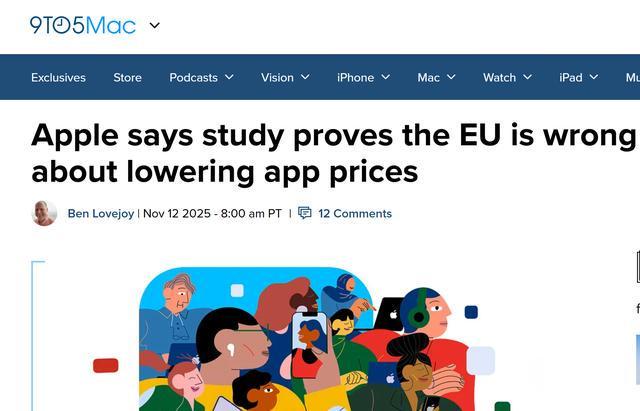
苹果报告称欧盟DMA未达降价预期,90%开发者未下调App价格
Huan Qiu Wang Zi Xun· 2025-11-13 03:51
Core Insights - The European Union's Digital Markets Act (DMA) has not achieved its primary goal of reducing app prices through increased competition, as approximately 90% of developers did not lower their app or in-app purchase prices [1][3] Group 1: Regulatory Impact - The DMA classifies major tech companies like Apple as "gatekeepers," mandating them to open their ecosystems to ensure fair market competition [1] - Apple has implemented three key measures in the EU, including allowing third-party app stores, reducing commission rates, and extending small business programs [1] Group 2: Research Findings - A study commissioned by Apple from The Analysis Group analyzed over 21,000 affected apps and 41 million transaction data points, revealing that only about 10% of developers chose to lower prices, with an average reduction of just 2.5% [3] - The findings contradict EU expectations that reduced developer costs would lead to lower consumer prices [3] Group 3: Developer Behavior - Apple stated that the DMA has failed to deliver promised price benefits to consumers, potentially resulting in lower security, privacy protection, and user experience for European users [3] - Some media analyses suggest that developers' reluctance to lower prices may stem from reallocating saved commission costs towards app feature optimization and performance improvements, which can be seen as an indirect benefit to consumers [3]


苹果App Store规则调整被曝将获欧盟批准,避免5000万欧元日罚款
Sou Hu Cai Jing· 2025-07-22 23:55
Core Points - Apple has adjusted its App Store rules and commission agreements, which is expected to receive approval from EU antitrust regulators, helping the company avoid potential daily fines [1][2] - Developers will now pay a 20% processing fee for transactions through the App Store, with those in Apple's small business program paying as low as 13% [1] - Developers directing users to third-party payment channels will incur fees ranging from 5% to 15%, and Apple will no longer limit the number of links developers can use to guide users to external payments [1] Regulatory Context - In April, the EU antitrust authority fined Apple €500 million (approximately ¥4.188 billion) for restricting developers from directing users to cheaper payment options outside the App Store, violating the Digital Markets Act (DMA) [2] - Apple was required to remove these restrictions within 60 days, or face daily fines of up to €50 million (approximately ¥419 million) based on its global daily revenue [2] - EU regulators are expected to approve Apple's proposed changes in the coming weeks, although the timeline may vary [2]

苹果提起上诉 拒绝向科技对手共享用户数据
news flash· 2025-06-02 04:50
Core Viewpoint - Apple is appealing against the EU's Digital Markets Act (DMA) requirement to share user data with competitors, arguing that it compromises its intellectual property and user privacy [1] Group 1: Company Actions - Apple plans to challenge the EU's requirement for interoperability that forces the company to share user information with external developers [1] - The company has been strongly opposing the demands imposed by the DMA, emphasizing the potential negative impact on its business model [1] Group 2: Regulatory Context - The DMA mandates that companies like Apple and Meta Platforms must comply with new regulations aimed at promoting competition in the tech industry [1] - Apple and Meta were among the first companies affected by the DMA, highlighting the immediate impact of the regulation on major tech players [1] Group 3: Company Statements - An Apple spokesperson stated that the technology designed by the company allows for seamless collaboration, providing a unique user experience that could be threatened by the EU's interoperability requirements [1] - The spokesperson also described the EU's demands as creating an unreasonable, costly, and innovation-stifling process [1]
欧盟判定苹果 App Store 仍不合规,限期整改以符合DMA要求
Sou Hu Cai Jing· 2025-05-27 23:04
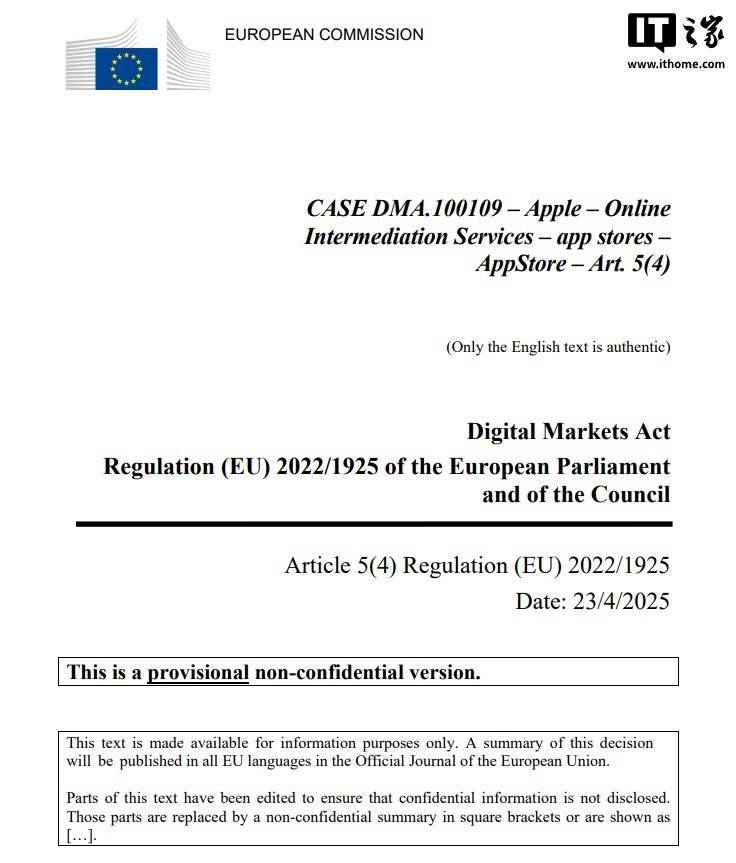
Core Viewpoint - The European Commission has released a report indicating that Apple's new terms for the App Store, which the company claimed were compliant with the Digital Markets Act (DMA), do not meet regulatory requirements [1][5]. Group 1: Regulatory Actions - Following a €500 million fine issued in April 2023 (approximately 4.089 billion RMB), the European Commission has mandated that Apple must fully adjust its App Store rules within 60 calendar days to comply with the DMA [5][6]. - If Apple fails to meet the deadline, the European Commission will initiate a "periodic fine" mechanism until compliance is achieved [5][6]. Group 2: Compliance Issues - The core controversy revolves around Apple's "anti-steering" policy, which the DMA stipulates must allow developers to inform users about alternative payment options and promote these alternatives within the app [6][7]. - Although Apple introduced a revised plan in March 2023, the European Commission found systemic flaws in this new proposal, stating that Apple has not provided convincing reasons to dispute the severity of its violations [6][7]. Group 3: Financial Implications - The periodic fines imposed on Apple will be determined based on the company's substantial financial strength, ensuring that the penalties are effective in enforcing compliance [6]. - Currently, Apple's rules permit each app to include a link to the developer's website, but this is subject to strict conditions, including a 27% commission on transactions made through external links, which is lower than the standard 30% for in-app purchases [6].
The European Union hits Apple and Meta with 700 million euros in fines, first under digital rules
TechXplore· 2025-04-23 18:51
Core Points - The European Union imposed fines totaling 700 million euros ($683 million) on Apple and Meta for violating digital competition rules under the Digital Markets Act (DMA) [3][4][6] - Apple was fined 500 million euros ($571 million) for restricting app developers from directing users to cheaper purchasing options outside its App Store [4][10] - Meta was fined 200 million euros for forcing users to choose between personalized ads or paying for an ad-free experience [4][11] Company-Specific Summaries Apple - The European Commission accused Apple of imposing unfair rules that prevent app developers from steering consumers to alternative purchasing channels [9][10] - Apple has 60 days to comply with the ruling or face unspecified periodic penalty payments [4] - The company claims it has made significant efforts to comply with the DMA, stating it has spent hundreds of thousands of engineering hours on changes [10][8] Meta - Meta's fine stems from its strategy of offering users the option to pay for ad-free versions of Facebook and Instagram, which the EU deemed insufficient for user consent regarding personal data usage [11][12] - The company introduced a third option allowing users to see fewer personalized ads without paying, which is currently under assessment by the Commission [13] - Meta's Chief Global Affairs Officer criticized the fines as a multibillion-dollar tariff that would harm its business model and negatively impact European economies [14]


合计7亿欧元!欧盟首次依据数字市场法案处罚苹果、Meta
Nan Fang Du Shi Bao· 2025-04-23 11:39
Core Points - The European Commission has imposed fines on Apple and Meta for violating the Digital Markets Act (DMA), with Apple fined €500 million (approximately 4.16 billion RMB) and Meta fined €200 million (approximately 1.66 billion RMB) [2] Group 1: Violations and Fines - Apple was found to have violated the DMA's "anti-steering" provisions by not allowing developers to inform users about alternative purchasing channels outside the App Store [3] - Meta's violation relates to its "pay or agree" advertising model, which did not provide users with an option for services using less personal data, thus limiting user choice [3][4] Group 2: Regulatory Actions and Requirements - The European Commission has mandated that both companies must implement corrective measures within 60 days or face additional fines [4] - The DMA, effective from March 2024, aims to prevent tech giants from abusing their market dominance and ensure consumer choice [4] Group 3: Implications and Statements - The European Commission officials emphasized that the DMA is crucial for ensuring fair competition in digital markets and protecting consumer rights [5] - There are speculations that these fines may be a response to U.S. tariff measures, potentially escalating tensions between the EU and the U.S. [5]