新兴城市消费

Search documents
供需错配下的新蓝海:新兴城市消费上涌与一线品牌“双向奔赴”
Guan Cha Zhe Wang· 2026-01-14 00:50
Core Insights - Hema's CEO announced that the company expects a revenue growth rate exceeding 40% by 2025, with its annual GMV projected to surpass 100 billion yuan [1] - The growth is driven by Hema's expansion into 40 emerging cities, achieving high initial sales performance in these locations [1] - Other brands like Starbucks and Lululemon are also accelerating their presence in non-first-tier cities, indicating a broader market shift [1] Group 1: Market Dynamics - There is a significant shift in China's urban development, with a reversal of the traditional trend of population influx into first-tier cities, leading to increased consumer activity in emerging cities [3] - The 2024 migration index for second-tier cities and above shows a decline, with more individuals choosing to stay in their hometowns for work [3] - Over 130 cities are projected to experience net population growth by the end of 2025, with 17 of the top 30 cities being second-tier or below [3] Group 2: Consumer Behavior - The influx of new residents, including internet professionals and entrepreneurs, is driving higher income levels and consumer willingness in emerging cities [5] - The fast-moving consumer goods market is stabilizing, with three to five-tier cities contributing 80% of the market's growth [5] - A significant majority of non-first-tier cities reported positive retail sales growth, with many third-tier cities exceeding the national average [5] Group 3: Supply and Demand Mismatch - Despite rising consumer demand, the supply chain in emerging cities has not kept pace, leading to a mismatch [7] - Consumers face challenges in accessing high-quality products, as local supermarkets primarily offer traditional goods [7] - The lack of modern retail experiences in emerging cities limits consumer engagement and frequency of purchases [7][9] Group 4: Brand Strategies - Major brands are capitalizing on the supply-demand gap by expanding into emerging cities, offering established product lines and service models [10] - Hema's strategy includes leveraging a national supply chain to provide high-quality products directly to consumers in these cities [12] - Other brands, such as Haidilao and Luckin Coffee, are also expanding their presence in lower-tier cities, indicating a trend towards market saturation in these areas [12][14] Group 5: Future Outlook - Emerging cities are becoming essential markets for brands, transitioning from experimental zones to critical battlegrounds for growth [14] - There is significant potential for continued consumer growth in these areas, necessitating brands to tailor their offerings to local demands [14] - The development of local policies and infrastructure will be crucial in unlocking the full consumer potential in emerging cities [14]


大品牌纷纷扎根,新兴城市消费藏着多少潜力?
Qi Lu Wan Bao· 2026-01-13 08:31
Core Viewpoint - The consumption landscape in China is shifting as brands expand into emerging cities, breaking the previous dominance of first-tier cities in retail and lifestyle offerings [1][2]. Group 1: Emerging Cities and Consumption Growth - The growth in emerging cities is driven by population influx and upgraded consumer demand, with a projected 4% year-on-year increase in social retail sales for 2025 [2]. - Cities like Guiyang, Hefei, and Changsha are expected to see a population increase of over 100,000 in 2024, indicating a shift in migration patterns as more individuals choose to stay in their hometowns for work [2][4]. - The demand for quality and experience among young consumers in emerging cities is now comparable to that of first-tier cities, leading to a convergence in lifestyle preferences [4][6]. Group 2: Brand Performance and Market Dynamics - Hema's "Box District Index" indicates strong market performance in emerging cities, with cities like Shijiazhuang and Xuzhou showing indices of 171 and 141, respectively, surpassing the national average [4]. - Hema's sales of Dungeness crabs in Shandong increased by over 150% during the "Eleventh" holiday, with Jinan and Qingdao experiencing growth rates of 450% and 400% [5]. - The shift from low-price competition to quality, personalized, and emotional consumption is becoming mainstream, with consumers in emerging cities increasingly seeking premium products [6][8]. Group 3: Strategic Opportunities and Policy Support - Emerging cities are positioned to benefit from supportive policies aimed at expanding domestic demand and enhancing infrastructure, as outlined in the 15th Five-Year Plan for Shandong [9][11]. - The development of a multi-polar support system is encouraged, with cities like Linyi and Jining being targeted for accelerated growth, creating new opportunities for brands [11][12]. - The robust consumer base and logistics advantages in cities like Linyi, which boasts the largest market cluster in China, are attracting brands like Hema to establish a presence [11][12].
当一线不再独占消费力,新兴城市如何点亮中国消费地图?
Sou Hu Cai Jing· 2026-01-05 06:27
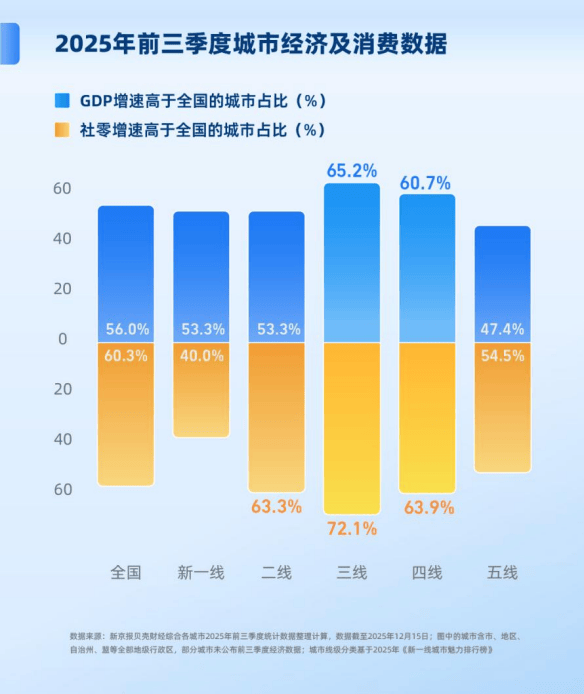
Core Insights - Consumption is a crucial component of domestic demand and a key support for the economic recovery in China, with a reported year-on-year growth of 4% in retail sales from January to November 2025, surpassing the growth rates of the previous year [1] - The Chinese government has prioritized boosting consumption as a key economic task, with recent policies aimed at enhancing financial support for consumption across various sectors [1] - Emerging cities are becoming the main drivers of consumption growth, with three to five-tier cities contributing 80% of the incremental growth in the fast-moving consumer goods market [3][4] Group 1: Economic and Consumption Trends - The macroeconomic data indicates a structural shift in China's economic growth dynamics, with emerging cities increasingly driving economic and consumption growth [4] - By December 15, 2025, 55.7% of non-first-tier cities reported GDP growth rates exceeding the national average, with significant contributions from third and fourth-tier cities [4] - Among 306 non-first-tier cities, 98.7% experienced positive growth in social retail sales, with 72.1% of third-tier cities outperforming the national average [4][6] Group 2: Consumer Behavior and Market Dynamics - The consumer market in non-first-tier cities is becoming increasingly competitive, with brands expanding their presence in these regions, leading to a shift in consumption patterns [9][10] - The rise of lifestyle brands and high-end products in emerging cities reflects a growing demand for quality and variety among consumers [10][11] - The trend of cross-city shopping is emerging, with residents of smaller cities traveling to nearby urban centers for shopping, indicating a blurring of consumption boundaries [30][32] Group 3: Retail Innovations and Supply Chain Developments - New retail models, such as Hema's integration of local products into urban consumption, are transforming traditional supply chains and enhancing consumer access to diverse products [18][20] - The "Hema Village" model is facilitating the entry of local agricultural products into urban markets, creating new consumption trends and enhancing local economies [22][24] - The performance of Hema stores in various emerging cities demonstrates that consumer enthusiasm is not strictly correlated with city tier levels, highlighting the potential for growth in these markets [26][30] Group 4: Lifestyle Changes and Consumption Patterns - The lifestyle preferences of consumers in emerging cities are evolving, with a focus on convenience and emotional satisfaction in shopping experiences [30][33] - Health-conscious consumption is on the rise, with an increasing demand for products that emphasize quality ingredients and health benefits [33][35] - The introduction of high-quality retail spaces is extending shopping hours and enhancing the overall consumer experience, contributing to a more vibrant night-time economy [36]