新兴市场贸易

Search documents
连续11年增长,2025年济宁市货物贸易进出口额再创历史新高
Qi Lu Wan Bao· 2026-01-30 10:19
Core Insights - In 2025, Jining's total import and export value reached 127.44 billion RMB, marking a historical high with a year-on-year growth of 7.4%, maintaining 11 consecutive years of growth [1][3] - Exports accounted for 106.24 billion RMB, growing by 7%, while imports reached 21.2 billion RMB, increasing by 9.4% [1][3] Group 1: Trade Scale and Market Share - Jining's foreign trade further deepened and solidified in the closing year of the 14th Five-Year Plan, achieving a doubling of import and export value since the beginning of the plan in 2021 [3] - The city's import and export value accounted for 3.6% of Shandong's total, an increase of 1.4 percentage points since the start of the 14th Five-Year Plan, both scale and provincial share reached historical highs [3] Group 2: Market Dynamics and Business Activity - The number of enterprises with import and export performance in Jining reached 2,981, an increase of 15.3%, with private enterprises being the main contributors, surpassing 100 billion RMB in import and export value [3] - Foreign-invested enterprises and state-owned enterprises reported import and export values of 13.36 billion RMB and 8.8 billion RMB, growing by 5.4% and 38.2% respectively [3] Group 3: Emerging Markets and Product Diversification - Jining's imports and exports covered over 200 countries and regions globally, with the top five trading markets accounting for 685.2 billion RMB, or 53.8% of the total [4] - Notable growth in trade with ASEAN, EU, and Brazil was recorded at 15.2%, 12.5%, and 50.8% respectively, while trade with Africa, Latin America, Middle East, and Central Asia also saw increases [4] Group 4: Product Composition and Import Growth - Mechanical and electrical products accounted for over 50% of exports, with a growth of 14.8%, contributing to a 7 percentage point increase in overall export value [4] - Key products such as automotive tires and used cars saw significant export growth of 25.4% and 75.5% respectively, while imports of metal ores increased by 59.4%, driving a 7.8 percentage point rise in total imports [4]

前11个月上海市进出口值增长5.7%,11月份出口创月度新高
Bei Ke Cai Jing· 2025-12-19 11:06
Core Insights - The core viewpoint of the article highlights the significant growth in Shanghai's import and export values for the first 11 months of the year, indicating a robust foreign trade performance that surpasses the national average growth rate [1] Group 1: Trade Performance - Shanghai's total import and export value reached 4.1 trillion yuan, representing a year-on-year growth of 5.7%, which is 2 percentage points higher than the national average [1] - Exports amounted to 1.83 trillion yuan, showing an increase of 11.2%, while imports were 2.27 trillion yuan, with a growth of 1.6% [1] - November marked a record high for monthly exports, with a total of 1.87 trillion yuan exported, reflecting an 18.2% increase [1] Group 2: Monthly Trends - For November alone, Shanghai's total import and export value was 387.49 billion yuan, growing by 10.6% [1] - The export value in November reached 186.6 billion yuan, marking an 18.2% increase, while imports were 200.89 billion yuan, with a growth of 4.4% [1] - Shanghai has experienced continuous growth in both imports and exports for eight consecutive months since April [1] Group 3: Emerging Markets - Emerging markets have become a crucial driver for import and export growth, with significant increases noted [1] - Trade with the European Union, Shanghai's largest trading partner, reached 742.31 billion yuan, growing by 1.4% [1] - Trade with ASEAN, the Middle East, and Africa saw imports and exports of 584.68 billion, 145.78 billion, and 135.77 billion yuan respectively, with growth rates of 12.6%, 17.5%, and 28.9% [1]
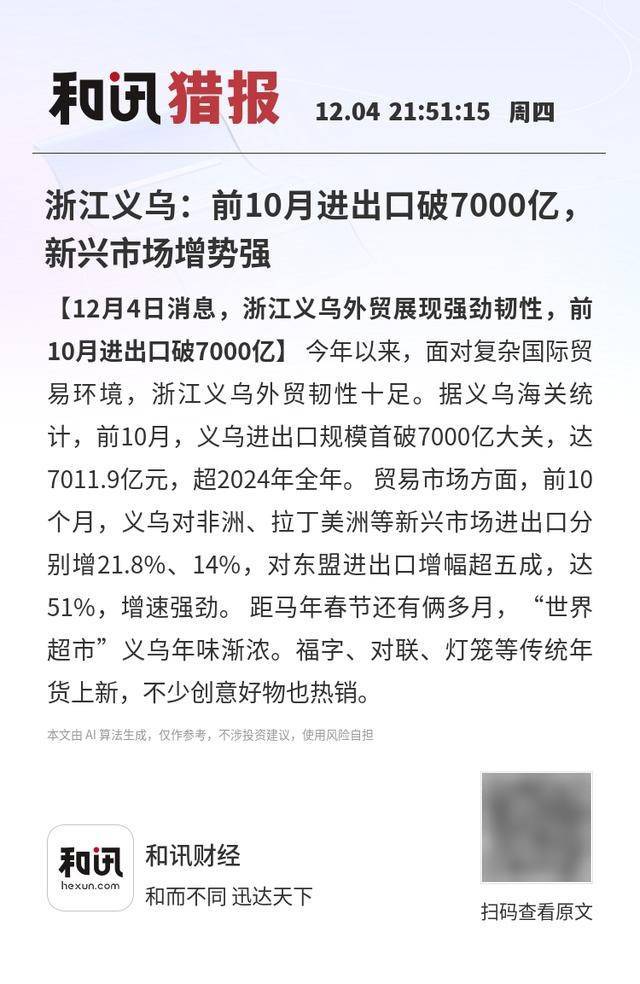
浙江义乌:前10月进出口破7000亿,新兴市场增势强
Sou Hu Cai Jing· 2025-12-05 02:33
Group 1 - The core viewpoint of the article highlights the strong resilience of foreign trade in Yiwu, Zhejiang, with import and export volume exceeding 700 billion yuan for the first ten months of the year, reaching 701.9 billion yuan, surpassing the total for the entire year of 2024 [1][3] - In terms of trade markets, Yiwu's imports and exports to emerging markets such as Africa and Latin America increased by 21.8% and 14% respectively, while trade with ASEAN saw a significant growth of over 50%, reaching 51% [1][3] - As the Lunar New Year approaches, traditional festive goods such as "Fu" characters, couplets, and lanterns are being introduced, alongside a variety of creative products that are experiencing strong sales [1][3]
新兴市场贸易机遇彰显 中小微外贸企业风险管控能力需加强
Jing Ji Guan Cha Wang· 2025-10-19 08:13
Core Viewpoint - The 138th China Import and Export Fair highlights the challenges and opportunities for small and micro foreign trade enterprises in navigating the complex global trade environment, as outlined in the SMERI report by China Export Credit Insurance Corporation [2][3]. Group 1: Overall Risk Assessment - The SMERI report indicates a significant increase in overall risk for small and micro foreign trade enterprises, with the 2025 SMERI index projected at 34.4, a rise of 5.8 points from the previous year, marking the largest increase since 2021 [3]. - Global economic growth is expected to enter a "new normal" of low to medium-speed growth, with structural adjustments and transformation pressures [3]. - Trade protectionism is intensifying, with risks in the industrial chain characterized by high volatility and strong interconnectivity, particularly from the U.S. and EU [3][4]. Group 2: U.S. Trade Policy Impact - U.S. trade policy adjustments, particularly under the "America First" principle, are identified as a major variable affecting global trade risks, with measures like "reciprocal tariffs" violating WTO principles and increasing trade friction [4]. - The removal of tax exemptions for low-value imports from China has led to a surge in the exit rate of small sellers in the cross-border e-commerce market [4]. - Plans to impose tariffs on Chinese shipping and further sanctions in technology sectors are expected to exert additional pressure on China's foreign trade market [4]. Group 3: EU's "De-risking" Strategy - The EU's "de-risking" strategy is becoming more stringent, with investigations into subsidies for electric vehicles and potential future policies affecting sectors like new energy and semiconductors [4]. - The anticipated chaos in global supply chains will significantly impact small and micro enterprises that provide services to multinational companies [4]. Group 4: Emerging Market Opportunities - The WTO forecasts a 3.0% growth in global merchandise trade by 2025, with Asian economies leading the recovery [5]. - China has become a major trading partner for over 150 countries, with trade agreements covering 34% of its imports and exports, and trade with Belt and Road Initiative countries exceeding 50% of China's foreign trade [5]. - Emerging markets are presenting substantial business opportunities, particularly in sectors like machinery and transportation equipment, with a notable increase in demand for Chinese products [5]. Group 5: Challenges in Emerging Markets - Despite the opportunities, challenges such as weak financial infrastructure and unstable payment channels in developing countries pose significant risks for foreign trade enterprises [7]. - The report highlights that small and micro enterprises are particularly vulnerable to buyer credit risks and exchange rate fluctuations, with limited capacity to manage these risks compared to larger firms [9]. Group 6: Sector-Specific Risks - The top five industries of concern for small and micro foreign trade enterprises include textiles, light manufacturing, consumer electronics, new energy products, and electronic information [9]. - Labor-intensive industries are more susceptible to trade barriers and raw material cost fluctuations, while technology-intensive sectors face rising compliance costs and intense competition [9].