新能源汽车融资

Search documents
车企年末掀起“百亿融资战”
Sou Hu Cai Jing· 2025-12-25 03:52
Core Viewpoint - The Chinese automotive industry is experiencing a significant "billion financing battle" as companies prepare for future market competition, with over 10 billion yuan raised in just two months [2][8]. Group 1: Financing Activities - In November and December, four major financing events occurred, including Deep Blue Auto's third round of financing expected to raise approximately 6.122 billion yuan, JAC Motors' 3.5 billion yuan private placement approved by the CSRC, and BAIC Blue Valley's 6 billion yuan refinancing project also approved [2]. - Polestar secured a total of approximately 1.2 billion USD in financing, including 300 million USD in equity and 600 million USD in loans, addressing its cash flow and debt pressures [7]. Group 2: Market Trends and Projections - The latest data from the China Association of Automobile Manufacturers indicates that in November, sales of new energy vehicles reached 1.823 million units, with a penetration rate of 53.2% [8]. - Predictions suggest that by 2026, domestic automobile sales may exceed 28 million units, with new energy vehicles potentially surpassing 20 million units next year [8]. Group 3: Strategic Financing Objectives - Traditional automakers like Deep Blue, BAIC Blue Valley, and JAC Motors are focusing on financing for new platform development, next-generation vehicle development, smart driving technology, and brand building [10]. - JAC Motors plans to invest over 4.2 billion yuan in its new energy passenger vehicle project and related body parts project, aiming for an annual production capacity of 200,000 new energy vehicles [12]. Group 4: Competitive Landscape - The current financing wave reflects a strategic move by established players to secure their positions in the market, while smaller brands may struggle to keep up due to limited financing options [8][10]. - Polestar, despite its previous ambitions, is facing challenges with a net loss of 1.558 billion USD and a significant decline in gross margin, highlighting the need for a sustainable business model and core technology [14]. Group 5: Future Implications - The recent financing activities signal the end of the initial chaotic phase in the automotive industry, marking the beginning of a new era focused on technological depth, capital strength, and operational efficiency [14].



百亿融资落子2026,大厂二代新能源品牌进行反攻
Sou Hu Cai Jing· 2025-12-25 02:49
Core Viewpoint - The capital game in the Chinese new energy vehicle (NEV) market is intensifying, with major players like Deep Blue, JAC Motors, and BAIC Blue Valley securing significant financing to enhance their competitive positions as the market matures and policy incentives wane [1][3][4]. Group 1: Financing and Investment - Deep Blue plans to raise approximately 6.122 billion yuan through capital increase [1] - JAC Motors has received approval for a 3.5 billion yuan private placement [1] - BAIC Blue Valley's 6 billion yuan refinancing project has also been approved [1] Group 2: Market Dynamics - The NEV market is transitioning from an exploratory phase to a deep cultivation phase, with sales exceeding 14.78 million units and a penetration rate surpassing 47% by November 2025 [6] - Traditional manufacturers are leveraging decades of experience in cost control and lifecycle management to gain an edge as the market slows down [4][6] Group 3: Competitive Landscape - New energy brands are shifting from passive followers to more proactive players, aiming to catch up in technology and service capabilities [3][4] - The competitive focus is now on product reliability and long-term ownership costs rather than just technological innovation [11][12] Group 4: Financial Performance - In Q3 2025, Zeekr's gross margin reached 19.2%, NIO's was 14.7%, and Xpeng's was 13.1%, indicating traditional manufacturers are establishing advantages in cost control and scale [7] Group 5: Strategic Initiatives - JAC Motors is investing 1 billion yuan in body parts projects to enhance self-sufficiency and reduce reliance on external suppliers [9] - The rise of brands like Hongmeng Zhixing and Xiaomi is not displacing traditional manufacturers but rather integrating their manufacturing expertise into new ventures [9]
深蓝汽车启动新一轮融资,新股东持股比例不超过20%
Sou Hu Cai Jing· 2025-11-28 06:32
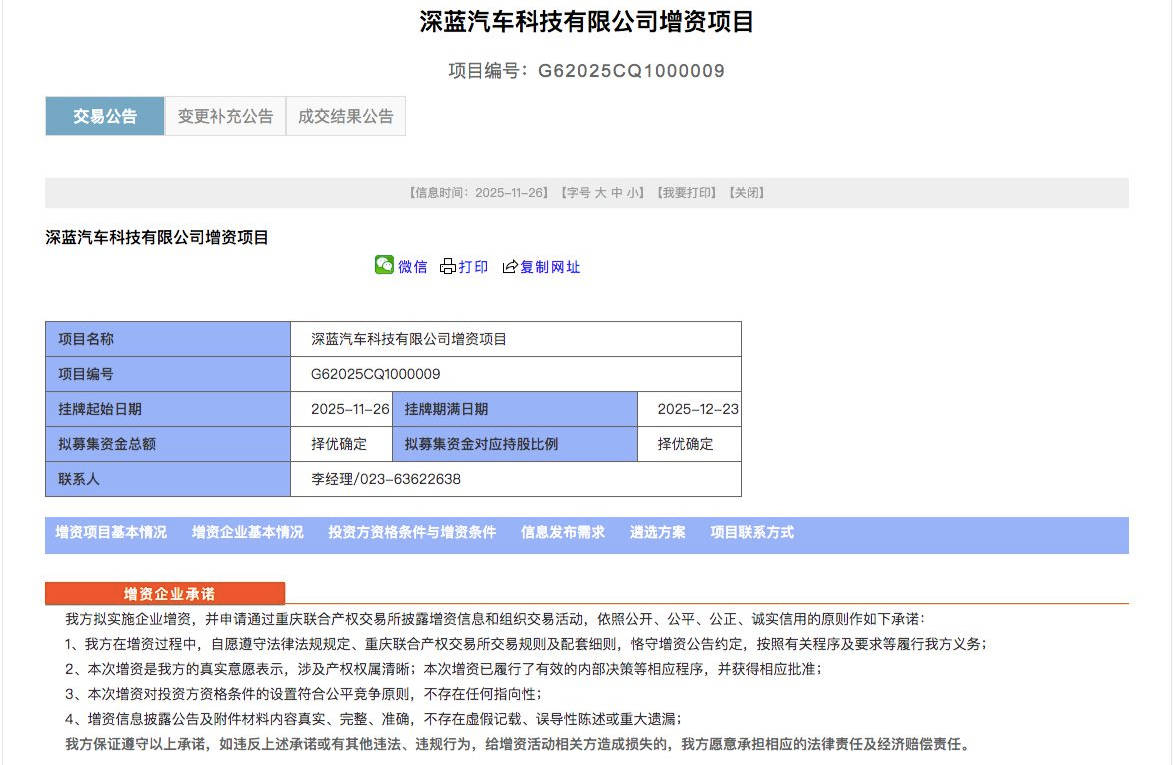
Core Viewpoint - Deep Blue Automotive has officially launched a new round of financing at the Chongqing United Property Rights Exchange, aiming to raise funds primarily for new vehicle research and development, innovation in smart and electric technologies, and enhancing global brand strength [1] Group 1: Financing and Shareholding Structure - The new shareholders will hold no more than 20% of the company, with the transaction expected to be completed by the end of December this year [1] - The total amount of funds to be raised is yet to be determined, and the shareholding ratio corresponding to the raised funds will also be determined [4] - Chongqing Changan Automobile Co., Ltd. is the largest shareholder with a 50.9959% stake, followed by Nanjing Runke Industrial Investment Co., Ltd. with an 11.078% stake [5] Group 2: Financial Performance - Deep Blue Automotive's audited annual revenue for 2022 to 2024 is projected to be 15.677 billion, 26.926 billion, and 37.224 billion yuan respectively, with net profits of -3.196 billion, -3.107 billion, and -1.571 billion yuan [5] - As of October 31, 2025, the total assets of Deep Blue Automotive are reported to be 31.474 billion yuan, with revenue of 39.797 billion yuan and a net loss of -1.025 billion yuan [5] Group 3: Sales and Production Goals - In September, Deep Blue Automotive's sales exceeded 30,000 units, with global sales reaching 33,600 units, marking a year-on-year increase of 48.1%, and in October, sales rose to 36,800 units [6] - The company aims to achieve an annual sales target of 360,000 units, with significant product and technology growth expected next year [6] - Changan Automobile plans to achieve annual sales of 5 million units by 2030, with Deep Blue Automotive responsible for 2 million units [6] Group 4: Production Capacity and Future Plans - Deep Blue Automotive is planning to take over the Beijing Hyundai Chongqing factory, which has a designed capacity of 300,000 vehicles and 300,000 engines [7] - The company's production capacity planning covers multiple bases in Chongqing, Beijing, and Nanjing, with an expected total annual capacity exceeding 1 million units [7] - The recent financing round may also see original shareholders increasing their investment through non-public agreements, aligning the pricing with external investors [7]
蔚来获11.6亿美元注资
Zheng Quan Shi Bao Wang· 2025-09-17 09:50
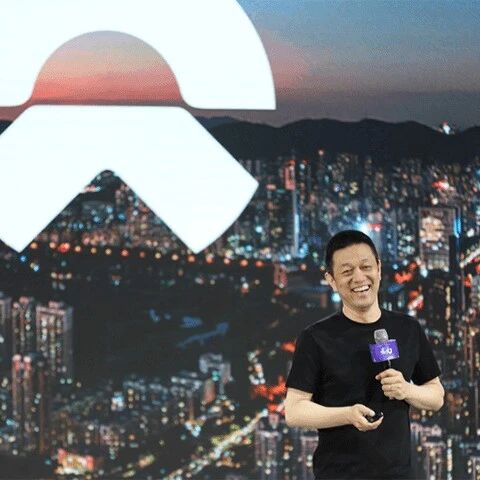
Core Viewpoint - NIO Inc. has successfully completed a financing round of $1.16 billion through a public offering of new shares, aimed at enhancing its financial strength and supporting key technological developments in smart electric vehicles [1] Group 1: Financing Details - The financing amount is $1.16 billion, which will be raised through a public issuance of new shares [1] - The funds will primarily be used for research and development of core technologies for smart electric vehicles [1] Group 2: Strategic Focus - The financing will also support the development of a new generation of technology platforms and vehicle models [1] - Expansion of charging and battery swap infrastructure is a key focus area for the utilization of the raised funds [1] - The company aims to further optimize its balance sheet as part of its financial strategy [1]

蔚来又融到钱了:到账70亿
36氪· 2025-09-12 14:11
Core Viewpoint - NIO has successfully raised over 10 billion USD in funding, showcasing its strong ability to attract long-term investment despite ongoing losses [6][12][44]. Financing Details - NIO announced the issuance of 181.8 million Class A ordinary shares, including American Depositary Shares (ADS), with a public offering price of 5.57 USD per ADS [12][15]. - The recent financing raised approximately 71.2 billion RMB, with significant participation from well-known long-term investment institutions from the US, UK, Switzerland, and other regions [6][16]. - The funds will primarily be used for core technology research and development in smart electric vehicles, expanding the charging and battery swap network, and optimizing financial conditions [18][19][20]. Financial Health - As of mid-2025, NIO's total assets were 100.046 billion RMB, with total liabilities of 93.43 billion RMB, resulting in a debt-to-asset ratio of 93.4%, significantly higher than the industry average of 60%-80% [24][25]. - NIO's current liabilities exceeded its current assets, indicating a declining short-term solvency [25][27]. - The recent funding is crucial for improving cash flow and alleviating short-term debt pressures, allowing NIO to focus on long-term strategies [30][31]. Sales and Profitability Goals - NIO aims to achieve profitability by the fourth quarter of 2025, requiring sustained sales growth and an increase in gross margin from approximately 10% to 16%-17% [33][36]. - In Q2 2025, NIO delivered 72,056 vehicles, a year-on-year increase of 25.6% and a quarter-on-quarter increase of 71.2% [40]. - The company has set ambitious sales targets for Q3, projecting deliveries between 87,000 and 91,000 vehicles, which would represent a year-on-year growth of 40.7% to 47.1% [41]. Investment Landscape - NIO has conducted at least 18 financing rounds since its establishment, raising nearly 100 billion RMB in total, positioning it as a leader in fundraising among new energy vehicle manufacturers [48][49]. - Compared to competitors like XPeng and Li Auto, NIO's financing rounds and amounts are significantly higher, reflecting its strong market position [50][51]. - The ongoing support from institutional investors is attributed to confidence in NIO's long-term vision and leadership [52][53].
蔚来融资正式开启,为长期发展提供资金支持
Xin Lang Ke Ji· 2025-09-10 09:06
Core Viewpoint - NIO Inc. plans to publicly issue up to 181,818,190 shares of Class A common stock to raise funds for various strategic initiatives [1] Group 1: Fund Utilization - The funds raised will be used for core technology research and development in smart electric vehicles [1] - The company aims to develop future technology platforms and models under its brand [1] - Expansion of the charging and battery swapping network is a key focus for the raised capital [1] - Strengthening the company's balance sheet and enhancing financial strength for long-term development is also a priority [1]
哪吒汽车危在旦夕,股东:可以出手救,条件是罢免创始人方运舟
3 6 Ke· 2025-05-30 12:48
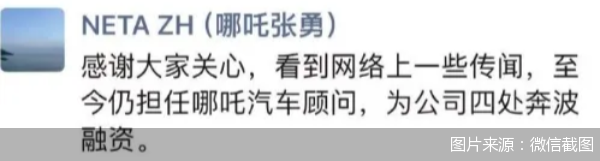
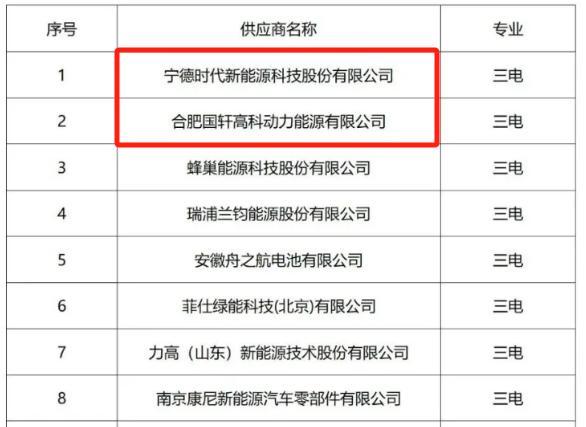
Core Viewpoint - Neta Auto's debt-to-equity swap plan has failed, leading to increased financial distress for the company, which owes approximately 6 billion yuan to suppliers [1][2]. Group 1: Debt Situation - Neta Auto owes around 6 billion yuan to suppliers, with an initial plan to resolve half of this debt, amounting to 3 billion yuan, to secure new funding [1]. - Only a little over 2 billion yuan of debt could be resolved through the debt-to-equity swap, leaving several billion yuan unresolved [2]. - The company had previously reached agreements with 134 core suppliers for over 2 billion yuan in debt-to-equity swaps, including major players like CATL and Guoxuan High-Tech [2][3]. Group 2: Management and Leadership Issues - There are calls from investors to remove founder and CEO Fang Yunzhu as a condition for continued support [4]. - Fang Yunzhu acknowledged the company's crisis in an internal letter, highlighting issues in strategy, organization, and management [6]. - High-level departures have occurred, including the resignation of the former CEO Zhang Yong and other executives [6]. Group 3: Operational Challenges - Over 300 dealers have demanded compensation for operational losses and the return of unpaid rebates and subsidies by May 11 [8]. - Fang Yunzhu has publicly apologized and promised to resolve issues related to parts supply and vehicle deliveries [10]. - Legal troubles are mounting, with over 400 judicial cases involving Neta Auto's parent company, and Fang Yunzhu being listed as a person subject to enforcement with 20 million yuan in frozen shares [10][14]. Group 4: Financial Performance - Neta Auto's sales peaked in 2022 at 152,000 units, but have since declined significantly, with 2023 sales dropping to approximately 127,500 units, a 16.16% decrease [20][23]. - Projections indicate a further decline in sales, with estimates of 64,500 units in 2024, representing a 49.37% drop [23]. - The company has faced management turmoil, with frequent changes in leadership affecting strategic direction and product planning [25]. Group 5: Future Outlook - Despite the current challenges, there may still be a glimmer of hope for Neta Auto, as the situation is not yet deemed a complete failure [17]. - The competitive landscape in the new energy vehicle sector remains intense, and the company's ability to navigate this crisis is uncertain [27].
经销商“上门”要钱,哪吒汽车还能撑多久
Bei Jing Shang Bao· 2025-04-14 10:51
Core Viewpoint - Neta Auto is facing significant operational challenges, including dealer protests over unpaid rebates and subsidies, which have led to a deterioration in its market position and financial health [1][4][6]. Group 1: Dealer Issues - Over 20 dealers from a network of over 300 have protested against Neta Auto, demanding the return of unpaid rebates and subsidies by May 11 [1][4]. - Dealers have reported that they paid millions in advance for vehicles that were never delivered, leading to financial distress and legal issues [2][4]. - Neta Auto has not provided any official communication to dealers since September of the previous year, leaving them reliant on rumors for information [2][4]. Group 2: Financial Performance - Neta Auto's financial situation is concerning, with a significant drop in cash reserves from 6.757 billion yuan at the end of 2022 to 2.837 billion yuan by the end of 2023 [8]. - The company has accumulated losses exceeding 18 billion yuan from 2021 to 2023, with a gross margin that has not turned positive, remaining at -34.4%, -22.5%, and -14.9% over the three years [8]. - Neta Auto's debt has increased slightly to 5.76 billion yuan, indicating ongoing financial strain [8]. Group 3: Market Position - Neta Auto, once a leader in the new energy vehicle sector, has seen its sales decline significantly, with only 86,000 vehicles delivered in the first three quarters of 2022, achieving just 28.63% of its annual target [8]. - The company has been unable to keep up with competitors like XPeng, Li Auto, and Leap Motor, which have all surpassed monthly sales of 30,000 units [2][8]. - Complaints from customers regarding the unavailability of spare parts have further damaged the brand's reputation [6]. Group 4: Future Prospects - Neta Auto is seeking to resolve its debt issues by signing a debt-to-equity conversion agreement with 134 core suppliers, which could facilitate a new round of financing [9]. - The company has announced plans to start localized production in Thailand, aiming to expand into the Southeast Asian market with a credit line of 21.5 million yuan [10].