无银化技术

Search documents
中来股份(300393) - 300393中来股份投资者关系管理信息20260318
2026-03-18 13:58
Group 1: Technology and Cost Advantages - The company's modified BC battery technology utilizes ultra-fine aluminum paste instead of silver paste, which significantly reduces metallization costs due to the high price of silver paste [2] - The technology features a "nano armor protective layer" that prevents aluminum diffusion into polycrystalline silicon, providing excellent vertical conductivity and very low horizontal conductivity [2] Group 2: Production Capacity and Plans - The company has an annual production capacity of 16GW for TOPCon batteries in Shanxi and plans to implement silver reduction technology on the back of TOPCon batteries to enhance market competitiveness [3] - A gradual transformation of an 8GW TOPCon battery production line is set to begin this year, with further modifications depending on business developments [3] Group 3: Business Strategy and Market Adaptation - Following the release of the "Document 136" on market-oriented pricing for renewable energy in 2025, the company is adopting a cautious strategy for its distributed EPC business while actively pursuing operations and maintenance for power plants [3] - The subsidiary, Zhonglai Zhilian Energy Engineering Co., Ltd., has obtained qualifications as an operator for virtual power plants in Shanghai, aiding in business expansion [3]

全球市占率27%,光伏导电浆料龙头聚和材料冲刺“A+H”
Zhi Tong Cai Jing· 2026-01-16 12:45
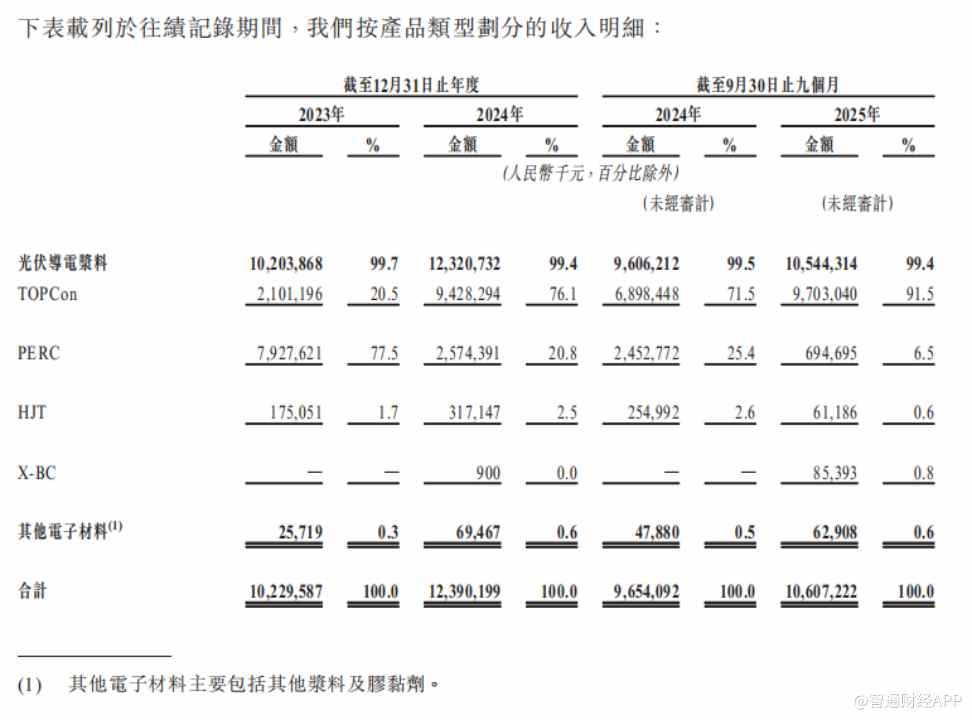
Core Viewpoint - The photovoltaic industry is undergoing a structural shift from a "silicon-centric" model to a "silver-reduction" approach, with domestic semiconductor material substitution entering a critical phase, presenting advanced material companies with opportunities for business upgrades and cross-industry breakthroughs [1] Group 1: Company Overview - Jiangsu Juhua New Materials Co., Ltd. (Juhua Materials) is a leading global manufacturer of photovoltaic conductive silver paste, established in 2015, focusing on R&D-driven advanced materials [2] - The company has developed a comprehensive product matrix covering mainstream routes such as TOPCon, PERC, HJT, and X-BC, with its TOPCon series accounting for 91.5% of revenue by September 2025 [2][3] - Juhua Materials holds the largest market share in the global photovoltaic conductive paste market at 27% as of September 30, 2025, with sales revenue ranking first among all manufacturers [2] Group 2: Financial Performance - Revenue for the fiscal years ending December 31, 2023, 2024, and the nine months ending September 30, 2025, were approximately RMB 10.23 billion, RMB 12.39 billion, and RMB 10.61 billion respectively, driven by increased demand for TOPCon paste and rising silver prices [11] - The company's gross profit margins have shown a declining trend, with margins of 9.2%, 7.8%, and 6.5% for the respective periods, while net profit margin decreased from 4.3% in 2023 to 2.2% in the nine months of 2025 [14] - Operating cash flow has been negative due to the industry's unique settlement model, with net cash flows of -RMB 2.67 billion, -RMB 0.9 billion, and -RMB 1.31 billion for the respective periods [17] Group 3: Market Potential - The global photovoltaic conductive paste market is projected to grow from RMB 14.7 billion in 2020 to RMB 50.4 billion in 2024, with a compound annual growth rate (CAGR) of 16.2% expected from 2025 to 2029 [6] - The market for blank mask plates in China is expected to reach RMB 2.9 billion in 2024 and RMB 7.6 billion by 2029, with a CAGR of 25.1% from 2025 to 2029 [8] Group 4: Strategic Initiatives - Juhua Materials is expanding into the semiconductor materials sector through strategic acquisitions, including a planned acquisition of SK Enpulse Co., Ltd.'s blank mask plate business for approximately RMB 3.45 billion [7] - The acquisition aims to enhance the company's position in the semiconductor materials market and support the national strategy for semiconductor self-sufficiency [7] - The company is also focusing on reducing silver content in its products and has achieved mass production of copper paste, which is expected to improve cost control and profitability [5][19]


新股前瞻|全球市占率27%,光伏导电浆料龙头聚和材料(688503.SH)冲刺“A+H”
Zhi Tong Cai Jing· 2026-01-16 12:25
Core Viewpoint - The photovoltaic industry is undergoing a structural shift from "silicon dominance" to "silver reduction," with domestic semiconductor material substitution entering a critical phase. Advanced material companies are facing dual challenges of upgrading their main business and cross-industry breakthroughs. Jiangsu Juhua New Materials Co., Ltd. (Juhua Materials) has submitted a listing application to the Hong Kong Stock Exchange to strengthen its photovoltaic business and accumulate momentum for its semiconductor material layout [1]. Group 1: Company Overview - Juhua Materials, established in 2015, is a research-driven advanced materials company focusing on photovoltaic conductive materials and other electronic materials. The company has developed a product matrix covering all mainstream routes, including TOPCon, PERC, HJT, and X-BC, aligning its product structure with industry trends [2]. - As of September 30, 2025, Juhua Materials ranked first globally in photovoltaic conductive paste sales, with a market share of 27% [2]. Group 2: Financial Performance - The company reported revenues of approximately 10.23 billion RMB, 12.39 billion RMB, and 10.61 billion RMB for the years ending December 31, 2023, 2024, and the first nine months of 2025, respectively. The growth was primarily driven by increased demand for TOPCon paste and rising silver prices [11]. - However, profit margins are under pressure, with gross margins of 9.2%, 7.8%, and 6.5% for the respective periods, and net profit margins declining from 4.3% in 2023 to 2.2% in the first nine months of 2025 [11][13]. Group 3: Market Dynamics - The global photovoltaic conductive paste market is projected to grow from 14.7 billion RMB in 2020 to 50.4 billion RMB in 2024, with an expected compound annual growth rate (CAGR) of 16.2% from 2025 to 2029. The overseas market is anticipated to expand significantly, particularly in Southeast Asia, the Middle East, and India [5]. - The market for blank mask plates in China is expected to reach 2.9 billion RMB in 2024 and grow to 7.6 billion RMB by 2029, with a CAGR of 25.1% from 2025 to 2029 [9]. Group 4: Strategic Initiatives - Juhua Materials is pursuing a dual growth strategy by expanding into the semiconductor materials sector through strategic acquisitions. The company plans to acquire the blank mask plate business from South Korea's SK Enpulse for 34.5 billion RMB, aiming to enhance its semiconductor material capabilities [7]. - The acquisition is expected to facilitate domestic production of high-end semiconductor materials and contribute to the localization of the supply chain, addressing key bottlenecks in the industry [7][8]. Group 5: Challenges and Opportunities - The company faces challenges related to cash flow and liquidity, with negative operating cash flows reported for the years 2023 to 2025. The reliance on bank acceptance bills for financing highlights the liquidity pressure [15]. - Despite these challenges, the company maintains a competitive edge through its research and development capabilities, with over 20 billion RMB invested in R&D and a strong patent portfolio [3].
银价飙涨,“用银”大户坐不住了
Xin Lang Cai Jing· 2025-12-31 14:13
Core Viewpoint - The silver price has surged significantly, with a nearly 35% increase in one month and close to a doubling over six months, driven by speculative funds and structural supply tightness, impacting both mining companies and manufacturing sectors reliant on silver as a raw material [1][2][12]. Group 1: Silver Price Dynamics - As of December 31, the main silver contract on the Shanghai Futures Exchange closed at 17,074 yuan per kilogram, down 4.27% for the day, but the overall upward trend remains intact [1]. - The price of silver has increased by 127% compared to the end of 2024 [1]. - The industrial demand for silver, particularly in the photovoltaic (PV) sector, is a significant driver, with silver usage in PV applications reaching 6,147 tons in 2024, accounting for 29% of industrial silver demand [2][12]. Group 2: Impact on the Photovoltaic Industry - The share of silver in the cost of photovoltaic components has risen sharply from less than 5% before 2024 to around 20% currently due to soaring silver prices [1][11]. - The production of photovoltaic cells and modules has seen growth, with cell production reaching approximately 560 GW and module production at about 514 GW in the first ten months of 2025, reflecting year-on-year increases of 9.8% and 13.5%, respectively [2][12]. Group 3: Cost Transmission Strategies - Many midstream companies are attempting to pass on the increased silver costs to downstream customers through price hikes, with some companies already implementing slight increases in component prices [5][16]. - For example, LONGi Green Energy has raised its component prices by 0.03 to 0.06 yuan per watt [16]. - However, the ability to pass on costs is challenged by a supply-demand imbalance in the downstream market, limiting the extent of price increases [17]. Group 4: Long-term Solutions and Technological Innovations - The industry consensus is shifting towards reducing silver usage through technological innovations, with "silver reduction" and "silver-free" technologies becoming key strategies for overcoming cost pressures [11][18]. - Companies like Dike Co. are developing low-silver and silver-coated copper pastes, which are expected to reduce costs while maintaining performance [18][19]. - The transition to alternative materials, such as copper, faces challenges due to copper's inferior conductivity and susceptibility to oxidation compared to silver [20].