少银化技术

Search documents
能源转型加速-风光储再迎发展良机
2026-03-17 02:07
Summary of Key Points from Conference Call Records Industry Overview - The records primarily focus on the solar energy and offshore wind power industries, highlighting recent developments, market dynamics, and future projections. Solar Energy Industry Insights Price Trends and Market Dynamics - Photovoltaic (PV) module prices have rebounded to 0.85 CNY/W, effectively passing on the cost pressure from silver prices, with expectations for improved demand in Q2 supporting price sustainability [1][3][4] - The recent price increase in PV products has exceeded market expectations, driven by factors such as industry self-discipline and rising raw material costs [3][4] - The price of silicon materials has slightly decreased, but the overall demand is expected to improve in Q2, supporting current price levels [4] Technological Advancements - The silver-copper technology is advancing rapidly, with JinkoSolar planning to complete a 40GW silver-copper conversion by mid-year, while other leading companies like Canadian Solar and JA Solar are also moving towards mass production [1][5] - Potential collaboration between JinkoSolar and Tesla may involve a technology licensing model, with estimated earnings of approximately 0.02 CNY per watt [5][6] Market Positioning and Profitability - Canadian Solar has restructured its assets to comply with U.S. regulations, securing manufacturing subsidies, which will enhance profitability as financial disclosures are made [1][7] - The investment logic in the solar industry focuses on companies that can achieve profitability first, those with incremental business opportunities, and those entering high-barrier markets like Canadian Solar in the U.S. [1][8] Energy Storage Industry Insights Competitive Landscape - The energy storage sector is not experiencing severe homogenization, as products are highly customized, reducing direct competition [9][10] - Major players like Huawei and Tesla are competing in high-margin markets, while new entrants focus on standardized products [9][10] Cost Transmission and Profit Margins - Energy storage integrators have strong cost transmission capabilities, successfully passing on the rising costs of battery cells to downstream customers [11][12] - The price of battery cells has increased by approximately 0.07 CNY/Wh, with domestic storage system prices rising by about 0.04-0.05 CNY/Wh, indicating a lag effect [12] Investment Valuation - The valuation logic for the energy storage sector is clear, with large integrators valued below 20 times earnings, while household storage is around 25 times [13][14] - The solar industry is currently facing challenges in profitability, with a price-to-book ratio around 2, but potential for reevaluation if companies achieve profitability in the near future [13][14] Offshore Wind Power Industry Insights Policy Developments - The UK has announced the removal of tariffs on 33 offshore wind-related industrial products, which may not directly benefit Chinese exports but indicates a trend towards local manufacturing [15][16] - The North Sea Declaration signed by nine European countries aims for 300GW of offshore wind capacity by 2050, with annual additions of 15GW from 2031 to 2040, significantly higher than current levels [15][16][17] Future Projections - China's "14th Five-Year Plan" sets a target of over 100GW of offshore wind capacity by the end of the plan, indicating strong governmental support and potential for rapid industry growth [17][18] - The market's reaction to these targets has been muted, suggesting a discrepancy between policy expectations and industry sentiment [18] Conclusion - The solar and energy storage industries are poised for growth driven by technological advancements, cost management, and supportive policies, while the offshore wind sector is set to expand significantly due to ambitious governmental targets and international collaboration.


太空算力时代-太空光伏万亿蓝海
2026-02-10 03:24
Summary of Key Points from the Conference Call on Space Photovoltaics Industry Overview - The focus is on the space photovoltaic (PV) industry, which is expected to grow significantly due to increasing demand for space-based computing power and advancements in solar technology [1][10][23]. Core Technologies and Companies - **Gallium Arsenide (GaAs) Solar Cells**: - Highest efficiency (31.5%-34.5%) but very high cost (RMB 200,000-300,000 per square meter) [1][2][12]. - Leading companies: GanZhao Photovoltaics and Sanan Optoelectronics [2][5]. - **P-Type Heterojunction (HJT) Solar Cells**: - Efficiency of 26%-27% (up to 30% when stacked) with lower costs (a few thousand RMB per square meter) [1][2][4]. - Notable progress by Dongfang Risheng in ultra-thin HJT technology [2][5]. - **Perovskite Solar Cells**: - Single-layer efficiency around 20%, can exceed 35% when stacked; lower raw material costs but complex manufacturing [1][2][4]. - Companies like GCL-Poly and Shanghai Gangwan are making significant advancements [2][5]. Cost and Efficiency Challenges - GaAs cells face limited cost reduction potential due to material scarcity and complex manufacturing processes [3][11]. - HJT is seen as a promising short-term technology due to its lower manufacturing costs and reliability [4]. - Perovskite technology has great potential if stability issues can be resolved [4]. Special Requirements for Space Applications - Space PV materials must withstand extreme temperature variations (from -180°C to +120°C) and UV radiation [16]. - Low-temperature silver paste and light conversion technologies are critical for performance in space [16]. Packaging and Materials - Space PV packaging uses CPI or UTG films instead of traditional glass, with UTG offering better performance but at a higher cost (RMB 6,000-8,000 per square meter) [20][21]. - The cost structure of packaging materials is influenced by raw materials (40%-50%), core processes (25%-35%), and yield losses (10%-15%) [22]. Market Dynamics and Future Outlook - The space PV market is expected to expand significantly in the next 3-5 years, driven by satellite launches and technological advancements [23]. - The demand for PV components will increase as more satellites are deployed, potentially leading to explosive market growth [23]. Risks and Challenges - Key risks include the ability of companies to survive until the market matures and the adaptability of technologies to space environments [29]. - Companies must address challenges related to UV resistance and thermal shock to succeed in the space PV market [29]. Conclusion - The space photovoltaic industry is poised for growth, with various technologies and companies leading the charge. However, significant challenges remain in terms of cost, efficiency, and material stability in the harsh space environment.

新股前瞻|全球市占率27%,光伏导电浆料龙头聚和材料冲刺“A+H”
Zhi Tong Cai Jing· 2026-01-16 12:28
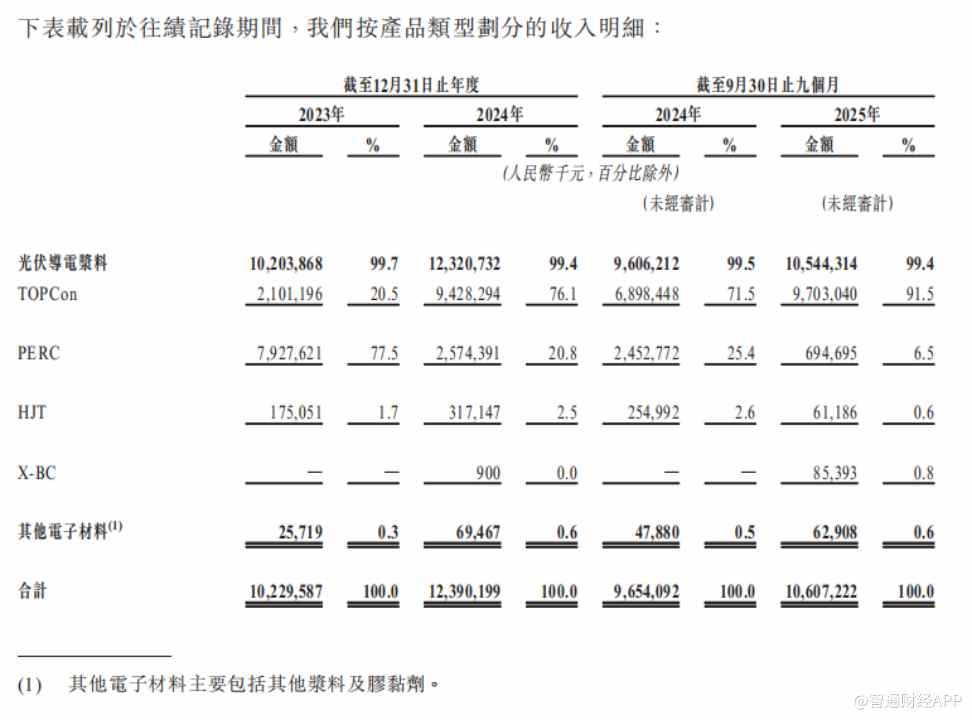
Core Viewpoint - The photovoltaic industry is undergoing a structural shift from "silicon dominance" to "silver reduction," with domestic semiconductor material substitution entering a critical phase, presenting advanced material companies with opportunities for business upgrades and cross-industry breakthroughs [1] Group 1: Company Overview - Jiangsu Juhua New Materials Co., Ltd. (Juhua Materials) submitted its listing application to the Hong Kong Stock Exchange, aiming to strengthen its photovoltaic business and accumulate resources for its semiconductor material expansion [1] - Established in 2015, Juhua Materials is a research-driven advanced materials company, primarily producing photovoltaic conductive materials and other electronic materials, with a product matrix covering all mainstream routes [2] Group 2: Market Position and Financial Performance - As of September 30, 2025, Juhua Materials ranked first globally in photovoltaic conductive paste sales, holding a market share of 27% [2] - The company's revenue for the fiscal years ending December 31, 2023, 2024, and the nine months ending September 30, 2025, were approximately RMB 10.23 billion, RMB 12.39 billion, and RMB 10.61 billion, respectively, driven by increased demand for TOPCon paste and rising silver prices [12][14] Group 3: Research and Development - Juhua Materials has a strong R&D capability, with 236 R&D personnel, accounting for 32% of its workforce, and has invested over RMB 2 billion in R&D from 2023 to September 2025 [5] - The company has developed low-silver and silver-free technologies, achieving mass production of silver-coated copper conductive paste and advancing research on ultra-low-temperature curing paste for perovskite batteries [5] Group 4: Industry Growth Potential - The global photovoltaic conductive paste market is projected to grow from RMB 14.7 billion in 2020 to RMB 50.4 billion in 2024, with a compound annual growth rate (CAGR) of 16.2% expected from 2025 to 2029 [6] - The market for blank mask plates in China is expected to reach RMB 2.9 billion in 2024 and RMB 7.6 billion by 2029, with a CAGR of 25.1% from 2025 to 2029 [9] Group 5: Strategic Expansion - Juhua Materials is expanding into the semiconductor materials sector through strategic acquisitions, including a planned acquisition of SK Enpulse's blank mask plate business for approximately RMB 3.45 billion [8] - The acquisition aims to enhance the company's position in the semiconductor materials market and support domestic production capabilities [8] Group 6: Financial Challenges - Despite steady revenue growth, the company faces profit pressure, with gross margins declining from 9.2% in 2023 to 6.5% in the nine months ending September 30, 2025, primarily due to rising silver prices and intensified industry competition [14] - The company has experienced negative cash flow from operating activities, necessitating financing through bank acceptance bills to cover working capital gaps [17]


银价飙涨,“用银”大户坐不住了
Xin Lang Cai Jing· 2025-12-31 14:13
Core Viewpoint - The silver price has surged significantly, with a nearly 35% increase in one month and close to a doubling over six months, driven by speculative funds and structural supply tightness, impacting both mining companies and manufacturing sectors reliant on silver as a raw material [1][2][12]. Group 1: Silver Price Dynamics - As of December 31, the main silver contract on the Shanghai Futures Exchange closed at 17,074 yuan per kilogram, down 4.27% for the day, but the overall upward trend remains intact [1]. - The price of silver has increased by 127% compared to the end of 2024 [1]. - The industrial demand for silver, particularly in the photovoltaic (PV) sector, is a significant driver, with silver usage in PV applications reaching 6,147 tons in 2024, accounting for 29% of industrial silver demand [2][12]. Group 2: Impact on the Photovoltaic Industry - The share of silver in the cost of photovoltaic components has risen sharply from less than 5% before 2024 to around 20% currently due to soaring silver prices [1][11]. - The production of photovoltaic cells and modules has seen growth, with cell production reaching approximately 560 GW and module production at about 514 GW in the first ten months of 2025, reflecting year-on-year increases of 9.8% and 13.5%, respectively [2][12]. Group 3: Cost Transmission Strategies - Many midstream companies are attempting to pass on the increased silver costs to downstream customers through price hikes, with some companies already implementing slight increases in component prices [5][16]. - For example, LONGi Green Energy has raised its component prices by 0.03 to 0.06 yuan per watt [16]. - However, the ability to pass on costs is challenged by a supply-demand imbalance in the downstream market, limiting the extent of price increases [17]. Group 4: Long-term Solutions and Technological Innovations - The industry consensus is shifting towards reducing silver usage through technological innovations, with "silver reduction" and "silver-free" technologies becoming key strategies for overcoming cost pressures [11][18]. - Companies like Dike Co. are developing low-silver and silver-coated copper pastes, which are expected to reduce costs while maintaining performance [18][19]. - The transition to alternative materials, such as copper, faces challenges due to copper's inferior conductivity and susceptibility to oxidation compared to silver [20].