末位淘汰制

Search documents
任正非的成功启示:做老板就是要分清楚谁应该团结,谁应该淘汰!
Sou Hu Cai Jing· 2026-02-04 08:45
Core Insights - The essence of a successful business lies in identifying allies and eliminating liabilities among employees and partners [1][3][6] - Effective management and responsible employees are considered the greatest assets of a company [3][4] - The process of entrepreneurship is fundamentally about expanding a community of shared interests [4][5] Group 1: Leadership and Team Dynamics - A leader must represent multiple interests to enhance their power, as the strength of a leader is derived from the collective support of their team [4][5] - The concept of "末位淘汰制" (bottom performer elimination) in Huawei is a strategy to combat organizational entropy, emphasizing that not all employees can be retained for the sake of unity [6][9] - Successful leaders, like Ren Zhengfei, are adept at recognizing the right individuals to empower at various stages of the company [9] Group 2: Employee Engagement and Performance - Many employees, particularly middle-aged individuals, seek stability and a sense of belonging, making them ideal candidates for team cohesion [7][8] - The majority of employees in large companies may be average performers, but their stability is crucial for organizational success [7][8] - The relationship between employers and employees is primarily reflected in the distribution of benefits and shared values, which is vital for maintaining a productive work environment [9][10]


【社评】“末位淘汰”?企业行使用工自主权须严守法律底线
Xin Lang Cai Jing· 2026-01-05 18:44
Core Viewpoint - The article emphasizes that performance evaluations should not be misused as a justification for arbitrary dismissals, and companies must adhere to legal standards when exercising employment autonomy [1][4]. Group 1: Legal Framework and Court Rulings - A recent case in Beijing highlighted that a company's practice of "bottom elimination" for employee dismissal was deemed illegal, as it did not comply with legal requirements [1]. - According to China's Labor Contract Law, dismissals must be based on "objective incompetence," and companies must follow procedures such as training or reassignment before termination [1][2]. - The Supreme Court's meeting minutes clarify that dismissing employees solely based on performance rankings is not legally valid [1]. Group 2: Performance Evaluation Practices - Companies often justify dismissals by claiming employees are "incompetent," but being ranked last does not equate to being incompetent, as performance differences may be minimal [2]. - Many companies have flawed evaluation systems that lack transparency and objectivity, leading to unfair dismissals based solely on performance rankings [2][3]. - The practice of "bottom elimination" is often a simplistic approach to management issues, shifting responsibility away from proper evaluation and support systems [3]. Group 3: Employee Rights and Corporate Responsibility - Companies must not abuse their autonomy in employment practices by implementing overly harsh evaluation standards that lead to wrongful terminations [4]. - The article stresses the importance of establishing a fair and scientific evaluation system that protects employees' rights to information and appeals [4]. - The court's ruling serves as a warning to companies that performance evaluations should not be a cover for arbitrary dismissals, and efficiency and employee rights can coexist [4].
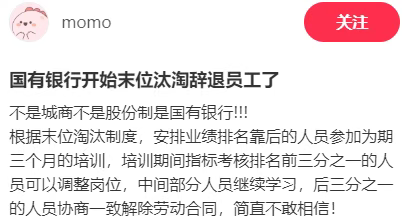
“铁饭碗”银行也开始末位淘汰了?普通人有机会,但没退路......
Xin Lang Cai Jing· 2025-12-16 06:24
Group 1 - The banking industry, traditionally seen as stable, is now facing significant pressure with employees being driven by performance metrics, leading to increased stress levels [1][16][19] - A tiered "bottom elimination system" has been implemented in some banks, where employees ranked in the bottom three for two consecutive months face demotions and salary reductions [2][3][18] - The volume of counter transactions has drastically decreased, with estimates indicating that cash and counter business now account for only about 10% of banking operations [4][17] Group 2 - The operational costs for bank branches are rising, with annual expenses ranging from 2 million to 5 million yuan, and management fees constituting 54.7% of total operating expenses for listed banks in 2024 [5][18][21] - The shift towards digitalization and automation is reducing the need for traditional teller roles, as many tasks can now be performed by machines and online services [10][22][23] - Employees are being encouraged to adapt to new roles that require more complex skills, such as wealth management and customer service, as the nature of their work evolves [11][24][25]
Meta离职大牛怒揭黑幕:内斗、抢功、末位裁员,全是毒瘤
虎嗅APP· 2025-07-13 02:52
Core Viewpoint - Meta is facing significant internal turmoil despite its external success, highlighted by a resignation letter from a former researcher that criticizes the company's toxic culture and internal conflicts [2][12][25]. Group 1: Internal Culture and Conflicts - The resignation letter from former Meta researcher Tijmen Blankevoort reveals a culture of internal strife, where collaboration is lacking and employees are primarily motivated by fear of job loss rather than a shared mission [2][13][15]. - Blankevoort notes that the generative AI department, responsible for developing the Llama model, lacks individuals who genuinely believe in the company's mission, with many employees feeling disillusioned [3][4][20]. - The "bottom-tier elimination" policy has created a culture of fear, leading to unhealthy competition among employees, which Blankevoort describes as a cancer within the organization [12][15][16]. Group 2: Departmental Disconnection - Blankevoort highlights a significant issue of disconnection between departments, particularly between the generative AI team and the hardware team responsible for products like the Ray-Ban glasses, resulting in missed opportunities for collaboration [17][18][20]. - The lack of a clear vision and the ongoing internal conflicts hinder Meta's ability to innovate effectively, contrasting with competitors like OpenAI and Anthropic, which have clear focuses and collaborative efforts [17][19]. Group 3: Leadership Response and Future Outlook - Following the publication of the resignation letter, Meta's leadership has expressed a desire to improve the company's culture and operations, indicating a recognition of the issues raised [26][27]. - The influx of new talent, including high-profile hires, is seen as a potential catalyst for positive change within the organization, although skepticism remains regarding the effectiveness of these changes [27][30]. - The ongoing internal challenges may lead to further resignations and discontent among employees, suggesting that the issues within Meta are far from resolved [31].


今年,GP的员工正在“大换血”
母基金研究中心· 2025-06-13 09:28
Core Viewpoint - The investment industry is undergoing significant personnel changes and structural adjustments due to the current economic downturn, with many firms prioritizing cost control and maximizing efficiency over traditional hiring practices [1][4][10]. Group 1: Personnel Changes - Many General Partners (GPs) are experiencing a "great reshuffle," with firms laying off a significant portion of young investors and traditional business background investors, while hiring those with industry or hard technology backgrounds [1]. - The current environment is described as a "hell mode" for young investors, who are struggling to gain practical experience and resources due to hiring freezes and layoffs [1]. - Investment firms are prioritizing retaining employees with core resources during layoffs, indicating a shift towards a more experienced workforce [1]. Group 2: Departmental Adjustments - New departments, such as those focused on investment attraction and return landing, are being established, but their relevance is being questioned due to recent policy changes that impact the fundraising landscape [2][3]. - The introduction of national guidelines discouraging the establishment of government investment funds for the purpose of attracting investment has led to significant changes in departmental structures within investment firms [2][4]. - The pressure to meet return requirements is expected to decrease, allowing GPs to focus more on independent investment decisions rather than being influenced by local government demands [4]. Group 3: Market Conditions - The current year, 2025, is seen as a critical period for many mid-sized and smaller GPs, facing challenges in fundraising, investment, and exit strategies [4][5]. - The emergence of "zombie funds" indicates that many firms are unable to raise new funds or achieve exits, leading to widespread cost-cutting measures such as layoffs and salary reductions [5]. - The investment community has shifted its expectations, with a focus on achieving modest returns rather than unrealistic high returns, reflecting a more cautious approach to investment [9][10].