
极限协同设计

Search documents
万亿美金芯时代提前到来,STCO承载英伟达“极限协同”下的物理重压?
半导体行业观察· 2026-03-29 01:46
Core Insights - The article discusses the significant transformation in the semiconductor industry driven by AI computing power, predicting that the "trillion-dollar chip era" may arrive by the end of 2026, ahead of the previously expected 2030 timeline [4][5] - Three major trends are identified: the rise of AI computing power, a storage revolution, and technology-driven industrial upgrades [5][6] Group 1: AI Computing Power - By 2026, global spending on AI infrastructure is expected to reach $450 billion, with inference computing power surpassing 70% for the first time, leading to strong demand for GPUs, HBM, and high-speed network chips [5][6] - The industry is experiencing a shift from "pursuing process miniaturization" to "pursuing system integration" as the demand for inference computing power increases [4][5] Group 2: Storage Revolution - Storage is becoming a core strategic resource for AI infrastructure, with global storage output projected to exceed wafer foundry output for the first time, marking it as the primary growth driver in the semiconductor sector [5] Group 3: Technology-Driven Industrial Upgrades - As the 2nm and below process approaches physical limits, advanced packaging is becoming strategically important, driving industry upgrades through a dual focus on "advanced processes + advanced packaging" [5][6] - The need for a new "operating system" to manage the complexities of the transition from chips to data centers is emphasized, as traditional methods are insufficient to meet the demands of AI [6][8] Group 4: System-Level Design - The concept of "Extreme Co-design" is emerging as a new paradigm in AI hardware development, shifting the focus from efficiency to survival as the industry faces unprecedented complexity [8][9] - The traditional EDA tools are becoming inadequate, necessitating a new approach called STCO (System Technology Co-Optimization) to address the industry's challenges [11][13] Group 5: STCO Strategy - STCO aims to redefine the design perspective from "IC" to "System," focusing on system interconnectivity rather than just individual chips [13] - The core value of STCO lies in "virtual rehearsal," allowing for costly physical trial-and-error to be shifted to virtual spaces, ensuring designs are correct on the first attempt [14] - EDA vendors are evolving from mere tool providers to becoming ecological platforms that connect chip design, wafer manufacturing, packaging testing, and system vendors [15] Group 6: Conclusion - The article concludes that mastering system-level design capabilities will be crucial for companies to establish a solid physical foundation for the AI era, as the industry transitions from "single chip" to "computing factories" [17][18]


黄仁勋深度访谈:“Token经济”爆发,AI计算占GDP比重将翻百倍,英伟达10万亿是必然
Hua Er Jie Jian Wen· 2026-03-24 03:22
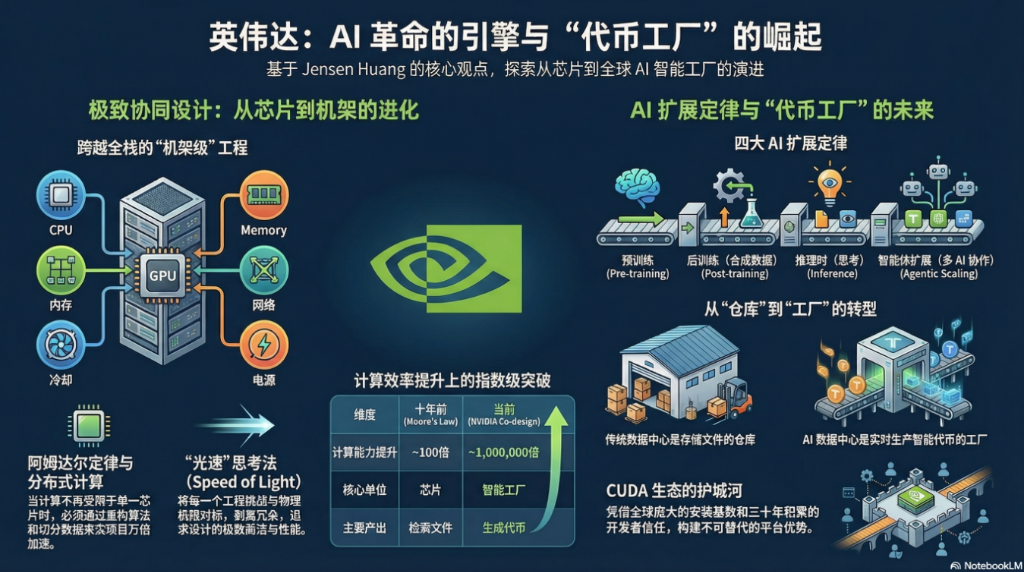
Core Insights - The essence of computing has fundamentally shifted from a "storage system" to a "generative system" with context-awareness capabilities, transforming computers from profit centers to factories directly linked to revenue generation [3][4]. - The concept of "Token" as a new commodity produced by AI factories is emerging, with significant value across various audiences, indicating a potential market where people are willing to pay substantial amounts for these tokens [3][4]. - The global GDP share attributed to computing is expected to increase by a factor of 100 in the future, driven by productivity enhancements [4]. - The company is confident in its growth trajectory, with a potential to reach a market valuation of $10 trillion, viewing this as an inevitable outcome [4]. Energy and Efficiency - Energy is a significant concern for AI expansion, but it is not the only issue; improving energy efficiency and acquiring more power are both critical paths forward [6]. - The efficiency metric emphasized is "tokens per watt per second," with a focus on extreme collaborative design to enhance energy efficiency [6]. - The current power grid is designed for peak demand, leaving much idle capacity that can be utilized by changing contracts between cloud providers and power companies to allow for "graceful degradation" of data centers during power shortages [6]. Supply Chain and Memory - The company is not worried about potential bottlenecks in AI production due to supply chain constraints, having established relationships with around 200 suppliers and advanced planning for high bandwidth memory (HBM) usage [7][8]. - The traditional assembly model for data centers has been replaced by a pre-assembly approach in the supply chain, requiring significant power reserves for testing before shipment [7]. AI Scaling Laws - The CEO outlines four scaling laws for AI expansion: pre-training, post-training, testing time expansion, and agentic scaling [9][10]. - The concern over "data exhaustion" is addressed by emphasizing the continued growth of training data, much of which will be synthetic, indicating that training is now limited by computational power rather than data availability [9][10]. Competitive Advantage and Future Outlook - The company's greatest competitive advantage lies in the extensive deployment of CUDA and the trust built within its ecosystem, supported by a large developer community [11]. - The exploration of deploying data centers in space is acknowledged, but significant physical challenges remain, with a current focus on optimizing energy use on Earth [11]. - The potential for AI to disrupt employment is discussed, with a prediction that the number of programmers could grow from 30 million to 1 billion, as AI becomes integrated into various professions [12][13].
黄仁勋:1000 亿美元、10GW,从卖卡到“卖 AI 产能”
3 6 Ke· 2025-09-28 01:48
Core Insights - The core discussion revolves around redefining NVIDIA's role from a chip supplier to a partner in building AI infrastructure, particularly through its collaboration with OpenAI on a 10GW AI factory project, which could generate up to $400 billion in revenue [1][5][25]. Group 1: Business Model Transformation - NVIDIA is transitioning from merely selling chips to providing a comprehensive AI power supply, likening its role to that of an energy company [3][25]. - OpenAI's shift from renting computing power to building its own AI factory signifies a broader industry trend where companies are establishing their own AI infrastructure [6][9]. - The collaboration with OpenAI is described as a significant business model transformation, emphasizing the need for continuous power supply for AI operations rather than one-time model training [2][5]. Group 2: AI Infrastructure and Demand - The demand for AI capabilities is rapidly increasing, with predictions consistently underestimating actual needs, leading to a global computing shortage [20][21]. - NVIDIA is preparing to meet this demand by planning extensive supply chain logistics for AI factories, ensuring timely delivery of components [22][23]. - The focus is shifting from individual chip performance to the overall efficiency and output of AI factories, where the combination of hardware and software plays a crucial role [26][30]. Group 3: Global AI Competition - Countries are increasingly recognizing the importance of having their own AI factories, akin to the necessity of power plants, to maintain technological sovereignty [35][36]. - The competition is not just about GPU availability but about establishing robust AI infrastructure that can support national capabilities [39][40]. - China is highlighted as a significant player in this global race, with expectations to build its own AI factories to support its market needs [42][43]. Group 4: Future of AI Operations - The future of AI operations is characterized by continuous reasoning processes rather than one-off computations, necessitating a shift in how AI systems are designed and deployed [10][11][15]. - The efficiency of AI factories will be measured by their ability to produce effective AI computations per unit of power consumed, making energy efficiency a critical factor [30][31]. - The ultimate competition will focus on who can effectively integrate all components of AI infrastructure to maximize output and efficiency [44][45].