
格物致知

Search documents
朱子年节观的闽地回响
Xin Lang Cai Jing· 2026-02-18 23:26
Core Viewpoint - Zhu Xi's theories on folk customs and festival views integrate "heavenly principles" with "human feelings," reshaping the cultural landscape of Fujian over 800 years, becoming a profound aspect of local culture [1] Group 1: Zhu Xi's Theories on Folk Customs - Zhu Xi's folk customs theory is rooted in the core of "Li Yi Fen Shu," asserting that "heavenly principles" are the ultimate basis for all things, manifested through specific customs like festivals and rituals [1] - He advocates for a rational examination of folk customs to align them with "heavenly principles," aiming for the transformation of customs into ethical practices [1] Group 2: Festival Practices and Ethical Implications - Zhu Xi emphasizes the importance of family cohesion and respect for ancestors during festivals, particularly advocating for sincerity and simplicity in rituals, opposing extravagance [2] - He critiques excessive drinking and frivolity during the Spring Festival, promoting the idea of "regulating with propriety" to maintain ethical standards [2] Group 3: Integration of Festivals with Economic and Agricultural Practices - Zhu Xi promotes the integration of festivals with agricultural activities, encouraging education and farming during festive times, reflecting a governance philosophy of "respecting heaven and working diligently for the people" [3] - He connects seasonal rituals with agricultural practices, emphasizing that festivals should align with the natural rhythms of farming [3] Group 4: Practical Approaches to Rituals - Zhu Xi's approach to ritual reform emphasizes adapting ancient customs to contemporary practices, advocating for a balance between tradition and practicality [4] - His work "Family Rites" serves as a guideline for rituals, stressing that the essence of rituals lies in maintaining familial respect and love, rather than merely following formalities [4] Group 5: Long-term Cultural Impact - Zhu Xi's theories on folk customs and festivals have significantly influenced the cultural characteristics of Fujian, emphasizing education, respect for rituals, and familial bonds, with effects lasting for centuries [5] - The ongoing observance of simple yet solemn family rituals during festivals in Fujian reflects Zhu Xi's enduring influence, highlighting the integration of ethical values with cultural practices [5]
汲取传统文化智慧赋能基层调解工作
Xin Lang Cai Jing· 2026-02-04 18:26
Core Viewpoint - The "He Lifang" mediation room in Jiujiang Economic and Technological Development Zone has successfully resolved over 200 civil and commercial disputes since its establishment, integrating cultural and institutional vitality into the construction of a law-based development zone [1] Group 1: Mediation Approach - The mediation approach emphasizes understanding the essence of disputes, aligning with Zhu Xi's philosophy of "investigating things to attain knowledge" [2] - A specific case involved a workplace injury where the mediation team clarified the core dispute regarding safety production responsibilities, leading to a reasonable compensation agreement and improved safety management [2] Group 2: Building Trust - The principle of "sincerity and integrity" is crucial for mediators to gain public trust, with the "He Lifang" room implementing a transparent supervision mechanism [3] - A notable case involved resolving a private lending dispute through multiple communications, ultimately achieving a high compliance rate of over 98% for mediation agreements [3] Group 3: Professional Team Development - The "He Lifang" mediation room has established a high-quality team through a "personal enhancement + team collaboration" model, providing training on legal policies, psychology, and communication skills [4] - An expert advisory group has been formed to provide authoritative guidance on complex disputes, contributing to the resolution of historical cases [4] - The mediation room operates with a "3+N" team model, collaborating with community service centers to address conflicts at the grassroots level [4]
朱熹的“渠”字与闽音实践
Xin Lang Cai Jing· 2026-01-16 23:10
Core Viewpoint - The article explores the significance of the term "渠" (qu) in the context of language evolution, cultural memory, and its role in the philosophical poetry of Zhu Xi, highlighting the interplay between classical and local dialects in Chinese culture [1][2][7]. Language Evolution - The term "渠" has transitioned from a common third-person pronoun in Southern dialects to a more limited usage in modern Mandarin, where it primarily refers to "water channel" or "canal" [2]. - In Southern dialects such as Cantonese and Hakka, "渠" continues to thrive as a third-person pronoun, showcasing its vitality as a "living ancient language" [2]. Cultural Memory - In regions where Zhu Xi taught, such as Jianou and Wuyishan, the term "渠" remains prevalent, linking contemporary speech to historical literary references, thus serving as a cultural bridge [2][7]. - The use of "渠" in everyday language fosters a deep cultural memory and local identity, connecting people to their historical roots [2][7]. Philosophical Approach - Zhu Xi's approach to language reflects a dialectical tension; while he upheld the standardization of language based on Central Plains pronunciation, he also recognized the value of local dialects in understanding classical texts [3][4]. - His "叶音" (ye yin) theory illustrates a method of adapting pronunciations to preserve the poetic beauty of ancient texts, often relying on local dialects for accuracy [4][5]. Educational Impact - Zhu Xi's integration of dialects into his teachings, particularly in "朱子语类" (Zhuzi Yulei), made philosophical discussions more accessible and relatable, blending literary and colloquial language [5][8]. - This approach contributed to the popularization of Neo-Confucian thought, making it resonate with a broader audience [5][8]. Poetic Expression - The phrase "问渠那得清如许" (How can the pond be so clear?) exemplifies how the use of "渠" as a dialect term enriches the emotional and philosophical depth of Zhu Xi's poetry, making abstract concepts more relatable [6][8]. - The incorporation of local dialects in poetry not only enhances its accessibility but also infuses it with a sense of warmth and life, reflecting the interconnectedness of philosophy and daily experience [6][8].
清远江心岛书院揭秘宋代雅俗共融
Nan Fang Nong Cun Bao· 2025-12-10 10:34
Core Viewpoint - The lecture by Professor Deng Xiaonan highlights the cultural essence of the Song Dynasty, emphasizing the integration of refined and popular culture, which reflects the dynamic social and cultural landscape of that era [2][3][4]. Historical Context - The Song Dynasty was characterized by a "South-North" political landscape, coexisting with northern powers like Liao, Xixia, Jin, and Yuan, leading to a stable political foundation focused on internal stability and cautious external defense [10][11][12]. - The presence of northern ethnic groups not only posed challenges but also stimulated the economic and cultural vitality of the Song society [15][16]. Cultural Shifts - The cultural focus shifted towards the common people, leading to a more secular and humanistic approach, with the government allowing greater freedom for cultural and economic development [17][18][19]. - The era saw a rise in urban culture, with diverse activities depicted in artworks like "Along the River During the Qingming Festival," showcasing the richness of Song urban life [30][31]. Education and Scholarship - The Song Dynasty experienced a surge in educational opportunities, with both official and private academies emerging to prepare scholars for the civil service examinations, leading to a broader public interest in education [51][52][53]. - The era produced significant academic achievements, with the emergence of "Song Learning," "New Confucianism," and "Li Xue," reflecting a rich and diverse intellectual landscape [58][59][60]. Literary and Artistic Developments - The coexistence of refined and popular culture in literature and art was notable, with the expansion of literary forms to include poetry, lyrics, and novels, appealing to a wider audience [90][91]. - The Song Dynasty's artistic expression, particularly in painting and calligraphy, showcased a unique style that reflected the emotional and philosophical depth of the period [101][102][104]. Cultural Essence - The integration of the mundane and the refined in Song culture illustrates a profound understanding of life, where everyday experiences were infused with artistic and philosophical significance [107][108]. - The concept of "Da Su Da Ya" (great vulgarity and great elegance) encapsulates the cultural spirit of the Song Dynasty, where the pursuit of aesthetic and moral values permeated daily life [112][113].


悟道茶香画意间(读画)
Ren Min Ri Bao· 2025-12-06 21:57
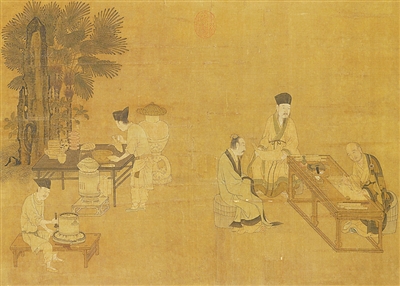
Core Viewpoint - The article highlights the significance of tea culture in China, particularly during the Song Dynasty, emphasizing its role as a spiritual and aesthetic pursuit rather than just a daily beverage [3][4]. Group 1: Tea Culture and Historical Context - The Song Dynasty is identified as the peak period for the development of tea culture in China, with meticulous practices from tea preparation to consumption [3]. - Liu Songnian's artwork "The Tea Grinding Scroll" exemplifies the elegance and intricacy of Song-style tea culture, showcasing detailed depictions of tea preparation and the serene atmosphere of tea gatherings [4][5]. Group 2: Artistic Representation and Philosophy - The painting features a clear narrative structure, with distinct roles for the servants and the hosts, reflecting the harmony and interaction typical of the era's tea culture [3][4]. - Liu Songnian's artistic style is characterized by elegance and realism, capturing the essence of daily life and the philosophical underpinnings of the Song Dynasty, such as the pursuit of knowledge and tranquility through everyday activities [4][5]. Group 3: Tea Preparation Techniques - The article describes the meticulous process of preparing tea, including grinding tea leaves and the specific steps involved in making tea, which are visually represented in the artwork [4]. - Various tea utensils depicted in the painting serve as historical evidence of the tea culture practices during the Song Dynasty, aligning with documented tea preparation methods [4].
静观之境存风骨(读画)
Ren Min Ri Bao· 2025-11-08 22:11
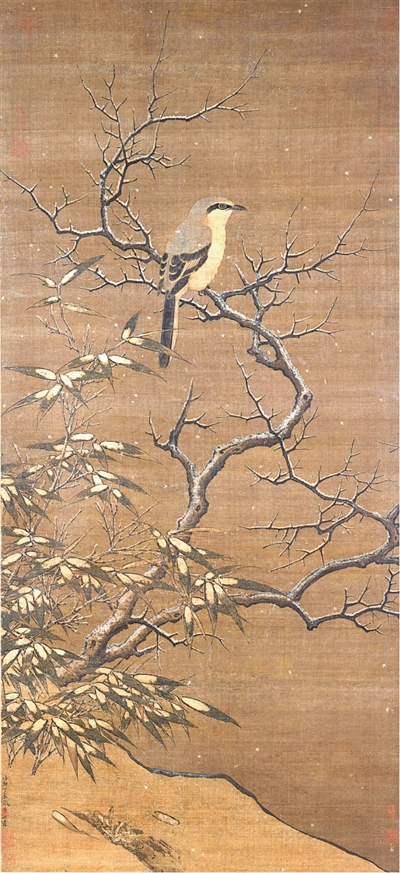
Core Perspective - The article emphasizes the aesthetic and philosophical significance of Li Di's painting "Snowy Tree and Cold Bird," reflecting the Song Dynasty's ideals of quiet observation and inner contemplation amidst the harshness of winter [2][3]. Summary by Sections Artistic Analysis - The painting, created in 1187, showcases a resilient thorn tree and a solitary bird, symbolizing strength and perseverance in a desolate winter landscape [2]. - The use of negative space and minimalistic elements in the artwork conveys a sense of tranquility and depth, allowing viewers to feel the essence of winter [2]. Historical Context - The year the painting was completed coincided with a period of personal loss for Emperor Xiaozong, which may have influenced the themes of solitude and resilience depicted in the artwork [3]. - The painting reflects the broader aesthetic pursuit of the Song Dynasty, emphasizing not just technical skill but also the profound exploration of existential themes [3]. Philosophical Implications - The artwork embodies the Song Dynasty's philosophy of "external barrenness with internal richness," illustrating the contrast between the starkness of the scene and the underlying vitality of life [3]. - The enduring message of the painting is one of dignity and hope, suggesting that even in the face of adversity, the spirit of life remains unyielding [3].
中国哲学视域下人工智能发展路径的多维建构与范式创新
Xin Hua Ri Bao· 2025-08-12 22:02
Group 1 - The core idea emphasizes the interaction between Chinese philosophy and artificial intelligence, highlighting the necessity of philosophical guidance in technological development and the evolution of philosophical thought in response to modern advancements [1][8] - The ethical framework for artificial intelligence is rooted in Chinese philosophical principles, advocating for human-centric development and the protection of individual rights through legal norms [2][8] - The integration of Chinese philosophical concepts, such as the dualism of "li" and "qi," can enhance the adaptability and flexibility of AI algorithms, addressing complex real-world challenges [3][8] Group 2 - The cultivation of interdisciplinary talent is essential for synchronizing technological and philosophical advancements, promoting social equity and collaborative progress [4][8] - The digital transformation of Chinese philosophy through AI technologies offers new avenues for dissemination and engagement, enhancing accessibility and understanding of philosophical concepts [5][8] - The global governance of artificial intelligence faces challenges due to differing national policies, but China advocates for a cooperative approach based on mutual respect and shared benefits [7][8]