棕榈油减产预期

Search documents
12月份棕榈油价格反弹走高的可能性较大
Xin Hua Cai Jing· 2025-12-08 07:27
Core Viewpoint - Domestic palm oil prices have increased by 2.44% week-on-week in early December, driven by concerns over production cuts and shifting demand from India, with expectations of continued strong performance in palm oil prices as production cut forecasts materialize [1][7]. Group 1: Production Insights - Concerns over production cuts have been heightened due to weather disturbances affecting palm oil output, leading to price increases [1][7]. - The Malaysian Palm Oil Association (MPOA) reported a 4.38% month-on-month decline in crude palm oil production for November, exceeding previous estimates of a 2.9% drop, which supports price increases despite overall high production levels [3]. - November palm oil exports from Malaysia saw a significant decrease of approximately 15%, suggesting potential inventory accumulation despite production declines [3]. Group 2: Demand Dynamics - The price differential has led to increased demand for palm oil from India, with expected imports rising by 4.6% month-on-month to 630,000 tons in November [5]. - Indian refiners have canceled about 70,000 tons of soybean oil purchases scheduled for December to January due to rising global soybean oil prices, opting for more competitively priced palm oil instead [5]. - Currently, palm oil prices in India are over $100 per ton lower than soybean oil, enhancing the attractiveness of palm oil imports [5]. Group 3: Market Outlook - As weather-related factors diminish, market focus is shifting back to the fundamentals of palm oil, with close attention on high-frequency production and sales data from major producing countries and the upcoming MPOB report [7]. - If production cuts are confirmed to be more significant than anticipated, this could further support price increases [7]. - The domestic market is experiencing a subdued trading atmosphere, with some regions facing pressure to expedite transactions, which may limit upward price movement [7]. - Overall, the likelihood of a price rebound in December is high, with expectations for 24-degree palm oil prices to range between 8,660 and 9,000 yuan per ton [7].

棕榈油:外强内弱格局延续,12月首周价格冲高
Xin Lang Cai Jing· 2025-12-08 06:33
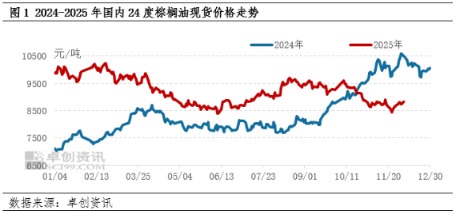
Core Viewpoint - In the first week of December, palm oil prices in China increased by 2.44% week-on-week due to concerns over production cuts and a shift in demand from India, despite a sluggish domestic market and ongoing inventory accumulation expectations [2][12]. Group 1: Price Movements - As of December 5, the domestic price of 24-degree palm oil was approximately 8,831 yuan per ton, with a weekly average of 8,777 yuan per ton, reflecting an increase of 209 yuan per ton [2][12]. - The price increase was driven by multiple favorable factors, including production concerns due to weather disturbances in producing regions [2][12]. Group 2: Production and Inventory - Malaysia's palm oil production in November decreased by 4.38% month-on-month, exceeding previous estimates of a 2.9% decline, which provided some support for prices [5][14]. - Despite the production decline, overall palm oil production remains relatively high, and a significant drop in exports (approximately 15%) is expected to lead to continued inventory accumulation [5][14]. Group 3: Demand Dynamics - Since October, the price gap between palm oil and soybean oil has widened, prompting Indian traders to increase palm oil imports by an estimated 4.6% to 630,000 tons in November [7][16]. - Indian refiners have canceled about 70,000 tons of soybean oil purchases originally scheduled for December to January, opting for more price-competitive palm oil instead, which is currently over $100 per ton cheaper than soybean oil [7][16]. Group 4: Market Outlook - As weather-related factors diminish, market focus is shifting back to fundamentals, with expectations that palm oil prices may continue to rise if production cuts are confirmed [9][18]. - The overall sentiment suggests that palm oil prices are likely to remain strong in December, with forecasts indicating a price range of 8,660 to 9,000 yuan per ton for 24-degree palm oil [9][18].

反弹将至or仍未触底?棕榈油本轮下跌回顾与未来展望
Dong Zheng Qi Huo· 2025-11-09 08:14
1. Report Industry Investment Rating - The investment rating for palm oil is "Volatile" [1] 2. Core Viewpoints of the Report - The end of the current decline in palm oil prices depends on four factors: whether the October MPOB data meets market expectations, the improvement of India's palm oil procurement, the production prospects in the producing areas from November to December, and the possibility of the implementation of biofuel policies in Indonesia and the United States [3] - The logic supporting the medium - to long - term rise of palm oil still exists, but short - term supply pressure is prominent. The upside space for the 01 contract is limited, while the 05 contract may present long - position opportunities and P2601 - P2605 reverse spread opportunities [4] 3. Summary by Relevant Catalogs 10 - Month Palm Oil Price Decline Review 1.1 The Beginning of the Current Decline: Unexpected Inventory Accumulation of Malaysian Palm Oil in September - After the double - festival holiday in October, the palm oil price showed a strong rebound trend, but the MPOB September report on October 10th showed that the Malaysian palm oil inventory reached 2360000 tons, far exceeding market expectations and hitting a 21 - month high [2][13] - In terms of production, the decline in production in the Malay Peninsula was offset by the increase in production in Sabah and Sarawak. In terms of exports, affected by the export tax adjustment in Indonesia and Argentina, and the substitution of soybean oil, Malaysia's overall export situation was not ideal. In terms of apparent demand, it is speculated that the large - scale inventory accumulation may be due to increased smuggling from Indonesia to Malaysia [14][15] 1.2 The Core of the Current Decline: Weaker - than - expected Reality and the Weakening of Strong Future Expectations - The continuous negative data of Malaysian palm oil and the lack of confidence in future strong expectations accelerated the decline. The MPOA's forecast of a more than 10% increase in production from October 1 - 20 far exceeded market expectations, and the decline in export data further increased the inventory pressure [18][22] - Indonesian data and policies also exacerbated the bearish sentiment in the market. Although the review of illegal plantations in Indonesia may affect future production, the current production data has not shown a negative impact. The market is also divided on the implementation of Indonesia's B50 policy [25][27] Palm Oil Price Outlook for the Future: Rebound Imminent or Not Yet at the Bottom? Short - Term Outlook - Key factors include the difference between the MPOB data and market expectations and whether November data shows an increasing production trend. If the data meets expectations, prices may stop falling and stabilize; if it is better than expected, there may be a limited rebound; if it is worse than expected, prices may continue to fall [32] - In terms of supply, it is expected that the production of Malaysian palm oil in November will decline slightly following normal seasonal changes. In terms of demand, India and Pakistan's restocking demand and Indonesia's B40 implementation progress need to be focused on [32][38][41] Long - Term Outlook - The core drivers are Indonesia's B50 policy and the US biofuel policy. If Indonesia's B50 policy is implemented in the second half of 2026, the increase in palm oil demand is expected to be 200000 - 300000 tons. Whether the upside space can be opened depends on the balance between production and biofuel demand [46][50] Investment Strategies and Suggestions - Short - term: Pay attention to the MPOB report and November high - frequency data. After the bearish sentiment in the market subsides, focus on the opportunity of a small - scale rebound, but the space is expected to be limited. If the data is more bearish than expected, consider short - selling opportunities for the 01 contract, with a support level of 8200 yuan [51] - Medium - to long - term: Pay attention to the weather in the producing areas, restocking in the consuming areas, and biofuel policies of relevant countries. Consider long - position opportunities for the 05 contract during the Ramadan trading period from the end of the fourth quarter to the beginning of the first quarter of next year [51]
产地或提前进入减产周期 10月棕榈油存走强预期
Xin Hua Cai Jing· 2025-10-09 06:49
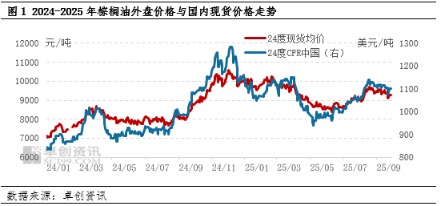
Core Viewpoint - Palm oil spot prices experienced a rebound in July and August, but saw a correction in September as market bullish factors were exhausted. However, tight fundamentals in Malaysia are expected to limit the price decline [1][3]. Group 1: Price Trends - In September, the CFR price for 24-degree palm oil in China was reported at $1,106 per ton, with an average import cost of approximately 9,438 yuan per ton, reflecting a slight month-on-month decrease of 0.24% [1]. - The domestic average price for 24-degree palm oil was 9,378 yuan per ton in September, down 0.17% from August. Despite this, high import costs are expected to suppress further declines in spot prices [1][3]. Group 2: Supply and Demand Dynamics - India's palm oil imports peaked in August but are expected to decline to around 830,000 tons in September, indicating weakening demand support for palm oil prices [3]. - Seasonal patterns suggest that palm oil production typically peaks in October, but adverse weather in Malaysia has led to an unexpected decline in production, with September output estimated at 1.76 million tons. This tightening supply may bolster palm oil prices [3]. - The seasonal index indicates a high probability of palm oil price increases in October, supported by a "weak supply, strong demand" scenario in Malaysia. However, domestic demand may not improve significantly, potentially limiting price increases [3].