汇率压力

Search documents
俄罗斯真没钱了
虎嗅APP· 2025-11-30 10:34
Core Viewpoint - The article discusses Russia's unprecedented move to sell its gold reserves to cover budget deficits, marking a significant shift in its fiscal policy amid ongoing military expenditures related to the Ukraine conflict [5][6][8]. Group 1: Gold Reserves and Fiscal Policy - On November 20, the Central Bank of Russia confirmed it has begun selling physical gold reserves to meet budgetary needs, a first in Russian history [5][6]. - From 2022 to November 1, 2025, Russia's National Wealth Fund saw its gold reserves decrease from 405.7 tons to 173.1 tons, a reduction of 232.6 tons, or 57% [7]. - This sale represents a substantial shift from previous practices, which involved only accounting adjustments between the government and the central bank, to actual physical transactions [7][8]. Group 2: Military Expenditures - Russia's fiscal pressure is evident, with a projected fiscal deficit of 3.69 trillion rubles in the first half of 2025, over five times that of the same period in 2024 [12]. - The government plans to allocate 41.469 trillion rubles for total expenditures in 2025, with 13.5 trillion rubles earmarked for defense, accounting for 32.55% of the budget [13]. - Military-related expenditures are expected to exceed 16.55 trillion rubles in 2025, averaging over 453 billion rubles per day [17]. Group 3: Revenue Decline - Energy revenue, a key fiscal pillar, has sharply declined since mid-2022, with oil prices dropping significantly [48][50]. - By May 2025, the average price of Urals crude oil fell to $53 per barrel, below the $75 needed for fiscal balance, leading to a 24% reduction in revenue expectations [50]. - Oil and gas tax revenues for January to October 2025 totaled 7.5 trillion rubles, a year-on-year decrease of over 21% [51]. Group 4: Economic Challenges - Approximately $300 billion in foreign reserves have been frozen, leading to a liquidity crisis and a 55% drop in the National Wealth Fund's liquid assets [55][56]. - The Russian government has resorted to printing money to address fiscal shortfalls, resulting in unprecedented growth in the money supply [62]. - Despite high interest rates aimed at curbing inflation, the annual inflation rate remains at 7.7% as of October 2025, significantly above the target of 4% [67]. Group 5: Market Impact and Future Outlook - The sale of 232.6 tons of gold is unlikely to significantly impact the international gold market due to its large daily trading volume [82]. - Domestic demand for gold in Russia has surged, with individuals purchasing approximately 282 tons over four years, indicating strong absorption capacity [87]. - The article predicts that if current spending and revenue trends continue, Russia's gold reserves could be depleted within 3 to 5 years, raising concerns about future fiscal sustainability [100].


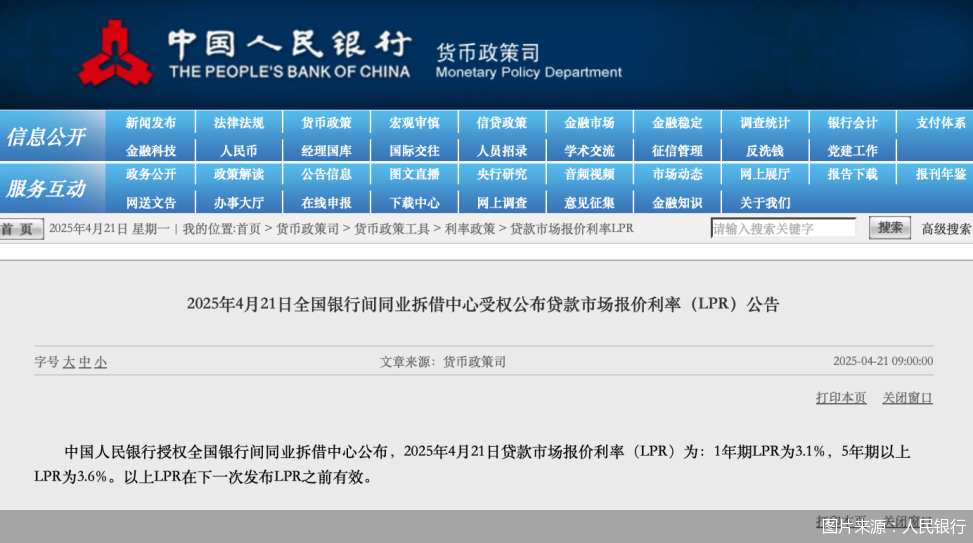
LPR继续持稳,二季度降息何时落地?
Bei Jing Shang Bao· 2025-04-21 05:53
Core Viewpoint - The latest Loan Prime Rate (LPR) remains unchanged, with the 1-year LPR at 3.1% and the 5-year LPR at 3.6%, indicating a stable monetary policy environment despite previous expectations for a rate cut [1][4]. Group 1: Monetary Policy and Economic Indicators - The LPR has remained stable for six consecutive months following a 25 basis point reduction in October 2024, reflecting a strong economic performance in the first quarter [1][4]. - The People's Bank of China (PBOC) has kept the 7-day reverse repurchase rate unchanged, which serves as the pricing basis for the LPR, contributing to the stability of the LPR [4]. - Financial indicators show reasonable growth, with social financing increasing by 8.4% year-on-year and RMB loans rising by 7.4%, indicating robust support for the real economy [4]. Group 2: External Influences and Future Expectations - External factors, such as the absence of the U.S. FOMC meeting in April and ongoing tariff impacts, may increase exchange rate pressures, leading to a cautious approach towards total rate cuts [5]. - Analysts expect a potential rate cut in the second quarter, with a possibility of a 30 basis point reduction, as conditions for monetary easing appear to be maturing [5][6]. - The focus on stabilizing the exchange rate may not significantly hinder monetary policy, allowing for potential adjustments in response to economic conditions [5][6].