
法币贬值交易

Search documents
“伽马挤压”引爆金市:突破5000美元后,交易员疯狂买入5500-6000看涨期权
智通财经网· 2026-01-27 01:11
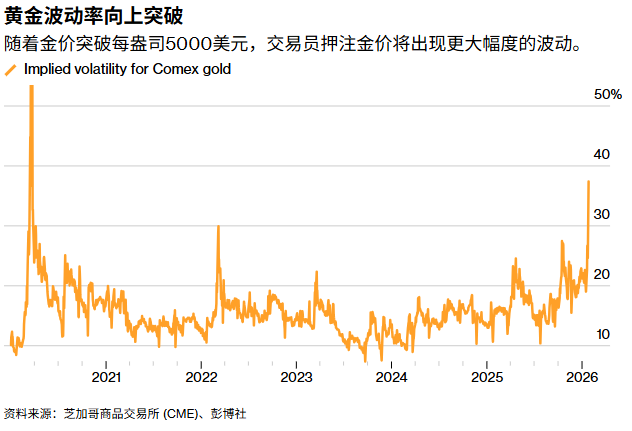
Core Viewpoint - The global commodity market reached a milestone on January 26, 2026, as both spot gold and COMEX gold futures prices surpassed the psychological threshold of $5,000 per ounce, marking the highest record in financial history. This breakout has led to aggressive buying in the options market, indicating strong consensus among market players for a "bull market second half" in gold [1]. Group 1: Market Dynamics - On the day of the price surge, gold prices increased by 2.5%, surpassing the $5,100 mark, which also boosted the entire metal sector. This rally is partly attributed to the resumption of "fiat currency devaluation trades," as investors shift from sovereign bonds and currencies to hard assets like gold and silver for safety [1]. - The breakthrough of the $5,000 level triggered a rare "gamma squeeze" effect in the options market, forcing many volatility sellers to cover their positions in both spot and futures markets, further driving up gold prices [4]. - The implied volatility of gold futures on the New York Mercantile Exchange has reached its highest level since the onset of the global pandemic in March 2020, with significant activity in call spreads indicating bullish sentiment among traders [4]. Group 2: Investment Strategies - Investors are actively buying call spreads on SPDR Gold Shares, including approximately 70,000 contracts for the September 590/595 spread and 37,000 contracts for the March 510/515 spread, indicating a low-cost strategy to position for further price increases in the coming months [5]. - According to analysts, if the ETF price rises by 10.1%, the potential return on the March position could reach 420% [5]. Group 3: Institutional Inflows - In January, the U.S. listed gold ETF sector saw a total inflow of $4.7 billion, with over half directed towards SPDR Gold Shares, reflecting strong institutional inflows and proactive long positions by market makers in anticipation of the $5,000 breakthrough [6]. - The ongoing geopolitical risks and expectations of dollar depreciation are driving demand for gold, as institutional investors increase their allocation to gold in their asset portfolios to historical highs [9]. Group 4: Future Outlook - Major Wall Street banks have quickly raised their price targets for gold in 2026, with Goldman Sachs indicating that the $5,000 breakthrough signifies a "sovereign value revaluation" phase, raising its year-end target to $5,400. Bank of America is even more optimistic, predicting that gold could reach $6,000 if geopolitical tensions do not ease [9]. - Despite the bullish sentiment, analysts caution that entering the "vacuum zone" above $5,000 may lead to increased volatility, necessitating vigilance against potential high-level fluctuations driven by momentum trading [9].

深夜,全线下跌!刚刚,16.39万人爆仓!
Sou Hu Cai Jing· 2026-01-01 16:01
Core Insights - The cryptocurrency market experienced a significant downturn on January 1, 2026, with Bitcoin and other major cryptocurrencies declining in value, leading to over $2 billion in liquidations and affecting more than 163,900 traders [1][2][3] Market Performance - Bitcoin fell from approximately $89,000 to around $87,800, marking a decline of over 1% within 24 hours, while other cryptocurrencies like Cardano and Dogecoin saw declines of over 3% and 2% respectively [2] - Bitcoin's price has dropped over 30% since reaching a historical high of $126,200 in October 2025, with December 2025 recording a decline of over 22%, the worst monthly performance since December 2018 [3][5] Analyst Predictions - Analysts from Cantor predict a potential "crypto winter," suggesting that Bitcoin's price may continue to decline over the next year, despite a long-term optimistic outlook on institutional adoption and regulatory clarity [4] - The market sentiment has shifted, with fears of a crypto winter potentially triggering further declines, as marginal buyers retreat due to fear [4] Market Dynamics - The options market reflects a standoff between bulls and bears, with put options concentrated around $85,000 and call options spread between $100,000 and $120,000 [3] - The recent downturn has led to a reassessment of market catalysts, with analysts noting that the excitement from the "Trump rally" and regulatory easing has faded, leaving only the potential for a rate-cutting cycle as a remaining bullish catalyst [5] Institutional Sentiment - Standard Chartered has significantly lowered its Bitcoin price target for 2026 from $300,000 to $150,000, indicating a bearish outlook for the cryptocurrency market [5] - The performance of Bitcoin and other cryptocurrencies has lagged behind stocks and precious metals since the October 2025 crash, signaling a lack of effective market catalysts [5] Liquidity Concerns - The decline in the adjusted net asset value (mNAV) of digital asset treasury companies raises concerns about potential forced liquidations in a liquidity-constrained market, which could exacerbate selling pressure [6]
深夜,全线下跌!刚刚,16.39万人爆仓!
券商中国· 2026-01-01 15:41
Core Viewpoint - The cryptocurrency market experienced a significant downturn at the beginning of 2026, with Bitcoin and other major cryptocurrencies seeing substantial declines, leading to over 16,000 liquidations and a total loss exceeding $2 billion in the past 24 hours [1][2][3]. Market Performance - As of January 1, 2026, Bitcoin dropped from approximately $89,000 to around $87,800, marking a decline of over 1% within 24 hours. Other cryptocurrencies like Cardano and Dogecoin also faced declines of over 3% and 2%, respectively [3]. - Bitcoin's price has fallen more than 30% since reaching a historical high of $126,000 in October 2025, with a monthly decline of over 22% in December 2025, the worst performance since December 2018 [4][6]. Liquidation Data - Coinglass reported that the total liquidation in the cryptocurrency market reached $2.28 billion in the last 24 hours, with long positions accounting for $1.57 billion and short positions for $0.71 billion. The largest single liquidation occurred on Hyperliquid-BTC-USD, valued at $5.8577 million [3][4]. Analyst Predictions - Analysts from Cantor predict that Bitcoin's price may continue to decline over the next year, despite a long-term optimistic outlook on institutional adoption and regulatory clarity. They suggest that the fear of a crypto winter could trigger further price drops [6]. - Some analysts believe that Bitcoin's price may stabilize between $80,000 and $100,000 in the first quarter of 2026, rather than experiencing a strong upward trend [7]. Market Sentiment - The cryptocurrency market has shown significant weakness compared to stocks and precious metals since the October 2025 crash, indicating that previous market catalysts have not met expectations, and new catalysts for 2026 have yet to emerge [8]. - The ongoing fear of a crypto winter is causing market participants to be cautious, with many analysts suggesting that the current market conditions may lead to further declines in Bitcoin's price [6][9].

杨德龙:人形机器人是我国具备优势的产业赛道
Xin Lang Ji Jin· 2025-10-22 06:35
Group 1: Industry Growth and Trends - The humanoid robot industry is experiencing rapid growth, with industrial robot and service robot production increasing by 29.8% and 16.3% year-on-year, respectively, significantly outpacing the growth of industrial added value [1][2] - Humanoid robots have emerged as the fourth major industry sector in China, following home appliances, smartphones, and new energy vehicles, indicating substantial future growth potential [2] - The current market for humanoid robots is in the early stages of development, transitioning from concept to order acquisition, with a focus on which companies can secure significant orders in the coming year [2] Group 2: Competitive Landscape - The majority of humanoid robot manufacturers are traditional automotive companies, leveraging their strong capital and shared R&D experience between smart driving and robotics [2] - The competition landscape within the industrial robot sector varies across different sub-markets, with a need for breakthroughs in heavy-duty industrial robots to advance to mid-to-high-end production [1][2] - New entrants in the robot manufacturing space are gaining attention from investors, indicating a growing interest in the sector [2] Group 3: Economic and Policy Context - The growth of the humanoid robot industry reflects the ongoing transformation of innovation potential into economic momentum in China [2] - The technology sector, including humanoid robots, is highlighted as a key area of support in the "14th Five-Year Plan," suggesting that these industries will attract significant capital inflows [3] - The overall performance of technology innovation sectors contrasts sharply with traditional industries, which are facing challenges such as overcapacity [3][4]
