
泛科技产业

Search documents
“巨无霸”缩水!宽基ETF开年大赎回 什么信号?
Sou Hu Cai Jing· 2026-02-09 00:49
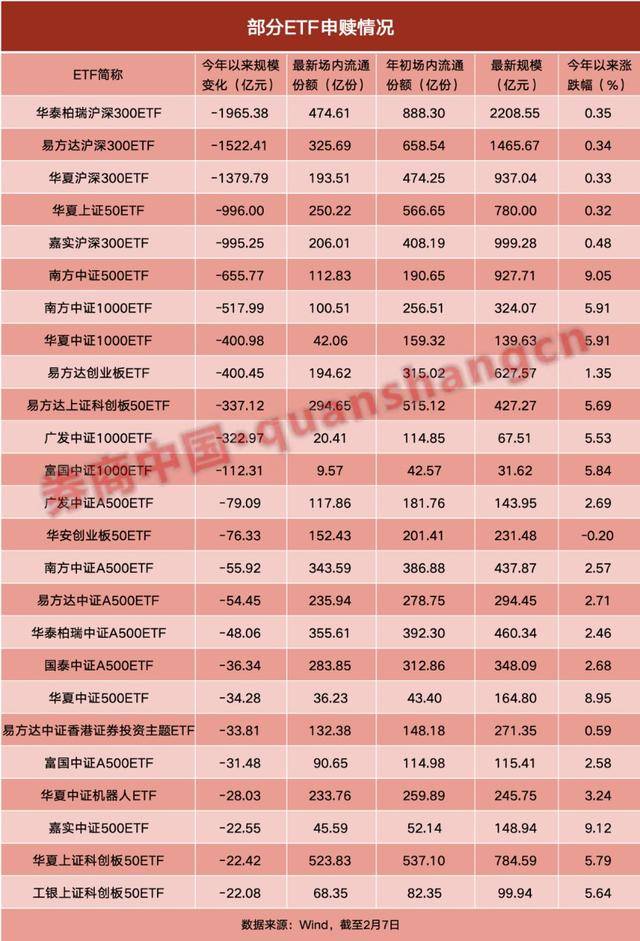
Core Viewpoint - The stock ETF market has experienced significant net outflows since the beginning of the year, with a total reduction of nearly 700 billion yuan in scale, primarily due to a decrease in shares rather than market declines [1][2][4] Group 1: ETF Market Overview - As of February 6, the total scale of stock ETFs is approximately 3.14 trillion yuan, down nearly 700 billion yuan since the beginning of the year [2] - There have been 17 trading days with net outflows out of 25 since the start of the year, with a peak single-day net outflow exceeding 130 billion yuan [2] - The largest contributors to the outflows include the Huatai-PB CSI 300 ETF, which saw a net outflow of 196.54 billion yuan, and both the E Fund and Huaxia CSI 300 ETFs, each with net outflows exceeding 100 billion yuan [3][4] Group 2: Specific ETF Performance - The Huatai-PB CSI 300 ETF's scale has dropped from 420 billion yuan to around 220 billion yuan, a decrease of over 50% [4] - The E Fund CSI 300 ETF has also seen a significant decline, with its scale dropping from over 300 billion yuan to 146.57 billion yuan [4] - The South China CSI 1000 ETF's shares decreased from 256.51 billion to 100.51 billion, marking a decline of 60.82% [4] Group 3: Market Sentiment and Future Outlook - Institutional investors are currently exhibiting a cautious risk preference, which is reflected in the outflows from broad-based ETFs despite positive average returns [6][7] - Analysts believe that the market is transitioning from liquidity-driven to earnings-driven dynamics, with a focus on performance validation in 2026 [8][9] - The outlook for 2026 remains optimistic, with expectations of continued growth in emerging industries and a resilient A-share and Hong Kong market [8][9]

“巨无霸”缩水!宽基ETF开年大赎回,什么信号?
证券时报· 2026-02-08 09:33
Core Viewpoint - The stock ETF market has experienced significant net outflows since the beginning of the year, with a total reduction of nearly 700 billion yuan, primarily driven by a decrease in shares rather than market declines [1][2][3]. Group 1: ETF Market Overview - As of February 6, the total scale of stock ETFs is approximately 3.14 trillion yuan, down nearly 700 billion yuan since the start of the year [3][6]. - The net outflow of stock ETFs has been observed for 17 out of the 25 trading days since the beginning of the year, with a peak single-day net outflow exceeding 130 billion yuan [3][6]. - The largest net outflows have been recorded in major ETFs such as Huatai-PB CSI 300 ETF, which saw a net outflow of 196.54 billion yuan, and both E Fund and Huaxia's CSI 300 ETFs, each with net outflows exceeding 100 billion yuan [5][6]. Group 2: Share Reduction and Performance - The share reduction in major ETFs has been substantial, with declines of 40% to over 60% in various products, including the Huatai-PB CSI 300 ETF, which saw a 46.57% drop in shares [2][6]. - Despite the outflows, the average performance of stock ETFs has been positive, with an average increase of 3.59% since the beginning of the year [8]. - Specific ETFs, such as the Southern CSI 500 ETF, have recorded significant outflows while still achieving positive returns, indicating a disconnect between fund flows and market performance [8]. Group 3: Institutional Insights and Future Outlook - Institutional investors remain cautious about short-term market risks, leading to the observed outflows, but they maintain a generally optimistic outlook for the investment landscape in 2026 [2][10]. - The market is expected to shift from liquidity-driven dynamics to profit-driven and performance-validated trends, with a focus on the intrinsic resilience of A-shares and Hong Kong stocks [2][10]. - Analysts suggest that the ongoing regulatory measures and the evolving market environment will continue to influence investor behavior and capital allocation strategies [9][11].

“巨无霸”缩水!宽基ETF开年大赎回,什么信号?
券商中国· 2026-02-08 08:19
Core Viewpoint - The stock ETF market has experienced significant net outflows since the beginning of the year, with a total reduction of nearly 700 billion yuan, primarily driven by a decrease in shares rather than market declines [1][2][3] Group 1: ETF Market Overview - As of February 6, the total scale of stock ETFs is approximately 3.14 trillion yuan, down nearly 700 billion yuan since the start of the year [3][6] - The largest net outflows have been observed in the Huatai-PB CSI 300 ETF, which saw a net outflow of 1965.38 billion yuan, while the E Fund and Huaxia's CSI 300 ETFs also experienced outflows exceeding 1000 billion yuan [5][6] - Over 675 stock ETFs recorded net outflows, accounting for over 50% of the 1240 products tracked [5][6] Group 2: Share Reduction and Performance - The share reduction in major ETFs has been significant, with declines of 40% to over 60% in various products, including the Huatai-PB CSI 300 ETF, which saw a 46.57% drop in shares [2][6] - Despite the outflows, the average increase in stock ETFs is 3.59%, indicating that the outflows are not due to poor performance [8] - Specific ETFs like the Southern CSI 500 ETF and the Southern CSI 1000 ETF have shown positive performance despite significant net outflows [8] Group 3: Institutional Investor Sentiment - Institutional investors are currently exhibiting a cautious risk preference, leading to the observed outflows from broad-based ETFs [8][9] - Analysts suggest that the market is transitioning from liquidity-driven to earnings-driven dynamics, with a focus on profitability verification in 2026 [10][11] - The outlook for 2026 remains optimistic, with expectations for continued growth in emerging industries and a resilient A-share and Hong Kong market [10][11]

牛市掘金科创板!陈果:估值处历史低位,景气赛道清晰,国产算力、医疗器械值得关注
Xin Lang Zheng Quan· 2025-08-18 09:32
Core Viewpoint - The Shanghai Composite Index has strongly broken through a 10-year high, igniting market enthusiasm, with a focus on investment directions post "bull market confirmation" [1] Group 1: Investment Opportunities - The Sci-Tech Innovation Board (STAR Market) and the ChiNext Board are currently seen as good investment directions, representing emerging growth and technology industries [1] - Key sectors associated with these boards include AI, innovative pharmaceuticals, and other frontier fields, indicating a strong correlation with the two indices [1] - Historical valuation analysis shows that both the STAR Market and ChiNext Board are currently below their historical average valuation levels, suggesting valuation attractiveness [1] Group 2: Sector Analysis - The STAR Market is concentrated in core industries such as semiconductors, domestic computing power, and medical devices, while the ChiNext Board has a more diversified composition including fintech, overseas computing power tech companies, and some new energy firms [2] - Current investment opportunities are spread across the STAR Market, ChiNext Board, and even the Hang Seng Tech Index, contrasting with the 2014-2015 period when the ChiNext Board was the sole focus [2] - Given the current valuations below historical averages and clear growth prospects in core hard-tech sectors, the STAR Market offers significant opportunities for investors [2]