
新兴成长

Search documents
华西证券2026年资本市场投资与产业年会在成都召开
Zhong Zheng Wang· 2026-01-09 03:11
Core Viewpoint - The conference held by Huaxi Securities emphasizes the need for a strong belief in "buying China" amidst a reshaping global landscape, focusing on long-term asset value and high-quality capital market development [1] Group 1: Company Strategy and Operations - Huaxi Securities is committed to a differentiated development strategy, providing customized and comprehensive financial support to clients, aiming to seize regional integration opportunities for deeper development [1] - The company has established a strong sell-side research team focused on five key sectors: new information technology, new materials, new consumption, equipment manufacturing, and healthcare [2] - Huaxi Securities employs a dual-manager service model, enhancing its one-stop service system to better meet the demands of nearly 500 government and enterprise clients [2] Group 2: Economic Outlook and Asset Trends - The chief economist of Huaxi Securities predicts that various asset classes will rise in 2026, with a combination of loose monetary and stable fiscal policies leading to a moderate recovery in inflation [2] - The year 2026 is expected to be a significant year for corporate profits, driven by the "new growth" and "anti-involution" themes, with industries like AI and high-end manufacturing entering clearer stages of commercialization [3] - The outlook for the RMB is positive, with its share in cross-border trade finance increasing, and the market risk appetite is expected to rise, favoring equity assets [3] Group 3: Sector-Specific Insights - The media industry is undergoing transformation with AI technology, shifting focus towards "AI attention" and full-process automation, with key players being those who control smart entry points and exclusive data [4] - The insurance sector is anticipated to see synchronized improvements in assets and liabilities, with potential for sustained valuation recovery [4] - In the securities industry, attention is drawn to firms with expected peer mergers, robust overseas business layouts, and effective wealth management transformations [4]

沪指14连阳!两市场成交额再超2.8万亿元 | 华宝3A日报(2026.1.7)
Xin Lang Cai Jing· 2026-01-07 09:30
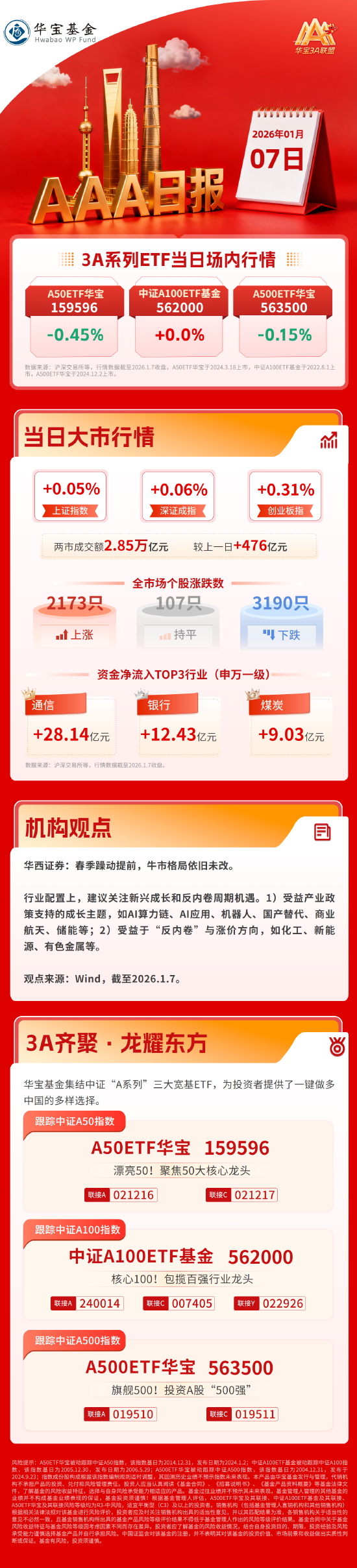
Group 1 - The market showed a slight increase with the total trading volume reaching 2.85 trillion yuan, an increase of 476 billion yuan compared to the previous day [6][2] - The number of stocks that rose, remained flat, and fell in the market was 3190, 107, and 2173 respectively [6][2] - The top three sectors with net capital inflow were banking (+28.14 billion yuan), coal (+12.43 billion yuan), and telecommunications (+9.03 billion yuan) [6][2] Group 2 - Huaxi Securities suggests that the spring market rally has started early, maintaining a bullish outlook [2][6] - The report emphasizes focusing on emerging growth sectors and opportunities related to the "anti-involution" trend, including AI computing power chains, AI applications, robotics, domestic substitution, commercial aerospace, and energy storage [2][6] - The report also highlights sectors benefiting from price increases, such as chemicals, new energy, and non-ferrous metals [2][6] Group 3 - Huabao Fund has launched three major broad-based ETFs tracking the China A50, A100, and A500 indices, providing investors with diverse options for investing in China [2][6] - The A50 ETF focuses on the top 50 core leading companies, while the A100 ETF encompasses the top 100 industry leaders [2][6]

关注新兴成长板块投资机会,成长ETF易方达(159259)标的指数早盘涨超2%
Sou Hu Cai Jing· 2026-01-05 05:11
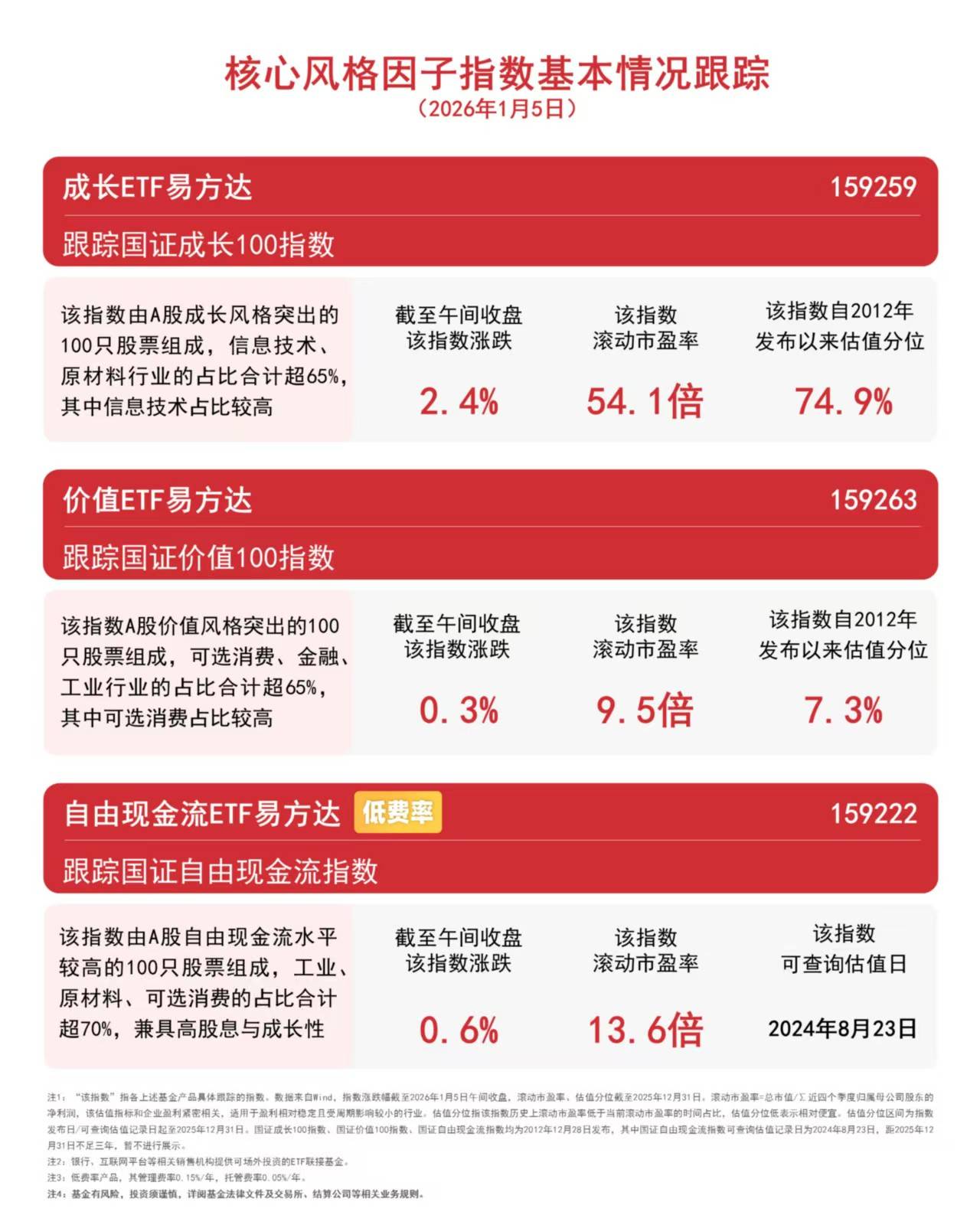
Group 1 - The technology growth sector showed strong performance, with the Guozheng Growth 100 Index rising by 2.4%, the Guozheng Free Cash Flow Index increasing by 0.6%, and the Guozheng Value 100 Index up by 0.3% as of midday close [1] - Huaxi Securities predicts that 2026 will be a significant year due to multiple positive factors, indicating a solid foundation for a bull market, with early signs of spring rally already observed [1] Group 2 - The Guozheng Growth 100 Index consists of 100 stocks with a strong growth style in the A-share market, with over 65% of its composition in the information technology and materials sectors, and a rolling P/E ratio of 54.1 times [3] - The Guozheng Value 100 Index is made up of 100 stocks with a strong value style, with over 65% in consumer discretionary and financial sectors, and a rolling P/E ratio of 9.5 times [3] - The Guozheng Free Cash Flow Index includes 100 stocks with high free cash flow levels, with over 70% in industrial, materials, and consumer discretionary sectors, and a rolling P/E ratio of 13.6 times [4]
中信建投:汽车顺周期属性弱化,科技属性及新兴成长方向是核心主线
Mei Ri Jing Ji Xin Wen· 2025-11-27 00:29
Core Viewpoint - The current market has weak expectations for automotive stimulus policies and overall production and sales volume for next year, indicating a weakening of the automotive cyclical attributes. The core focus is shifting towards technology attributes and emerging growth directions [1] Group 1: Market Expectations - The market's anticipation for automotive stimulus policies and production/sales volume for next year is low [1] - The cyclical nature of the automotive industry is diminishing, leading to a focus on technology and growth sectors [1] Group 2: Future Trends - The year 2026 is highlighted as a significant year for new vehicles from Huawei, which is worth monitoring [1] - Companies like Xiaopeng, GAC, and Changan showcased self-developed robotic products during the auto show, indicating a shift towards integrating robotics in the automotive sector [1] - The upcoming technological iterations and mass production of Tesla's FSD V14, Robotaxi, and Optimus in 2026 are expected to create a turning point in the industry, with automotive and robotics as key applications of physical AI [1] - The technological attributes of automotive stocks may undergo a re-evaluation as these trends develop [1]

均衡配置 寻找确定性 年底私募投资“关键词”出炉
Zhong Guo Zheng Quan Bao· 2025-11-25 20:29
Core Viewpoint - The recent adjustment in the A-share market is attributed to a combination of internal and external factors, leading to a collective risk-averse behavior among investors [1][2]. Group 1: Market Adjustment Factors - The adjustment is seen as a result of multiple factors, including concerns over the economic fundamentals and a complex external environment, alongside fluctuations in liquidity expectations for December [2]. - The tightening of overseas liquidity, particularly following the Federal Reserve's hawkish stance, has led to a net outflow of foreign capital, putting pressure on high-valuation technology stocks in the A-share market [2]. - Defensive behaviors, such as profit-taking by institutional investors as the year-end approaches, have contributed to short-term market volatility [2][4]. Group 2: Private Equity Strategies - Private equity firms are responding to the high market positions with varied strategies, including maintaining high positions, using derivatives for risk hedging, and actively adjusting portfolios for future market conditions [1][4]. - As of November 14, the average stock position of private equity firms reached 81.13%, with large firms holding an even higher average of 87.07%, indicating a high level of market engagement [4]. - Some firms, like Dushuquan, are employing precise risk hedging techniques, such as purchasing out-of-the-money put options to protect against extreme drawdowns [5]. Group 3: Long-term Market Outlook - Despite short-term challenges, private equity firms maintain confidence in the long-term market, actively seeking new investment opportunities during the adjustment [7]. - Dushuquan emphasizes that the current market adjustment is a "healthy correction" within a long-term upward trend, which can help optimize market leverage levels and trading structures [8]. - Firms are focusing on sectors with structural growth potential that do not rely on overall economic recovery, particularly in emerging growth areas like AI technology, semiconductor, and new consumption trends [7].
广发基金陈韫中:做成长股的“探路者” 均衡之中见锐度
Zhong Guo Zheng Quan Bao· 2025-11-16 23:09
Core Insights - The article highlights the investment strategy of Chen Yunzong, a fund manager at GF Fund, focusing on identifying growth stocks and their growth stages through a dual-track approach of "traditional growth" and "emerging growth" [1][2]. Investment Strategy - Chen emphasizes a systematic approach to understanding industry attributes, industry cycle stages, and long-term trends before selecting quality growth stocks [1][2]. - The investment framework is centered around capturing excess returns from diverse growth directions, including technology and manufacturing sectors [2][3]. Performance Metrics - As of October 31, the GF Growth Initiation A fund managed by Chen achieved a one-year return of 88.81%, ranking in the top 3 out of 1,876 similar funds [1]. Fund Launch - A new fund, GF Innovation Growth, is set to launch on November 17, which will dynamically adjust the allocation between traditional and emerging growth to capture excess returns while maintaining industry balance [1][6]. Growth Categories - Growth stocks are categorized into "traditional growth" (e.g., new energy, semiconductors, military industry) and "emerging growth" (e.g., robotics, embodied intelligence, satellite internet) [2][5]. - Traditional growth strategies focus on cyclical growth, while emerging growth serves as an offensive tool for capturing future trends [2][3]. Dynamic Allocation - The allocation between traditional and emerging growth is adjusted based on market liquidity and risk appetite, enhancing both offensive and defensive capabilities of the portfolio [3][4]. Industry Rotation - Chen's investment approach involves a systematic method of industry rotation based on industry cycles, focusing on "industry position" and "valuation margins" rather than merely chasing market trends [4][5]. Future Focus Areas - Key sectors of interest include computing power, storage, edge innovation, brand globalization, robotics, satellite internet, and solid-state batteries [6][7]. - The computing power sector is particularly emphasized, with expectations of significant capital expenditure increases from domestic cloud service providers in the upcoming quarters [6][7]. Specific Sector Insights - The military industry is highlighted as a high-value sector, while the robotics sector is seen as a major application terminal for AI [7]. - Solid-state batteries and low-altitude economy are also critical areas of focus, with expectations of early breakthroughs in these technologies [7].

广发基金陈韫中:做成长股的“探路者”,均衡之中见锐度
Zhong Guo Zheng Quan Bao· 2025-11-16 23:03
Core Insights - The article highlights the investment strategy of Chen Yunzong, a fund manager at GF Fund, focusing on growth stocks through a dual-track approach of "traditional growth" and "emerging growth" [1][2]. Investment Strategy - Chen emphasizes the importance of understanding industry cycles and long-term trends before selecting quality growth stocks, aiming to optimize buying and selling timing based on industry cycles [1][2]. - The investment framework includes a focus on diverse growth sectors such as technology and manufacturing, moving beyond just TMT (Technology, Media, and Telecommunications) to include areas like military and energy [2]. Growth Categories - Growth stocks are categorized into "traditional growth" (e.g., new energy, semiconductors, military) and "emerging growth," with differentiated strategies for each [2][3]. - Traditional growth is approached with a "cyclical growth" mindset, focusing on sectors undergoing industrial changes, while emerging growth serves as an "offensive lever" targeting future trends like robotics and quantum computing [2][5]. Dynamic Portfolio Management - The portfolio management strategy involves dynamically adjusting the allocation between traditional and emerging growth based on market liquidity and risk appetite [3]. - When market conditions are favorable, the allocation to emerging growth increases; conversely, it shifts towards traditional growth during risk-averse periods [3]. Industry Rotation Approach - Chen's investment approach to industry rotation is systematic, focusing on the balance between "industry position" and "valuation margins," rather than merely chasing market trends [4]. - A significant portion of research efforts is dedicated to tracking emerging growth sectors, leveraging insights from industry leaders and global comparisons [4][5]. Forward-Looking Investment Areas - The new fund, GF Innovation Growth, will adopt a balanced growth-oriented strategy, targeting sectors like computing power, storage, and robotics [6]. - Chen identifies opportunities in domestic computing power, which is expected to see increased capital expenditure from cloud service providers, and anticipates a positive cycle in the storage sector [6][7]. Specific Sector Focus - The military sector is highlighted as a key area for investment, with a favorable risk-reward profile [7]. - The robotics sector is viewed as a significant application of AI, with the domestic industry yet to be fully valued [7]. - Solid-state batteries and low-altitude economy are also critical areas of focus, with expectations for early breakthroughs in solid-state battery applications [7].
做成长股的“探路者” 均衡之中见锐度
Zhong Guo Zheng Quan Bao· 2025-11-16 20:13
Core Insights - The article highlights the investment strategy of Chen Yunzong, a fund manager at GF Fund, focusing on identifying growth stocks and their respective growth stages through a dual-track approach of "traditional growth" and "emerging growth" [1][2] Investment Strategy - Chen Yunzong emphasizes a systematic approach to understanding industry attributes, clarifying industry cycle stages and medium to long-term trends before selecting quality growth stocks [1][2] - The investment framework is centered around capturing excess returns from diverse growth directions, including technology and manufacturing sectors, while also expanding research beyond TMT (Technology, Media, Telecommunications) to include military and energy sectors [2] Growth Categories - Growth stocks are categorized into "traditional growth" and "emerging growth," with differentiated strategies for each. Traditional growth includes sectors like new energy, semiconductors, and military, where a cyclical growth mindset is applied [2] - Emerging growth serves as an "offensive lever" in the portfolio, focusing on sectors like robotics, embodied intelligence, satellite internet, quantum computing, and solid-state batteries, which are expected to represent future trends [2][3] Dynamic Allocation - The allocation between traditional and emerging growth is dynamically adjusted based on market liquidity and risk appetite, enhancing the portfolio's offensive capabilities in bull markets and defensive strength in volatile markets [2][3] Industry Rotation - Chen Yunzong's investment approach involves industry rotation based on a systematic method rather than merely chasing market trends, focusing on the balance between "industry position" and "valuation margins" [3] - A significant portion of research efforts is dedicated to tracking emerging growth directions, involving visits to industry leaders and studying cutting-edge trends globally [3] Future Growth Areas - The new fund, GF Innovation Growth, will adopt a balanced growth-oriented strategy, targeting sectors such as computing power, storage, edge innovation, brand globalization, robotics, satellite internet, and solid-state batteries [4] - The computing power sector is highlighted as a key focus, with expectations of significant capital expenditure increases from domestic cloud service providers in the upcoming quarters [5] Market Outlook - The storage sector is anticipated to enter an upward cycle, with NAND flash memory prices beginning to rise since September, expected to maintain favorable industry conditions for one to two more quarters [5] - The military sector is viewed as having high cost-effectiveness, while the robotics sector is seen as a major application terminal for AI, with the domestic robotics supply chain not yet fully priced [5]
广发基金陈韫中: 做成长股的“探路者” 均衡之中见锐度
Zhong Guo Zheng Quan Bao· 2025-11-16 20:09
Core Insights - The article highlights the investment strategy of Chen Yunzong, a fund manager at GF Fund, focusing on the dual-track approach of "traditional growth" and "emerging growth" in identifying investment opportunities in growth stocks [1][2]. Investment Strategy - Chen Yunzong emphasizes a systematic approach to understanding industry attributes, identifying industry cycle stages, and selecting quality growth stocks [1][2]. - The investment framework includes a focus on both traditional growth sectors (like new energy, semiconductors, and military industry) and emerging growth sectors (such as robotics, embodied intelligence, and quantum computing) [2][5]. - The strategy involves dynamic adjustment of the allocation between traditional and emerging growth based on market liquidity and risk appetite [3][4]. Performance Metrics - As of October 31, the GF Growth Initiation A fund managed by Chen Yunzong achieved a one-year return of 88.81%, ranking in the top 3 out of 1,876 similar funds [1]. Sector Focus - Key sectors of interest include computing power, storage, edge innovation, brand globalization, robotics, satellite internet, and solid-state batteries [6][7]. - The computing power sector is particularly highlighted, with a focus on both overseas and domestic opportunities, as domestic cloud service providers are expected to significantly increase capital expenditures [6]. Emerging Trends - The article discusses the importance of understanding the lifecycle of growth assets, which typically transition from thematic phases to technological implementation and then to scale expansion [5]. - Solid-state batteries are identified as a critical component for the development of robotics and drones, with expectations for early breakthroughs in this area [7].
兼顾传统成长与新兴成长 绩优基金经理捕捉轮动行情
Zheng Quan Shi Bao· 2025-11-12 18:42
Group 1 - The stock market has experienced increased volatility since late October, but growth-style assets remain a key focus for capital, influenced by the Federal Reserve's second interest rate cut of the year and China's "14th Five-Year Plan" emphasizing support for emerging technology sectors [1] - The market is characterized by a structural differentiation, with funds shifting towards specific segments like storage and energy, while previously popular sectors like optical modules are in a consolidation phase [1] - The growth style is overall dominant this year, but leading sub-industries vary at different stages, with technology and energy sectors taking turns in leading performance [1] Group 2 - Chen Yunzhong, a mid-career fund manager with nearly 10 years in the securities industry and over 4 years of investment experience, has achieved significant returns, including a 46.82% return in the Guangfa Small Cap Select A fund, surpassing the benchmark by 36 percentage points [2] - His management strategy involves dividing growth tracks into traditional and emerging growth, focusing on sectors with strong certainty and leveraging top companies to capture industry beta and stock alpha [2] - Traditional growth sectors include "new semi-military" areas such as new energy, semiconductors, and military industry, characterized by mature industry development and specific cycles [2] Group 3 - Emerging growth sectors are in the early stages of industrialization, focusing on technologies like embodied intelligence, new storage and computing, satellite internet, quantum computing, and solid-state batteries, which are also highlighted in the national technology plan [3] - Chen Yunzhong emphasizes the need for tactical trading in these volatile assets, successfully timing entry and exit points to capture upward trends while avoiding significant downturns [3] - Current promising growth directions include computing power, storage, edge innovation, brand internationalization, robotics, satellite internet, and solid-state batteries, with a particular focus on domestic cloud service providers expected to increase capital expenditures significantly in the coming months [3]