主题ETF

Search documents
麦高视野:ETF观察日志 (2026-03-17)
Mai Gao Zheng Quan· 2026-03-18 02:59
- The report introduces the RSI (Relative Strength Index) as a quantitative factor, calculated using the formula: $ RSI = 100 - 100 / (1 + RS) $, where RS represents the ratio of average gains to average losses over a 12-day period. RSI values above 70 indicate an overbought market, while values below 30 suggest an oversold market[2] - Another quantitative factor mentioned is the net subscription amount (NETBUY), calculated using the formula: $ NETBUY(T) = NAV(T) - NAV(T-1) * (1 + R(T)) $, where NETBUY(T) represents the net subscription amount, NAV(T) is the ETF's net asset value, and R(T) is the return on the current trading day[2] - The report tracks various ETFs based on their underlying indices, such as CSI 300, CSI 500, CSI A500, and thematic indices like non-bank financials, dividends, and China internet sectors. These indices serve as benchmarks for ETF performance analysis[2][4] - The report provides daily monitoring of ETF metrics, including RSI values, net subscription amounts, trading volumes, and institutional holdings, offering insights into market trends and investor behavior[2][4] - The RSI values for different ETFs range widely, with examples including 43.34 for Huatai-PineBridge CSI 300 ETF, 36.27 for Southern CSI 500 ETF, and 50.91 for Ping An CSI A50 ETF, reflecting varying market conditions across indices[4] - Net subscription amounts also vary significantly, such as 11.01 billion for Huatai-PineBridge CSI 300 ETF, -2.28 billion for China Asset Management CSI 500 ETF, and 1.88 billion for Guotai CSI A500 ETF, indicating diverse investor activity[4] - Institutional holdings percentages are highlighted, with examples like 87.11% for Huatai-PineBridge CSI 300 ETF, 93.09% for China Asset Management CSI 300 ETF, and 56.96% for E Fund CSI A500 ETF, showcasing the level of institutional participation in these funds[4]
景顺长城:麦高证券麦高金工团队
Mai Gao Zheng Quan· 2026-02-10 11:26
- The report introduces the **RSI (Relative Strength Index)** as a quantitative factor. The construction idea is to measure the relative strength of price movements over a specific period to identify overbought or oversold conditions. The formula is: $ RSI = 100 - \frac{100}{1 + RS} $, where $ RS $ is the ratio of the average gain to the average loss over a 12-day period. $ RSI > 70 $ indicates an overbought market, while $ RSI < 30 $ indicates an oversold market[2] - Another quantitative factor mentioned is **Net Subscription (NETBUY)**, which measures the net inflow or outflow of funds in ETFs. The formula is: $ NETBUY(T) = NAV(T) - NAV(T-1) \times (1 + R(T)) $, where $ NAV(T) $ is the net asset value on day $ T $, $ NAV(T-1) $ is the net asset value on the previous day, and $ R(T) $ is the return on day $ T $[2] - The report also highlights **Intraday Trend Analysis**, which uses 5-minute interval transaction prices to construct intraday price trends. Red dots mark the highest and lowest prices of the day. However, due to data limitations, some intraday data may be incomplete[2] - The **Institutional Holding Ratio** is another factor, calculated based on the latest annual or semi-annual reports of ETFs, excluding holdings by linked funds. The data is an estimate and may have deviations[3] - The report provides detailed tracking of various ETFs categorized into "broad-based" and "thematic" indices, such as CSI 300, CSI 500, and sector-specific indices like non-bank financials and dividends. These indices serve as benchmarks for ETF performance evaluation[2][4] - The report includes a comprehensive table of ETF performance metrics, such as RSI values, net subscription amounts, and institutional holding ratios, for various ETFs tracking indices like CSI 300, CSI 500, CSI 1000, and others. For example, the RSI for CSI 300 ETFs ranges from 50.04 to 54.02, while net subscription values vary significantly across ETFs[4] - The report also tracks thematic ETFs, such as those focused on semiconductors, artificial intelligence, and renewable energy, providing performance metrics like RSI, net subscription, and institutional holding ratios. For instance, the RSI for semiconductor ETFs ranges from 49.16 to 50.40, while net subscription values show significant variation[7]
“巨无霸”缩水!宽基ETF开年大赎回,什么信号?
证券时报· 2026-02-08 09:33
Core Viewpoint - The stock ETF market has experienced significant net outflows since the beginning of the year, with a total reduction of nearly 700 billion yuan, primarily driven by a decrease in shares rather than market declines [1][2][3]. Group 1: ETF Market Overview - As of February 6, the total scale of stock ETFs is approximately 3.14 trillion yuan, down nearly 700 billion yuan since the start of the year [3][6]. - The net outflow of stock ETFs has been observed for 17 out of the 25 trading days since the beginning of the year, with a peak single-day net outflow exceeding 130 billion yuan [3][6]. - The largest net outflows have been recorded in major ETFs such as Huatai-PB CSI 300 ETF, which saw a net outflow of 196.54 billion yuan, and both E Fund and Huaxia's CSI 300 ETFs, each with net outflows exceeding 100 billion yuan [5][6]. Group 2: Share Reduction and Performance - The share reduction in major ETFs has been substantial, with declines of 40% to over 60% in various products, including the Huatai-PB CSI 300 ETF, which saw a 46.57% drop in shares [2][6]. - Despite the outflows, the average performance of stock ETFs has been positive, with an average increase of 3.59% since the beginning of the year [8]. - Specific ETFs, such as the Southern CSI 500 ETF, have recorded significant outflows while still achieving positive returns, indicating a disconnect between fund flows and market performance [8]. Group 3: Institutional Insights and Future Outlook - Institutional investors remain cautious about short-term market risks, leading to the observed outflows, but they maintain a generally optimistic outlook for the investment landscape in 2026 [2][10]. - The market is expected to shift from liquidity-driven dynamics to profit-driven and performance-validated trends, with a focus on the intrinsic resilience of A-shares and Hong Kong stocks [2][10]. - Analysts suggest that the ongoing regulatory measures and the evolving market environment will continue to influence investor behavior and capital allocation strategies [9][11].


多只通信设备主题ETF今年以来净值增长超100%
Zheng Quan Ri Bao· 2025-12-14 16:18
Core Insights - The performance of thematic ETFs in the A-share market has become a focal point for investors, with significant growth observed in sectors such as communication equipment, artificial intelligence, non-ferrous metals, and gold [1][2] - Communication equipment thematic ETFs have shown remarkable performance, with several ETFs achieving over 100% growth in net value year-to-date, particularly the Guotai CSI All-Share Communication Equipment ETF, which leads with a 118.55% increase [1][2] - The influx of capital into these ETFs indicates investor confidence in long-term trends, although some funds have experienced net outflows recently, suggesting profit-taking behavior [2][3] Thematic ETF Performance - The Southern Growth Enterprise Market Artificial Intelligence ETF and the Huabao Growth Enterprise Market Artificial Intelligence ETF have also performed well, each exceeding 100% growth in net value [2] - Nine gold-themed ETFs have shown strong performance, with year-to-date net value growth rates exceeding 80% [2] - Despite leading growth, the capital flow for communication equipment ETFs is not entirely consistent, as evidenced by a net inflow of 56.22 billion yuan for the Guotai ETF, contrasted by a net outflow of 3.13 billion yuan in December [2][3] Market Dynamics - The market environment since 2025 has reinforced the logic of thematic investment, with high-growth and visible performance industries attracting concentrated capital [4] - ETFs have become essential tools for capital allocation and participation in thematic rotations, with an expectation of a richer product system as new themes emerge [4] - Investors are advised to be cautious of the volatility associated with high-growth ETFs, emphasizing the importance of considering industry cycles, valuation levels, and capital movements when making investment decisions [4]
宽基指数增速放缓!内部分化显现,这个挂钩ETF年内净赎回超900亿
Sou Hu Cai Jing· 2025-11-25 12:24
Core Insights - The growth rate of broad-based index ETFs has significantly slowed down in 2025 compared to the explosive growth seen in the previous year [2][3] - The number of stock ETFs increased from 832 at the end of last year to 1,066, with net asset value rising from 28,876.80 billion to 36,021.33 billion, a year-on-year increase of 24.74% [2] - In contrast, the scale of index ETFs grew at a much slower rate of approximately 8.77%, with net asset value increasing from 21,856.45 billion to 23,773.29 billion [2] ETF Market Dynamics - The leading growth in stock ETFs this year comes from thematic ETFs, which saw their number and scale rise to 495 and 7,738.70 billion respectively, marking an 88.54% increase [2] - Industry and strategy ETFs also experienced significant growth, with increases of 58.58% and 50.21% respectively [2] - The market is characterized by uneven opportunities, with active funds focusing on a few high-growth sectors, leading to reduced attractiveness of broad-based ETFs [3] Performance of Specific ETFs - The CSI A500 index ETF has seen the highest net redemption, with outflows exceeding 900 billion, despite a 15.74% increase in its value [5][10] - The CSI A500 ETF products collectively have a scale of approximately 1,919.26 billion, but this is down by about 635.80 billion from the end of last year [7] - The market has seen a shift in fund flows from broad-based ETFs to industry-specific ETFs, particularly in TMT and financial real estate sectors [8] Management and Competition - The top two ETF managers, Huaxia Fund and E Fund, dominate the market with total ETF scales of 8,983.07 billion and 8,327.23 billion respectively, showing significant growth in non-money market ETFs [12] - Seven ETF managers have added over 1,000 billion in scale this year, accounting for nearly 60% of the total market growth [13] - Huaxia Fund's robot ETF has shown remarkable growth, increasing from 41.37 billion to 239.30 billion, a growth rate of 478.44% [13] Global ETF Landscape - Huaxia Fund and E Fund have entered the top twenty global ETF providers, marking a significant achievement for Chinese firms in the global market [14] - The competitive landscape remains stable among the top global ETF providers, with BlackRock and Vanguard leading the market [14]
主题ETF关注度提升:海外创新产品周报20251103-20251103
Shenwan Hongyuan Securities· 2025-11-03 12:54
Report Summary 1. Report Industry Investment Rating No industry investment rating is provided in the report. 2. Core Viewpoints - The attention on thematic ETFs in the US has increased, with new products in sectors such as electricity, natural gas, and unmanned driving [7][8]. - US ETFs have seen continuous inflows into equity products, while gold ETFs have continued to experience outflows [10]. - Bond products among US ETFs have performed well this year, with broad - based composite bond products and 20 - year - plus Treasury bond ETFs achieving notable returns [14]. - In September 2025, the total amount of non - money public funds in the US increased, but the redemption pressure on domestic equity products rose. Last week, domestic equity funds saw outflows approaching $20 billion, while bond products returned to inflows [4][16]. 3. Summary by Catalog 3.1 US ETF Innovation Products: Thematic ETF Attention Grows - Last week, there were 20 new ETF products issued in the US. Franklin Templeton issued 5 different municipal bond products [7]. - Arin Risk Advisors issued a tail - risk ETF, which aims to avoid risks during market downturns through active management and has a flexible portfolio structure [8]. - VistaShares issued an electricity ETF, Global X issued a natural gas ETF, and REX Shares issued an unmanned driving ETF, indicating increased attention to relevant themes [8]. - Roundhill expanded leveraged + option weekly dividend products, and Rex Shares issued an option product [9]. 3.2 US ETF Dynamics 3.2.1 US ETF Funds: Equity Products See Continuous Inflows - In the past week, US ETFs had inflows of over $30 billion, with significant inflows into equity products and continuous outflows from gold ETFs. The SPDR S&P 500 ETF had inflows of over $15 billion, leading other products. Growth ETFs had inflows, while leveraged ETFs continued to experience outflows [10][12]. 3.2.2 US ETF Performance: Bond Products Perform Well - This year, US stocks have performed well, and bonds have also delivered good returns. Broad - based composite bond products have yields of over 6%, and 20 - year - plus Treasury bond ETFs have yields of over 7%. Short - term bonds and municipal bonds have relatively weaker performance [14]. 3.3 Recent Fund Flows of US Ordinary Public Funds - In September 2025, the total amount of non - money public funds in the US was $23.47 trillion, an increase of $0.49 trillion compared to August. The scale of domestic equity products increased by 2.13%, but the redemption pressure increased. Last week, domestic equity funds saw outflows approaching $20 billion, while bond products returned to inflows [4][16].
麦高视野:ETF观察日志(2025-09-30)
Mai Gao Zheng Quan· 2025-10-09 02:46
1. Report Industry Investment Rating - Not provided in the report 2. Core Viewpoints of the Report - The report tracks daily frequency data of various ETFs, including wide - based and thematic ETFs, and presents information such as intraday market trends, management fees, tracking indices, RSI relative strength indicators, net subscriptions, trading volumes, and institutional holding ratios for each ETF [2][3][4] 3. Summary by Relevant Catalogs 3.1 Data Explanation - The table tracks daily frequency data of ETFs and is divided into "wide - based" and "thematic" sub - tables. The "wide - based" ETFs track mainstream wide - based indices like CSI 300, CSI 500, etc., while "thematic" ETFs track industry/style indices such as non - bank, dividend, and China concept Internet [2] - The RSI relative strength indicator is calculated based on the ratio of average gains to average losses over a 12 - day period. RSI>70 indicates an over - bought market, and RSI<30 indicates an over - sold market [2] - Net subscription is calculated using the formula NETBUY(T) = NAV(T)–NAV(T - 1)*(1 + R(T)), where NAV(T - 1) is the previous trading day's ETF net value [2] - T+0 indicates whether the T+0 trading method is supported. Institutional holding ratio is the estimated ratio from the latest annual or semi - annual reports of ETF funds, excluding the holding ratio of corresponding linked funds [3] 3.2 Wide - based ETFs - Multiple wide - based ETFs are listed, such as those tracking the CSI 300, CSI 500, SSE 50, etc. For example, the Huatai - Peregrine CSI 300 ETF has a circulation market value of 425.344 billion yuan, an RSI of 67.84, and a net subscription of 10.77 billion yuan [4] 3.3 Thematic ETFs - **Consumer Electronics**: There are several consumer electronics ETFs, like the ChinaAMC China Securities Consumer Electronics Theme ETF with a circulation market value of 44.62 billion yuan and an RSI of 69.63 [6] - **Non - bank**: Non - bank financial ETFs include the Guotai CSI All - Index Securities Company ETF with a circulation market value of 553 billion yuan and an RSI of 53.18 [6] - **Dividend**: Dividend - related ETFs, such as the Huatai - Peregrine SSE Dividend ETF, have different performance indicators. This ETF has a circulation market value of 196.76 billion yuan and an RSI of 32.08 [6] - **New Energy**: New energy ETFs, like the ChinaAMC CSI New Energy Vehicle ETF, show different trends. It has a circulation market value of 59.86 billion yuan and an RSI of 83.71 [6] - **Chip Semiconductor**: Chip semiconductor ETFs, such as the ChinaAMC China Securities Semiconductor Chip ETF, have a circulation market value of 286.56 billion yuan and an RSI of 75.85 [6] - **Photovoltaic**: Photovoltaic ETFs, for example, the Huatai - Peregrine CSI Photovoltaic Industry ETF, have a circulation market value of 139.79 billion yuan and an RSI of 71.42 [6] - **Military Industry**: Military industry ETFs, such as the Guotai CSI Military Industry ETF, have a circulation market value of 141.29 billion yuan and an RSI of 58.98 [6] - **ESG**: ESG - related ETFs, like the E Fund CSI Shanghai Environment Exchange Carbon Neutrality ETF, have a circulation market value of 9.45 billion yuan and an RSI of 83.11 [6] - **Robot**: Robot - themed ETFs, such as the ChinaAMC CSI Robot ETF, have a circulation market value of 228.03 billion yuan and an RSI of 60.10 [6] - **Central and State - owned Enterprises**: Central and state - owned enterprise ETFs, such as the Bosera Central Enterprise Innovation - driven ETF, have a circulation market value of 34.89 billion yuan and an RSI of 55.92 [6] - **Artificial Intelligence**: Artificial intelligence ETFs, such as the E Fund CSI Artificial Intelligence ETF, have a circulation market value of 250.15 billion yuan and an RSI of 65.19 [6] - **Real Estate**: Real estate ETFs, such as the ChinaAMC CSI All - Index Real Estate ETF, have a circulation market value of 8.18 billion yuan and an RSI of 68.93 [6] - **Biomedical**: Biomedical ETFs, such as the Guotai CSI Biomedical ETF, have a circulation market value of 33.41 billion yuan and an RSI of 56.85 [6] - **China Concept Internet**: China concept Internet ETFs, such as the E Fund CSI Overseas Internet ETF, have a circulation market value of 434.49 billion yuan and an RSI of 70.55 [6] - **Resources**: Resource - related ETFs, such as the Southern CSI Shenwan Non - ferrous Metals ETF, have a circulation market value of 143.45 billion yuan and an RSI of 74.35 [6] - **Consumption**: Consumption - related ETFs, such as the Penghua CSI Wine ETF, have a circulation market value of 203.36 billion yuan and an RSI of 39.40 [6]
落袋为安!超37亿“跑了”
Zhong Guo Ji Jin Bao· 2025-05-12 06:48
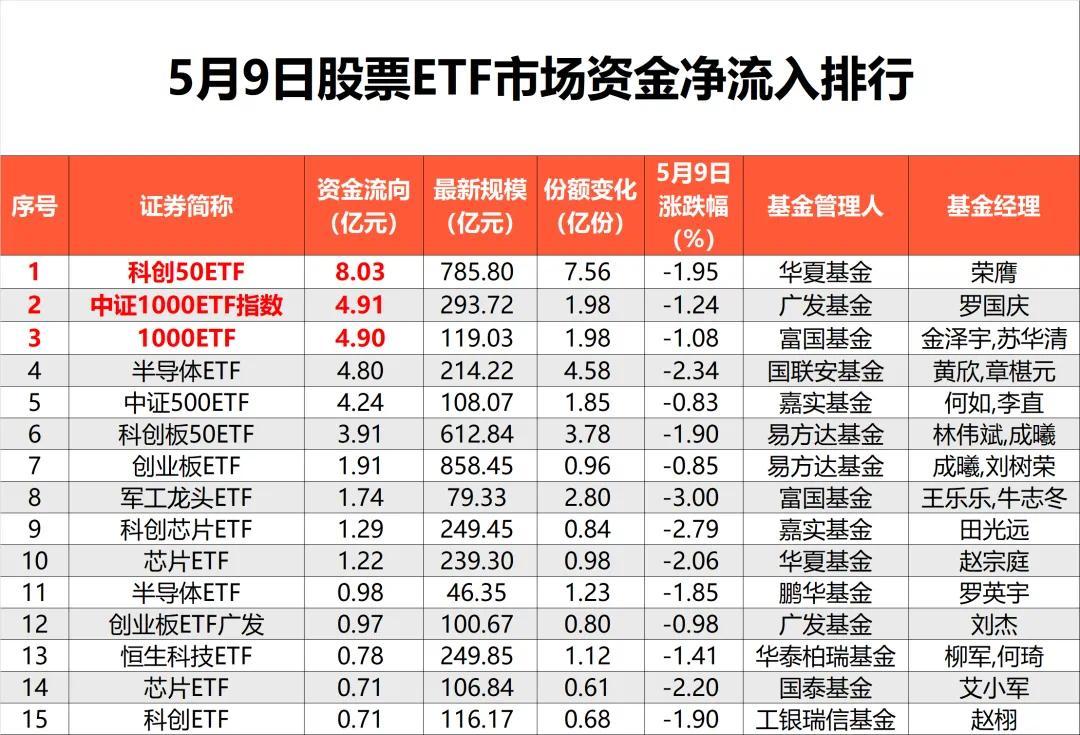
Market Overview - On May 9, the A-share market experienced fluctuations with bank stocks performing well against the trend, while retail stocks declined and military concept stocks adjusted after previous gains [1] - The stock ETF market saw a net outflow of 3.7 billion yuan, with the CSI 300 index and military sector ETFs leading in outflows [1][2] ETF Fund Flows - As of May 9, the total scale of 1,082 stock ETFs reached 3.53 trillion yuan, with a net outflow of 3.744 billion yuan during the market's downturn [2] - The top inflow was seen in the STAR 50 index ETF, which had a net inflow of 1.357 billion yuan, while the flagship STAR 50 ETF from Huaxia Fund saw over 800 million yuan in inflows [2][4] Specific ETF Performance - The STAR 50 ETF led the inflows with 803 million yuan, followed by the CSI 1000 ETF and semiconductor ETF with inflows of 491 million yuan and 480 million yuan respectively [3][4] - Conversely, the CSI 300 ETF experienced the largest outflow, with a net outflow of 1.253 billion yuan, contributing to a total outflow of 2.303 billion yuan from broad-based ETFs [5][6] Sector Insights - The semiconductor ETF showed strong inflow capabilities, leading the sector with a net inflow of 480 million yuan, while military and liquor ETFs also faced outflows as short-term funds opted to secure profits [4][7] - Despite short-term outflows, institutional funds remain optimistic about domestic demand and dividend sectors, indicating a preference for stability amid external uncertainties [7]