
注册制深化

Search documents
百亿金融科技ETF(159851)盘中跌破半年线,“抄底”资金火速进场,什么信号?
Xin Lang Ji Jin· 2025-11-11 02:45
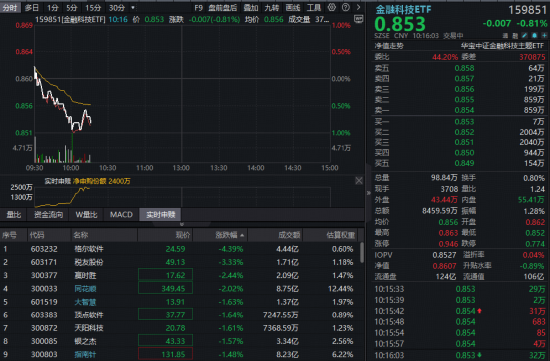
Core Viewpoint - The A-share market is experiencing a general decline, particularly in the fintech sector, which has seen significant drops in stock prices, prompting a surge in "bottom-fishing" investments in related ETFs [1][3]. Group 1: Market Performance - On the morning of the 11th, the A-share market broadly declined, with the fintech sector dropping over 1% [1]. - Key stocks such as Tax Friend Co., Ltd. and Geer Software led the decline, each falling over 4% [1]. - The popular fintech ETF (159851) also saw a decline, dropping over 1% and falling below its six-month moving average, despite a rapid influx of "bottom-fishing" capital, with real-time net subscriptions reaching 24 million units [1]. Group 2: ETF Insights - The fintech ETF (159851) has surpassed 10 billion yuan in size, with an average daily trading volume of 500 million yuan over the past month, indicating strong liquidity and market interest [3]. - The ETF's index covers a wide range of themes, including internet brokerages, financial IT, cross-border payments, AI applications, and Huawei's HarmonyOS, making it a diversified investment option [3]. Group 3: Industry Outlook - According to CITIC Securities, the current configuration value of internet brokerages is highlighted by three main supports: policy support, improved funding environment, and the industry's own transformation dynamics [3]. - The profitability outlook for internet brokerages is enhanced by market recovery and successful transformations, providing a unique growth potential [3].

荀玉根出任国信证券研究所所长,明星分析师能否重振这家“老牌研究所”?
Xin Lang Cai Jing· 2025-09-05 02:20
Core Viewpoint - The recruitment of prominent analyst Xun Yugen by Guosen Securities is aimed at enhancing research capabilities and diversifying income sources for the firm, which has seen a recovery in its operating performance over the past two years [1][3]. Company Overview - Guosen Securities has appointed Xun Yugen as Chief Economist, Director of the Economic Research Institute, and Head of the Postdoctoral Office, marking a significant career move for the well-regarded analyst [2]. - Xun Yugen has a long history in securities research, having previously held key positions at various firms, including being named the best analyst in strategy research multiple times [2]. Performance Metrics - Guosen Securities has experienced a decline in its research revenue, with total commission income of 253 million yuan in 2024, down 16.82% year-on-year, placing it 19th in industry rankings [7][8]. - In the first half of the year, the firm ranked 15th in the industry with total commissions of 124 million yuan, reflecting a 16.68% year-on-year decline [8]. Historical Context - The research division of Guosen Securities has seen a significant decline from its peak performance between 2004 and 2016, when it was consistently ranked among the top firms in the industry [7][10]. - The firm’s research revenue and industry ranking have deteriorated over the years, with a notable drop in commissions starting in 2017 due to the loss of key analysts and a decline in overall platform competitiveness [12][13]. Strategic Initiatives - Guosen Securities is actively working to strengthen its research capabilities by attracting top talent, with a focus on enhancing its influence in the market and improving collaboration across various business lines [6][14]. - The company aims to explore specialized, high-quality, and international research paths, particularly in strategic emerging industries such as new energy and high-end manufacturing [14].


“旗手”盘中加油,顶流券商ETF(512000)V型向上,逾50亿资金博弈券商“错杀”机会
Xin Lang Ji Jin· 2025-09-04 03:24
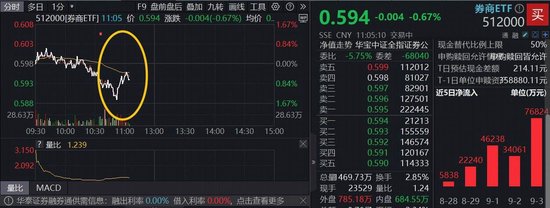
Market Overview - As of September 4, the A-share market continued to decline, with the Shanghai Composite Index and Shenzhen Component Index both dropping over 1%, and the ChiNext Index falling nearly 3% [1] - The top-performing broker ETF (512000) initially fell about 1.5% but later rebounded, currently down 0.67%, indicating better performance compared to the broader market [1] Broker Sector Performance - Broker stocks showed mixed results, with Huayin Securities and Pacific Securities rising over 3%, while Haitong Securities and CITIC Securities fell over 1% [2] - The broker ETF (512000) has seen significant net inflows, with 7.68 billion yuan on a single day and over 5 billion yuan accumulated in the last 20 days [5] Market Conditions and Future Outlook - The current financing balance accounts for 2.32% of the A-share market's circulating market value, with financing purchases below the historical peak of 2015 [3] - Central China Securities suggests that the A-share market is in a favorable environment with supportive policies and ample liquidity, expecting a steady upward trend in the short term [3] - The broker sector is benefiting from policies aimed at activating the capital market, with measures like the deepening of the registration system and the introduction of long-term funds expanding business opportunities [3] ETF Characteristics - The broker ETF (512000) has surpassed 30 billion yuan in scale, with an average daily trading volume of 9.48 billion yuan, making it one of the most liquid ETFs in the A-share market [7] - The ETF tracks the CSI All Share Securities Companies Index, encompassing 49 listed broker stocks, with nearly 60% of its holdings concentrated in the top ten leading brokers [7]
关键一跌!“旗手”护盘未果,三大支撑,顶流券商ETF(512000)近20日大举吸金41亿!
Sou Hu Cai Jing· 2025-09-02 10:19
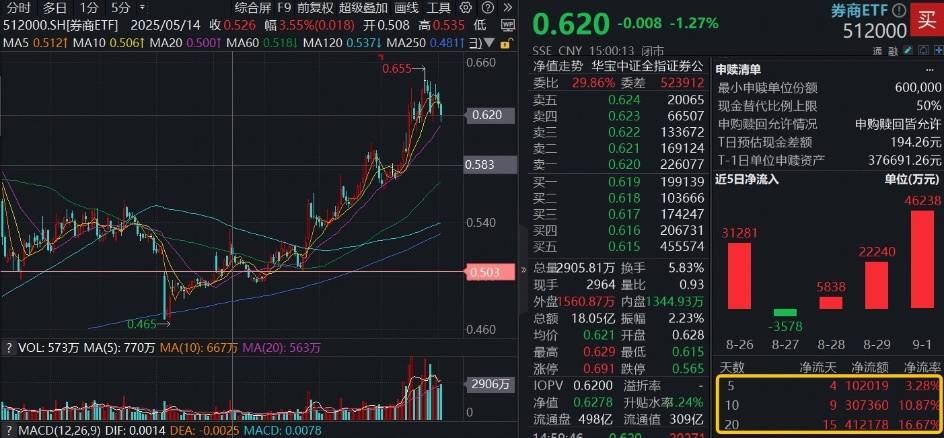
Market Overview - A-shares experienced a sudden adjustment with all three major indices closing in the red, despite brokerages attempting to support the market [1] - The Pacific Securities surged over 6% during the day, with a net inflow of 2.686 billion yuan from main funds [1] - The broker ETF (512000) saw a decline of 1.27%, marking three consecutive days of losses, with a total trading volume exceeding 1.8 billion yuan [1][3] ETF Performance - The broker ETF (512000) has seen a net inflow of 4.62 billion yuan in a single day, accumulating over 4.1 billion yuan in net inflows over the past 20 days [3] - The latest fund size of the broker ETF (512000) has surpassed 31.2 billion yuan, reaching a historical high, with an average daily trading volume of over 900 million yuan [3][5] Industry Outlook - Morgan Stanley does not believe the market has entered a fully overheated state, indicating that current trading volumes and margin financing balances are manageable compared to historical records [4] - Zhongyuan Securities suggests that the A-share market is in a favorable environment with supportive policies and ample liquidity, expecting a steady upward trend in the short term [4] Broker Performance - All 49 broker stocks in A-shares reported positive growth in net profit for the first half of the year, with 13 companies seeing growth exceeding 100% [5] - The core businesses of brokerage firms, particularly brokerage and proprietary trading, are expected to drive further performance recovery [5][8] Valuation and Investment Potential - The price-to-book ratio (PB) of the index tracked by the broker ETF (512000) is currently at 1.65 times, which is within the median range of the past decade [5] - The broker sector is positioned for potential upward movement, as it remains undervalued compared to historical highs [7] Policy and Funding Support - The active capital market policy is expected to enhance the business scope for brokerages, including investment banking, brokerage, and asset management [7][8] - The recovery of market confidence is anticipated to boost trading activity and margin financing, with the influx of pension and insurance funds expected to support brokerage performance [8][9]
中小券商业绩爆发!华西证券净利猛增11倍
21世纪经济报道· 2025-08-29 03:47
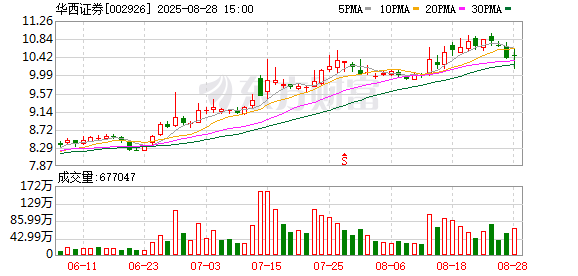
Core Viewpoint - The securities industry in China has shown significant recovery in the first half of 2025, with many brokerages reporting strong earnings growth driven by active trading in the A-share market [1][2]. Group 1: Earnings Performance - As of August 28, 2025, 14 listed brokerages have reported their mid-year earnings, with 10 of them achieving revenue exceeding 2 billion yuan and net profits over 1 billion yuan [1][2]. - Six brokerages, including Dongwu Securities and Guoyuan Securities, reported net profits exceeding 1 billion yuan, with Dongwu Securities achieving a revenue of 4.43 billion yuan and a net profit of 1.93 billion yuan [2][4]. - Notably, Huaxi Securities experienced a net profit surge of 11 times, while Northeast Securities and Hualin Securities saw net profit growth of 2 times and over 1 time, respectively [1][5]. Group 2: Revenue and Profit Growth - In the first half of 2025, all 14 listed brokerages reported a year-on-year increase in net profit, with Huaxi Securities, Northeast Securities, and Hualin Securities showing remarkable growth rates of 1195.02%, 225.90%, and 172.72% respectively [5][6]. - Two brokerages reported a decline in revenue but an increase in net profit, specifically Zheshang Securities and Xibu Securities, with revenue decreases of 23.66% and 16.23% respectively [6][8]. Group 3: Business Drivers - The main drivers of growth in the securities industry were brokerage and proprietary trading businesses, with all 14 brokerages reporting an increase in net income from brokerage fees [8][10]. - Nine brokerages, including Huaxi Securities and Guoyuan Securities, saw their brokerage fee income increase by over 40% year-on-year [8][10]. - Investment income also generally increased, with several brokerages reporting a doubling of investment net income compared to the previous year [8][11]. Group 4: Investment Banking and Asset Management - The investment banking sector showed signs of recovery, with 11 out of 14 brokerages reporting an increase in investment banking fee income [12][13]. - However, asset management businesses posed a drag on overall performance, with only Dongwu Securities and Changcheng Securities reporting growth in asset management fee income [12][13]. Group 5: Market Outlook - The securities sector's investment value is gaining attention due to significant earnings recovery, supported by favorable policies and capital influx [14]. - The industry is focusing on developing high-value-added services, particularly wealth management and institutional business, to enhance income stability and profitability [14].



中小券商业绩爆发!华西证券净利猛增11倍 经纪、自营成引擎
2 1 Shi Ji Jing Ji Bao Dao· 2025-08-28 13:33
Core Viewpoint - The A-share market's active trading has led to a collective positive performance among brokerage firms in their 2025 mid-year reports, with many reporting significant revenue and profit growth [2][3][12]. Group 1: Financial Performance - As of August 28, 2025, 14 listed brokerages have released their mid-year reports, primarily small and medium-sized firms [2]. - Among these, 10 brokerages, including Zheshang Securities, Dongwu Securities, and Guoyuan Securities, reported revenues exceeding 2 billion yuan, with net profits surpassing 1 billion yuan for six of them [2][4]. - Notably, Huaxi Securities experienced a net profit surge of 11 times, while Northeast Securities and Hualin Securities saw net profit growth of 2 times and over 1 time, respectively [2][7]. - In terms of revenue, Zheshang Securities, Dongwu Securities, and Guoyuan Securities achieved revenues of 6.107 billion yuan, 4.428 billion yuan, and 3.397 billion yuan, respectively, with net profits of 1.149 billion yuan, 1.932 billion yuan, and 1.405 billion yuan [5][6]. Group 2: Revenue and Profit Growth - All 14 listed brokerages reported a year-on-year increase in net profit for the first half of 2025, with Huaxi Securities, Northeast Securities, and Hualin Securities showing exceptional growth rates of 1195.02%, 225.90%, and 172.72%, respectively [7][8]. - Two brokerages reported a decline in revenue but an increase in net profit, while 12 brokerages achieved simultaneous growth in both metrics [9][10]. - The overall brokerage industry saw a significant increase in trading volume, with a 60.9% year-on-year rise, contributing to the revenue growth [12][14]. Group 3: Business Drivers - Brokerage and proprietary trading businesses emerged as the main drivers of revenue growth in the securities industry [13][14]. - Nine brokerages, including Huaxi Securities and Guoyuan Securities, reported a year-on-year increase in brokerage fee income exceeding 40% [14]. - Investment income also showed a positive trend, with several brokerages, including Dongwu Securities and Zheshang Securities, reporting over 100% growth in investment net income [16][19]. Group 4: Investment Banking and Asset Management - The investment banking sector showed signs of recovery, with 11 out of 14 brokerages reporting a year-on-year increase in investment banking fee income [20][21]. - However, asset management business has been a drag on performance, with only Dongwu Securities and Changcheng Securities reporting growth in asset management fee income [23][24]. Group 5: Market Outlook - The brokerage sector's investment value is gaining attention due to significant performance recovery, supported by favorable policies and capital influx [25]. - The industry is focusing on developing high-value-added businesses, particularly wealth management and institutional services, to enhance revenue stability and profitability [25].


中原证券:A股市场中期慢涨格局有望延续
天天基金网· 2025-08-22 11:17
Group 1 - The core viewpoint is that the A-share market is expected to continue a slow upward trend in the medium term, supported by multiple favorable factors [2][3]. - There is a significant shift of household savings towards the capital market, providing a continuous source of incremental funds [3]. - The overall profit growth expectation for A-share listed companies has turned positive, ending a four-year decline, with notable profit elasticity in the technology innovation sector [3]. Group 2 - Western Securities is optimistic about the upward trend of the capital market and the opportunities for brokerage stocks under improved risk appetite and continuous inflow of incremental funds [4]. - The core logic for the increased allocation value of the brokerage sector is supported by three aspects: policy, funding, and self-transformation [4]. - The policy environment is favorable, with clear directives to "activate the capital market," including the deepening of the registration system and the optimization of trading mechanisms, which expand the business space for brokerages [4]. - The funding aspect shows that market confidence recovery is driving transaction volume and margin trading, with expectations of pension and insurance funds entering the market, providing a solid foundation for brokerage performance [4]. - The brokerage industry is focusing on developing high-value-added businesses, particularly wealth management and institutional business, optimizing revenue structure and enhancing profit stability [4][5].

券商板块强势上扬,光大证券、信达证券涨停,广发证券等走高
Zheng Quan Shi Bao Wang· 2025-08-22 06:37
Group 1 - The brokerage sector has shown strong performance recently, with stocks like Everbright Securities and Xinda Securities hitting the daily limit, and Guangfa Securities rising over 7% [1] - The market's active trading reflects the effects of new public fund assessment regulations, capacity reduction, economic policy direction from high-level meetings, and U.S. tariff policies, leading to increased market volume and volatility [1] - Historically, the strength of the brokerage sector has been driven by domestic macro policy easing, stock market stimulation, overseas liquidity expansion, and the alleviation of risk events [1] Group 2 - CITIC Securities believes that the current value of the brokerage sector is supported by three core factors: policy, funding, and self-transformation [2] - The policy environment is focused on "activating capital markets," with measures such as deepening the registration system, optimizing trading mechanisms, and introducing long-term funds, which expand the business scope for brokerages [2] - The recovery of market confidence has led to increased trading activity and margin financing, along with the expected influx of pension and insurance funds, providing a flexible foundation for brokerage performance [2] - The industry is focusing on developing high-value-added businesses, particularly wealth management and institutional services, to optimize revenue structure and enhance profitability stability [2] - The combination of policy expectations, improved funding, and internal dynamics enhances the profitability outlook for the brokerage sector, making it an attractive investment option [2]
中小银行IPO辅导报告密集披露,汉口银行“长跑”15年仍在等
Bei Jing Shang Bao· 2025-07-23 14:16
Core Viewpoint - The A-share IPO market for banks has been stagnant for three and a half years, with 15 banks currently in the listing guidance phase, facing various challenges in their path to IPO [1][3][10]. Group 1: Current Status of Banks in IPO Guidance - There are 15 banks in the IPO guidance phase, with guidance durations ranging from over 2 years to 15 years, highlighting the prolonged nature of the process [1][3]. - HanKou Bank has been in the guidance phase since December 2010, focusing on capital supplementation to alleviate capital adequacy pressure [3][4]. - New entrants like Guilin Bank began their guidance process in August 2023, indicating a mix of experienced and new players in the IPO preparation [3][4]. Group 2: Challenges Faced by Banks - Many banks are struggling with issues related to equity management, asset ownership, and corporate governance, which hinder their IPO progress [6][9]. - Specific challenges include unresolved equity disputes, excessive shareholding by employees, and incomplete asset rights documentation [7][8]. - Capital pressure remains a significant constraint, with banks like HanKou Bank needing to explore multiple channels for capital supplementation to meet IPO requirements [9]. Group 3: Market Environment and Regulatory Landscape - The IPO market has become increasingly cautious, with no new bank listings since January 2022, reflecting a tightening regulatory environment [10]. - The shift to a registration-based system has led to stricter scrutiny of corporate governance and a focus on regional banks' roles in local economies [10][11]. - Banks are advised to assess their readiness and market conditions carefully before submitting IPO applications, considering factors like risk management and economic recovery [11]. Group 4: Recommendations for Banks - Analysts suggest that banks in the guidance phase should adopt a dual approach: continue rectifying issues for IPO readiness while exploring alternative capital-raising methods [11]. - Engaging strategic investors and optimizing equity structures through mergers and acquisitions are recommended strategies for banks facing prolonged guidance periods [11].

侃股:10%,沪深主板“ST”股更加理性
Bei Jing Shang Bao· 2025-06-29 12:43
Core Viewpoint - The adjustment of the price fluctuation limit for ST and *ST stocks from 5% to 10% aims to align them with regular stocks, thereby reducing the number of consecutive price limits and enhancing investor protection [1][2]. Group 1: Market Impact - The new regulation is expected to decrease the occurrence of consecutive price limits for problem stocks, which will help in reducing capital accumulation and lowering investment risks [1]. - The current 5% limit has led to market inefficiencies, as seen in the example of *ST Yushun and *ST Yazhen, where stock prices surged over 300% without fundamental improvements [1][2]. - The adjustment is anticipated to improve pricing efficiency and resource allocation in the market, marking a significant step in the deepening of the registration system [1][2]. Group 2: Comparison with Other Markets - The fluctuation limit for regular stocks is 10%, while the previous 5% limit for ST stocks created an arbitrage opportunity, leading to increased market volatility [2]. - In comparison, the Sci-Tech Innovation Board and the Growth Enterprise Market have a 20% fluctuation limit for risk warning stocks, which has resulted in more rational price movements and fewer consecutive price limits [2]. Group 3: Long-term Outlook - In the long run, the adjustment is expected to lead to a more rational market value for ST stocks and higher pricing efficiency [2][3]. - The new limit may accelerate the exit of poorly performing stocks from the market, as significant negative news could lead to quicker price declines and trigger delisting mechanisms [2]. Group 4: Potential Risks - For small-cap and illiquid ST stocks, the 10% fluctuation limit may exacerbate liquidity risks, leading to larger price swings during significant buy or sell orders [3].