
港股投资价值

Search documents
李蓓力挺A股港股:全球高性价比资产凸显,龙头ROE筑底支撑力强劲
Xin Lang Zheng Quan· 2025-11-30 02:01
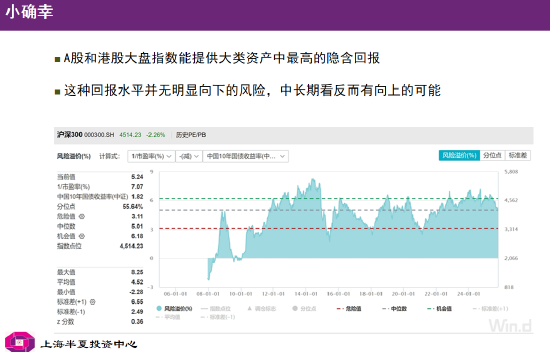
Group 1 - The current A-share and Hong Kong stock indices are highlighted as high-return assets with significant cost-effectiveness, even amid economic pressure and ongoing deflation [1][4] - The core index's ROE (Return on Equity) has stabilized and will not decline further, providing crucial support for the market [1][4] - A-shares and Hong Kong stocks exhibit a notable return advantage compared to global assets, with the CSI 300 index's PE (Price-to-Earnings ratio) at approximately 13 times, implying a return of 7% [1][4] Group 2 - Despite concerns about economic downturns and deflation impacting profits, the core index's ROE has remained flat over the past two years, not following the economic decline [4] - Historical data shows that during significant economic downturns, the core index's ROE tends to find strong support at current levels, preventing further declines [4] - The profitability of leading companies remains robust during economic lows, as they outperform smaller firms, leading to a natural industry clearing process [4] Group 3 - The construction materials industry is cited as an example where leading companies are showing signs of profit improvement despite overall industry challenges [4] - The profitability of leading firms has started to recover from around 6%, while the second-tier companies are struggling with only 1% net profit [4] - This resilience in leading companies' profits is a key reason for the core index's ability to stabilize its ROE without significant downward risk [4][5]

港股,重大调整!即将实施!
券商中国· 2025-05-16 15:34
Core Viewpoint - The Hong Kong stock market is undergoing significant adjustments with the inclusion of new stocks in various indices, which may enhance investment opportunities and market performance in the near future [1][2][3]. Index Adjustments - The Hang Seng Index will add Midea Group (0300.HK) and ZTO Express (02057.HK), increasing its constituent stocks from 83 to 85 [3]. - The Hang Seng Technology Index will include BYD Company (01211.HK) while removing Tencent Literature (00772.HK), maintaining a total of 30 constituent stocks [5]. - The Hang Seng China Enterprises Index remains unchanged with 50 constituent stocks [4]. - The Hang Seng Composite Index will increase from 502 to 505 stocks, adding companies like Bruker (00325.HK), Gu Ming (01364.HK), and Mixue Group (02097.HK) [5]. Market Performance - The Hong Kong stock market experienced a weak fluctuation today, with the Hang Seng Index down by 0.46%, the China Enterprises Index down by 0.49%, and the Technology Index down by 0.31% [8]. - Despite the daily decline, the weekly performance shows strength, with the Hang Seng Index up 2.09% for the week, achieving six consecutive weekly gains [8]. Future Outlook - Analysts believe that recent monetary policy adjustments, including interest rate cuts, will positively impact Hong Kong stock earnings, with continued inflows of southbound capital expected [9]. - Current valuations of Hong Kong stocks are at historically low to mid-levels, suggesting strong long-term investment potential [9]. - The market is anticipated to benefit from improved economic conditions, liquidity, and technological advancements, which could lead to a resurgence of the Hong Kong stock market [9].

港股窄幅震荡 南向资金青睐消费股
Zhong Guo Zheng Quan Bao· 2025-04-29 21:43
Group 1 - The core viewpoint of the articles indicates that there is a projected net inflow of southbound funds into the Hong Kong stock market, estimated to be between 800 billion HKD to 1 trillion HKD for the year, with a more certain incremental inflow of 200 billion HKD to 300 billion HKD in the latter part of the year [1][2] - Recent trends show that southbound funds have favored non-essential consumer stocks, with a net buying amount exceeding 600 billion HKD in the past month, while sectors like telecommunications have seen significant net selling [2] - Analysts suggest that the Hong Kong stock market is expected to see stable earnings growth, supported by a reduction in the impact of US tariff policies and proactive macroeconomic policies from China [3] Group 2 - The Hang Seng Index has shown slight fluctuations, with a recent closing at 22,008.11 points, reflecting a mixed performance over the past trading days [1] - Southbound funds recorded a net outflow of 43.94 billion HKD this week, with notable outflows on specific days, indicating a temporary shift in investor sentiment [1][2] - Analysts recommend focusing on sectors that benefit from domestic demand policies, such as consumer and technology sectors, as well as industries with lower trade dependency and higher dividend yields, including finance, energy, telecommunications, public utilities, essential consumption, and real estate [3]
