资管行业

Search documents
“居民财富何处流”研究二:中国居民财富:第三次历史“大迁徙”
GUOTAI HAITONG SECURITIES· 2026-02-24 12:56
Group 1: Historical Wealth Migrations - The first historical migration occurred from 1998 to 2018, where deposits moved to real estate due to housing market reforms and rising property prices[3][14]. - The second migration from 2018 to 2023 saw wealth returning to deposits as the real estate market declined, with average annual new deposits reaching approximately 12 trillion yuan, significantly higher than the previous 4-5 trillion yuan[4][21]. - The third migration, starting in 2023, is characterized by a shift towards "deposits+" as low interest rates and inflation expectations reshape asset allocation strategies[5][28]. Group 2: Current Trends and Influencing Factors - Since 2023, new deposits have decreased to 16.7 trillion yuan, indicating a loosening of concentrated deposit allocations[28]. - The relative attractiveness of deposit yields has declined due to multiple rounds of interest rate cuts, prompting a shift towards "deposit-like" financial products[28][29]. - The recovery in bond and equity markets since 2024 has improved the relative returns of risk assets, making them more appealing compared to deposits[29][32]. Group 3: Implications of Inflation Expectations - Inflation expectations are a key variable influencing the direction and intensity of the current wealth migration, with low inflation leading to a preference for capital preservation products[11][32]. - The concept of "deposits+" emphasizes a wealth allocation philosophy that prioritizes stable returns while controlling for capital drawdown risks[33]. - If inflation expectations rise significantly, the flow of resident wealth may shift again, necessitating close monitoring of economic indicators[33].
活力与韧性、拓新与赋能,回答时代命题——第十九届华夏机构投资者年会暨华夏金融(保险)科技论坛召开
Hua Xia Shi Bao· 2025-12-13 06:17
Group 1 - The forum held in Beijing focused on the theme of "Vitality and Resilience, Innovation and Empowerment," aiming to address contemporary challenges and explore future pathways for development [2][5] - The Chinese economy demonstrated resilience with a GDP growth of 5.2% year-on-year in the first three quarters, amounting to an economic increment of 39,679 billion [3][5] - The asset management industry in China is entering a golden development period, with a combined entrusted management scale of approximately 70 trillion, serving as a stabilizing force for the capital market [8][29] Group 2 - The banking sector is urged to balance development and safety, enhancing risk prevention capabilities while integrating deeply into the high-quality economic development framework [7][29] - The financial industry is increasingly focusing on technology to support innovation and the development of technology enterprises, marking a significant leap in financial technology [29][32] - The insurance industry is facing challenges due to outdated operational models, yet it remains a sunrise industry with significant potential for growth, particularly in serving low-income households [24][29] Group 3 - The transition of China's economy from high-speed to medium-speed growth necessitates a shift in growth drivers from investment and exports to innovation and consumption [10][12] - The capital market is encouraged to support new productive forces through a more inclusive venture capital market and a well-established legal environment [14][29] - The importance of long-term value creation in the face of uncertainty is emphasized, with a focus on managing market volatility and balancing returns [34][37]


李蓓力挺A股港股:全球高性价比资产凸显,龙头ROE筑底支撑力强劲
Xin Lang Zheng Quan· 2025-11-30 02:01
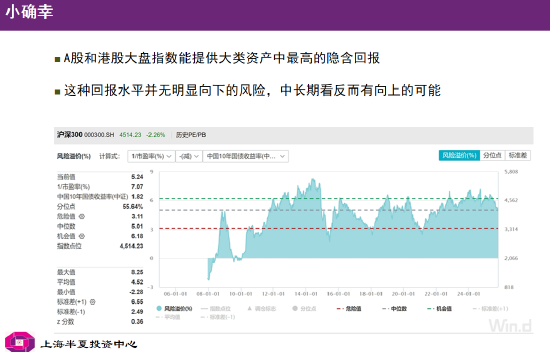
Group 1 - The current A-share and Hong Kong stock indices are highlighted as high-return assets with significant cost-effectiveness, even amid economic pressure and ongoing deflation [1][4] - The core index's ROE (Return on Equity) has stabilized and will not decline further, providing crucial support for the market [1][4] - A-shares and Hong Kong stocks exhibit a notable return advantage compared to global assets, with the CSI 300 index's PE (Price-to-Earnings ratio) at approximately 13 times, implying a return of 7% [1][4] Group 2 - Despite concerns about economic downturns and deflation impacting profits, the core index's ROE has remained flat over the past two years, not following the economic decline [4] - Historical data shows that during significant economic downturns, the core index's ROE tends to find strong support at current levels, preventing further declines [4] - The profitability of leading companies remains robust during economic lows, as they outperform smaller firms, leading to a natural industry clearing process [4] Group 3 - The construction materials industry is cited as an example where leading companies are showing signs of profit improvement despite overall industry challenges [4] - The profitability of leading firms has started to recover from around 6%, while the second-tier companies are struggling with only 1% net profit [4] - This resilience in leading companies' profits is a key reason for the core index's ability to stabilize its ROE without significant downward risk [4][5]